River2Sea D Walker: the paddle-tail that rigs on anything
This lure shines under specific conditions. CarnaFish tells you in 10 seconds if today is one of them.
A name can mislead you. River2Sea's D Walker is not a topwater and it doesn't zigzag: it's a soft paddle-tail swimbait, a mid-water or deep lure depending on what you put in front of it. The word walker belongs to the model name, not to a lure family — a classic trap on American catalogues, where a topwater also sells under the heading walking bait.
A body built to take anything
What sets the D Walker apart is less its action than its rigging range. River2Sea states it can be fished on a jighead, a screwlock hook, a swim jig, a spinnerbait or a vibrating jig, and that as far as the brand is concerned there is no wrong way to rig it. For a soft plastic, that's a deliberate position: it isn't trying to be the best answer for one rig, it's trying never to be a bad answer for any of them.
Against a strongly characterised paddle like the Keitech Fat Swing Impact 4.8, whose action and stocky profile are a signature in themselves, the D Walker plays it neutral: a conventional baitfish profile, a wide tail, and nothing that forces one particular rig.
The plastic is described as super durable, with the usual argument that goes with it: more fish per bait, less time spent re-rigging. Worth checking on the water, because a soft plastic's lifespan depends as much on the rig as on the formula.
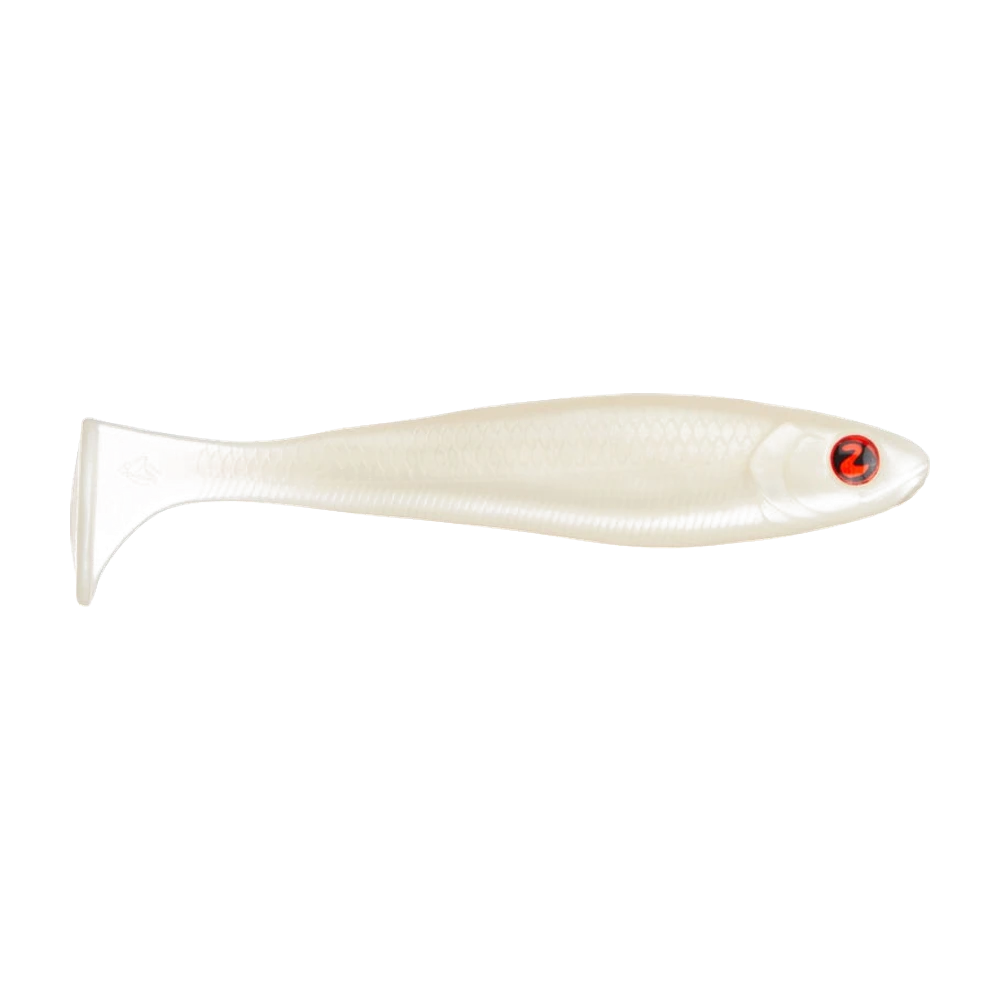
The detail that makes the versatility credible is the hook slots, one on the belly and one on the back, which the manufacturer describes as there to increase hook penetration. The idea is simple: the hook point sits in a groove rather than buried in a mass of plastic, so it drives through less material on the set. That matters on a Texas-rigged weedless setup, where a third of the misses come down to a hook point still trapped in the body. On the product photo, shot in profile, those slots aren't readable — the bait is pictured from the side, and the grooves are on the back and belly.
Two sizes, and no weight
The manufacturer's chart has only three columns — size, length, quantity — and it's worth reading all the way across:
- Size 100: 4 in, or 10.2 cm, sold in packs of 4.
- Size 120: 4-3/4 in, or 12.1 cm, sold in packs of 3.
There is no weight column at all. The last figure on each line is a pack count, not a mass. If you need the bare bait's weight to size a jighead precisely or to respect a casting limit, weigh it yourself: the manufacturer doesn't publish it.
The size names, 100 and 120, point to the order of magnitude in millimetres. The length column is what counts though: 10.2 and 12.1 cm.
Which size for which rig
The 100 is the all-round trailer size: behind a spinnerbait or a vibrating jig it adds bulk and a swimming action without drowning the host's vibration. The 120 earns its place on a bare jighead when you want profile, or in summer over fish feeding on larger fry. Beyond that, a pre-rigged bait like the Megabass Magdraft changes the logic entirely: that's a swimbait armed from the factory, not a soft plastic to combine.
The action comes from the host rig, not the bait
That's the point that changes how you fish this swimbait. Bare on a jighead, it's a slow straight retrieve with pauses, like any paddle. But behind a vibrating jig you're no longer working the bait: you set a speed at which the blade thumps hard without blowing out, and the D Walker comes along supplying the profile and a wide swimming action. Behind a spinnerbait it's the same logic, with a running depth you control only through rod angle and speed.
On a screwlock hook, finally, the D Walker becomes a cover bait: weighted or not, rigged weedless, you pitch it into sunken branches and swim it tight to the wood. It's the slowest of the five rigs and the one that asks for the most patience, because the action depends entirely on your reel speed. Three slow turns, a two-second pause during which the bait glides and tips over, then pick up again: that tipping moment is where the bite usually comes, exactly as it does with a finesse shad on the fall.
When you rig a paddle behind a vibrating jig, check that it sits perfectly in line with the blade, and trim the head of the soft plastic with a knife if you need to so it seats against the jig collar. A trailer rigged crooked makes the blade thump irregularly, and the bait stops swimming altogether: you feel it in the rod as a dull knocking instead of a steady buzz.
The classic trailer mistake
Picking a trailer too big for the blade. A 10 g vibrating jig with a 12 cm swimbait behind it loses most of its vibration: the mass of the soft plastic damps the oscillation. Stay on the 100 behind light blades, and keep the 120 for heavy rigs or for a plain jighead.

Not sure what to tie on?
Photograph your spot: CarnaFish reads the scene, cross-checks the conditions and gives you the zone, the lure and the retrieve. Free on iOS and Android.
Colors by water and forage
- Silver baitfish: pearl white, the color of the photographed sample, which throws light with no contrast at all and works as well in open water as behind a blade.
- Clear water over rock: green pumpkin, a neutral tone that doesn't raise an alarm with wary fish, especially bass in a clear pond.
- Stained water, high water, low light: chartreuse with a black back, so the bait still exists at a metre of visibility. It's also the pick that most often produces on pike in Europe in late autumn.
A versatile swimbait doesn't replace reading the spot properly, and that's exactly what CarnaFish does: photograph the water and the AI gives you the zone, the depth and the presentation that fit today's conditions. To choose between pike lure families before you even open the box, our guide to picking a pike lure covers the ground.
The short version
- Walker belongs to the model name: this is a soft paddle-tail swimbait, not a topwater.
- Two sizes, 10.2 cm in packs of 4 and 12.1 cm in packs of 3. The manufacturer's chart gives no weight at all.
- Belly and dorsal hook slots are claimed to improve hook penetration on the set.
- The maker claims every rig: jighead, screwlock hook, swim jig, spinnerbait, vibrating jig.
FAQ
Is the D Walker a topwater lure?
No. The word walker is part of the model's trade name. It's a soft paddle-tail swimbait fished in mid-water or near the bottom depending on the jighead or host rig you choose.
How much does a D Walker weigh?
The manufacturer doesn't publish it. Their chart has only three columns: size, length and pack count. If the bare bait's weight matters for your rig, weigh it yourself rather than trusting a figure found elsewhere.
What size should I use as a vibrating jig trailer?
Size 100, at 10.2 cm, in the vast majority of cases. An over-bulky trailer damps the blade's oscillation and costs the vibrating jig the one thing that makes it worth throwing, its steady thump.
What are the hook slots for?
River2Sea presents them as a way to increase hook penetration. The point sits in a groove on the back or belly rather than in the thickness of the plastic, which cuts the amount of material it has to drive through on the set.
Does the D Walker suit pike and zander?
Yes, both sizes match the formats most used on those species in Europe. Rig it on a jighead suited to the depth, and add a steel or titanium leader if pike are present on the spot.
Do I need a special hook for this swimbait?
Not necessarily, but a screwlock hook makes centring far easier and stops the bait sliding down the shank on every cast. Otherwise the dorsal and belly slots let you work with a conventional wide-gap Texas hook.
The full bass lure guideSeason-by-season strategy: which family of lure, when, and why.Go from theory to fish
CarnaFish reads your spot from a photo and gives you the game plan: zone, lure, retrieve. Free on iOS and Android.