Berkley Powerbait Nessie: the soft glide bait that skips under docks
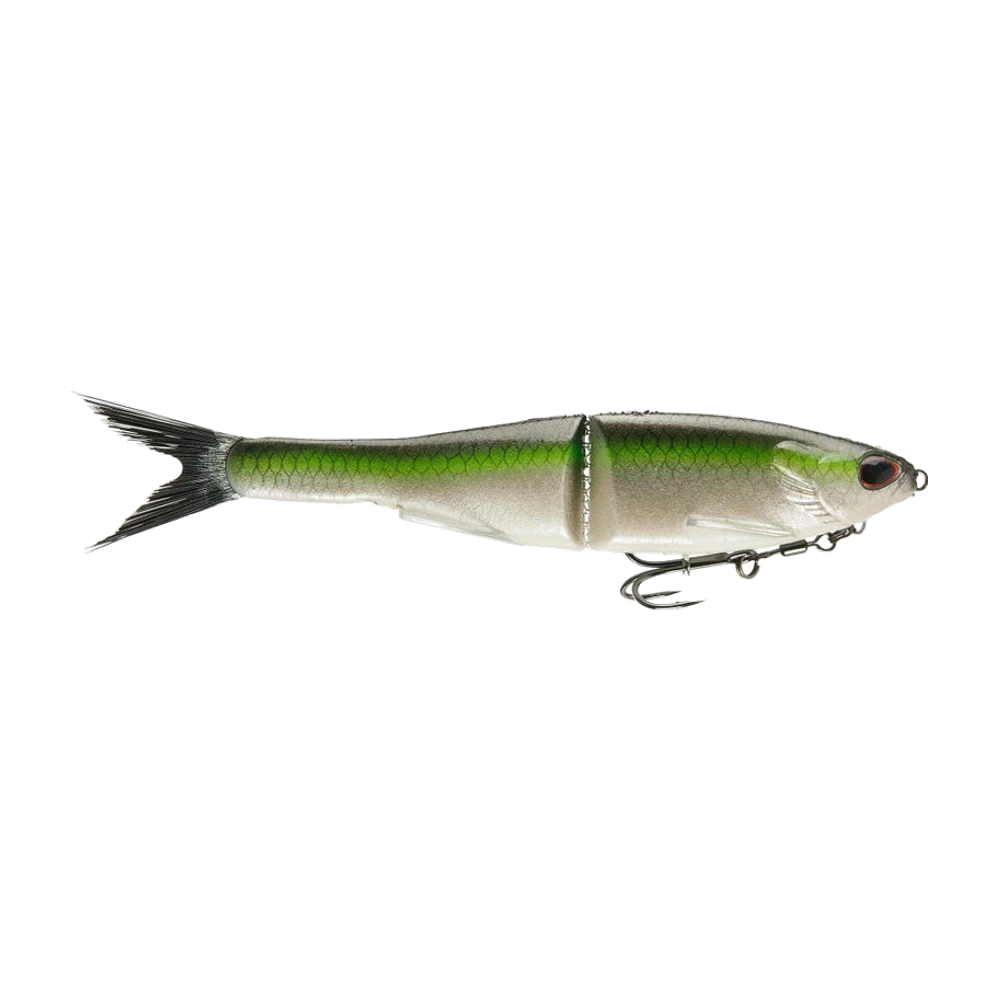
The right lure in the wrong spot still catches nothing. CarnaFish spots the zone that works, from a single photo.
Hard glide baits have a flaw nobody mentions in the videos: they don't get anywhere. The moment you need to slide one under a dock, under a low branch or along a boathouse, the hard body skips crooked, kicks sideways and ends up hung. The Nessie answers exactly that limit, keeping a glide bait's S-swim in a soft body that absorbs impact and will actually skip.
A soft body on a reinforced joint
Everything rests on a central joint reinforced with an internal mesh. That's the point that normally kills soft jointed baits: the hinge takes the most work and is the first thing to tear after a few dozen fish. Berkley built a mesh into it that holds the plastic without restricting travel, so both halves of the body keep their swing.
Two other details make the swim. The bait holds an upright horizontal posture, back up, instead of rolling onto its side at rest, thanks to stabilising belly fins moulded underneath. And the tail isn't a paddle: it's a brush-style tail of soft fibres that puts a slight drag on the rear end, so every turn finishes with a trailing follow-through rather than a hard stop.
Berkley rates all four sizes as slow-sinking. That's not a footnote: a floating glide bait rises the second you stop, which makes it impossible to work a specific layer. With the Nessie, every pause buys you depth, and the rate of fall becomes a genuine fishing variable.
Four sizes, with a big step between them
Berkley's published numbers are clear: 5 in at 12.7 cm and 0.4 oz / 11.3 g, 7 in at 17.8 cm and 1 oz / 28.3 g, 9 in at 22.9 cm and 2 oz / 56.7 g, and 11 in at 27.9 cm and 4.25 oz / 120.5 g. All four are slow-sinking.
The 12.7 cm casts on an ordinary medium-heavy rod and targets bass year round. The 17.8 cm is the hinge size: still castable on a standard baitcaster, already bulky enough to interest a passing pike. Above that you're in another world. At 56.7 g you need a dedicated swimbait rod, and at 120.5 g you're into big-bait tackle, with an XH-power rod and a high-capacity reel. Don't be tempted by the 11 in if you don't already own the outfit to match: you'll break the rod before you touch a fish.
Before every cast, check that the retention clip is still holding the treble against the belly. A treble hanging crooked pinches the soft body during the glide and kills half the S-motion, and you'll spend the day wondering why the bait is swimming badly.
Glide it, don't pull it
The S-swim isn't a reel action. You build it with the rod, tip low and pointed at the water, using small soft wrist pulls — one pull, the bait goes one way; a second, it comes back the other. Between them you only reel up slack. If you feel hard resistance in the pull, you're pulling too hard or too fast: the bait then turns on the spot instead of gliding sideways.
Rhythm changes everything. Tight-spaced pulls give tight turns and a compressed zigzag track, useful for keeping the bait in front of a precise piece of cover. Pulls two or three seconds apart give long glides either side of the axis, covering far more width and drawing the most committed follows.
Skipping is the headline
This is where the soft body pays for itself. A low, flat cast parallel to the surface, and the Nessie skips under a dock, under a moored boat, under branches that dip into the water. A hard glide bait skips badly and ends up clattering into the pilings — which is exactly why most anglers don't even try. Aim at the waterline under the obstacle, cast low, and let the bait sink two or three seconds on arrival before the first pull. Plenty of bites come on that drop, before you've worked it at all.
Where to use it, and on what
For bass, the Nessie works structure: docks, pilings, drowned trees, lily edges, and big shallow flats where a large profile acts as a trigger. For pike, the 17.8 and 22.9 cm sizes cover weed edges in autumn and grass-bed exits when fish are hunting in open water.
One point not to gloss over: with a single treble under the belly, a pike that swipes sideways sometimes misses the hook entirely. If you're specifically targeting pike, a steel or titanium leader is mandatory, and you have to accept a higher drop-off rate than with a two-treble swimbait such as a Megabass I-Slide. In exchange, the soft body cushions the strike and fish hold the bait far longer than they would a hard lure — something the Powerbait formula moulded into the plastic reinforces further.
If you want the same family in an easier package, a Megabass Magdraft or a Berkley Powerbait Jointed Minnow ask less of your rod hand for a decent result. The Nessie rewards precision, and that's also what makes it demanding.
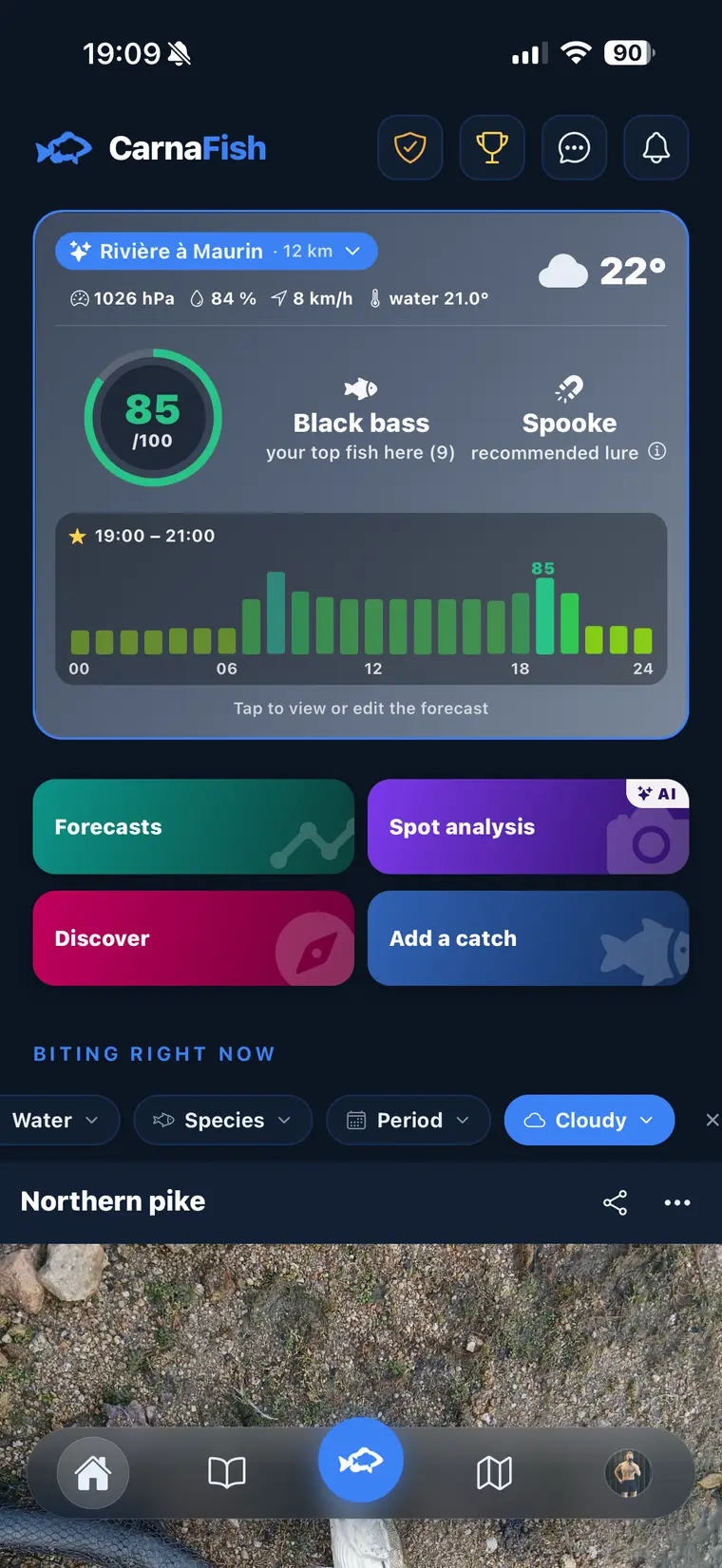
Not sure what to tie on?
Photograph your spot: CarnaFish reads the scene, cross-checks the conditions and gives you the zone, the lure and the retrieve. Free on iOS and Android.
Colours by water
- Clear water: a chartreuse-green back over a pearl-white belly, exactly the finish in the photo. The back-to-belly contrast stays readable at distance while still reading as a baitfish.
- Stained water: a neutral silver, which throws side light back without turning into a dark mass.
- Overcast or dark water: a definitely dark back. A glide bait is mostly read from below, and a clean silhouette matters more than any pattern detail.
The right spot before the right bait
A glide bait this size doesn't forgive a bad spot: you'll spend ten minutes per zone, and an empty zone is expensive. That's exactly what CarnaFish saves you: a photo of the water, and the AI suggests the zone, the depth and the type of presentation that fit the day. To frame big-bait choice for pike, our guide to choosing a pike lure walks through the families and sizes worth owning.
What to remember
- Soft body on a reinforced joint: a glide bait's S-swim in a lure you can actually skip under docks.
- Four slow-sinking sizes: 12.7 cm / 11.3 g, 17.8 cm / 28.3 g, 22.9 cm / 56.7 g and 27.9 cm / 120.5 g.
- The swim is built with the rod in soft pulls, not with the reel; pulling hard kills the lateral glide.
- One treble under the belly: check the retention clip every cast, and accept a few more drop-offs on pike.
FAQ
Does the Nessie float or sink?
It sinks, slowly, in all four sizes. That's what Berkley's spec sheet states, and it's what lets you pick your running depth by varying how long you pause.
Which size should a beginner start with?
The 12.7 cm at 11.3 g casts on an ordinary medium-heavy rod and is plenty for bass. The 17.8 cm at 28.3 g is the right compromise if pike are also on the menu.
Do the bigger sizes need a special rod?
Yes. At 56.7 g and especially at 120.5 g you need a dedicated swimbait outfit. Throwing a 120 g lure on a standard baitcaster is a short road to a broken rod.
How do I get the S-swim?
Rod tip low and pointed at the water, small soft wrist pulls, reeling up slack between them. Pull hard and the bait spins on the spot instead of gliding sideways.
Can you really skip it under a dock?
That's the whole point of the soft body. A low cast parallel to the surface and the bait goes where a hard glide bait kicks sideways. Let it drop two or three seconds on arrival before you work it.
Do I need a wire leader with the Nessie?
Wherever pike are present, yes — steel or titanium, no argument. On a pure bass spot, a heavy fluorocarbon leader is enough and stays more discreet.
The full bass lure guideSeason-by-season strategy: which family of lure, when, and why.Go from theory to fish
CarnaFish reads your spot from a photo and gives you the game plan: zone, lure, retrieve. Free on iOS and Android.