Roboworm Sculpins: the bottom-fish profile that works on the rocks
This lure shines under specific conditions. CarnaFish tells you in 10 seconds if today is one of them.
Some days the fish simply will not leave the bottom. You swim a swimbait through the middle of the column and nothing happens; you run a crankbait, it ticks the rocks and comes back empty. The forage that day is not out in open water: it is a small big-headed fish lying between the stones, one that almost never swims and moves in eight-inch bursts. The Roboworm Sculpins is cut to imitate exactly that prey, and it asks for a way of fishing that has nothing in common with a standard shad.
A profile most soft plastics ignore
Sculpins, gobies and every other small bottom fish share the same anatomy: a wide head, a body that narrows sharply toward the rear, no swim bladder and therefore no ability to hold mid-water. They settle, they wait, they dart a foot or so when disturbed, then they settle again. That silhouette is missing from most soft-plastic boxes, because the standard catalogue is built out of shads, straight worms and creature baits.
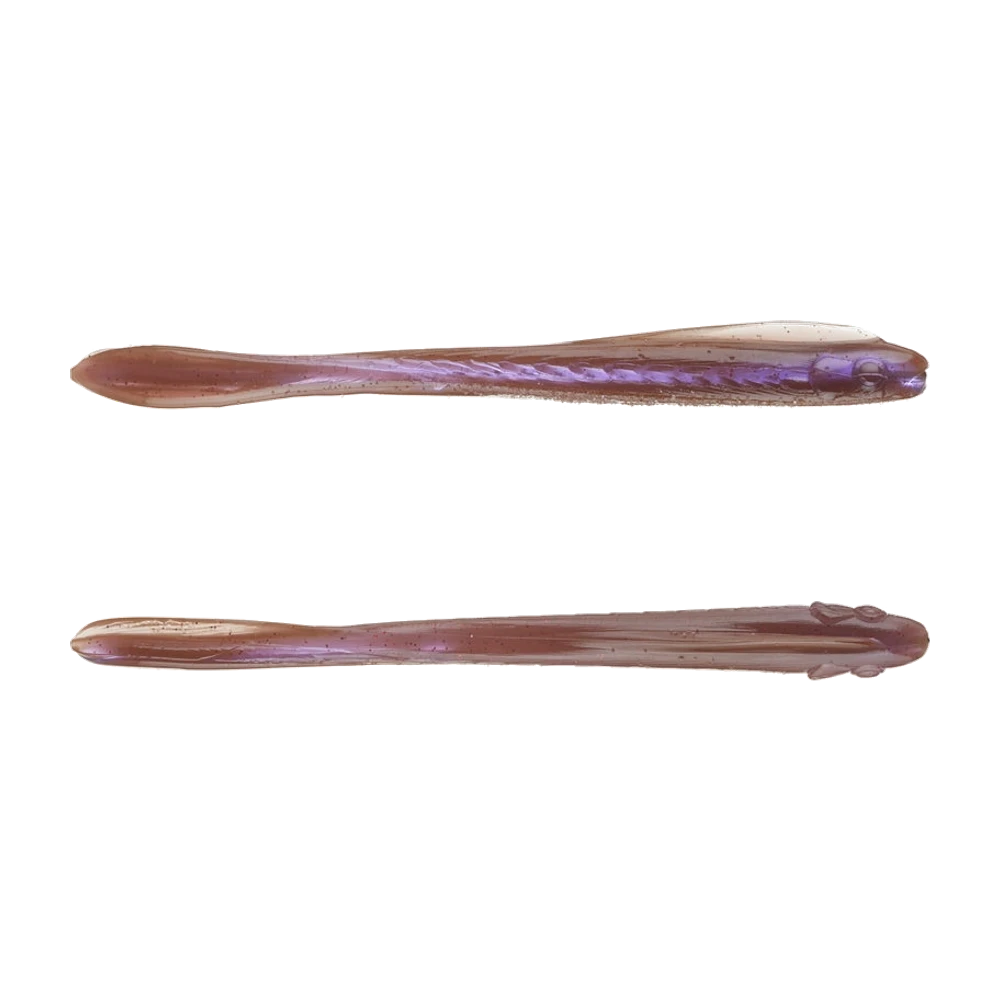
Roboworm builds the Sculpins around exactly that shape. The mould carries a detailed head with eyes and gills, a lateral line reproduced along the flank, and a tail that tapers to a thin blade able to quiver on the smallest input. In the product photo the moulded eye and the gill plate stand out clearly on the head, and the lateral-line engraving runs the full length of the flank — observations from a product photo rather than a specification, but they line up with what the maker describes.
Roboworm pairs that body with its Salt Release System, salt loaded into the plastic that leaches out gradually in the water. The company expects it to widen the strike zone and make fish hold the bait longer; that is the manufacturer's claim, not a measurement. What you can verify yourself is that salted plastic feels and holds differently from unsalted plastic, and that it tears faster after a few fish.
What the spec sheet gives, and what it does not
Roboworm's table runs to two columns: length and quantity. One size, four inches, which is 10.2 cm, sold eight to a pack. That is all of it. There is no published weight and no density class.
That gap is worth stating out loud, because it changes how you approach the bait. Salted plastic usually sinks, but Roboworm never writes it for the Sculpins, and plastisol density varies enough between formulations that guessing is pointless. The useful habit: drop one in a bucket of water before your first session. Ten seconds tells you whether it goes down on its own, hangs in suspension or holds the surface, and you pick your weight from that instead of correcting blind on the water. Two minutes that save a morning spent fishing too high.
With a soft bait whose density is not published, never start with the heaviest rig in the box to get down fast. Start instead with the lightest head that still finds bottom in the day's conditions: the Sculpins is only worth anything if it keeps the freedom to move in small hops, and lead is what takes that away.
Three rigs that genuinely use it
Light ned or shaky head
This is the reference rig. A round or pointed head of 2 to 5 g, the hook driven into the back over the first third, and at rest the bait sits nose down with the tail slightly raised, exactly like a bottom fish rooting around. Drag it four to eight inches, stop for three seconds, repeat. The bite almost always comes during the stop, usually as nothing more than weight settling onto a slack line.
Drop shot
Nose-hooked eight to twelve inches above the sinker, the Sculpins holds its height while you shake the line. The thin blade tail is what makes this rig interesting: vibrate the tip without moving the sinker and the tail works while the body stays almost still. It is the slowest presentation this bait allows, the one to reach for when fish are visible on sonar and refuse anything that moves too much.
Weightless Texas over clean bottom
On gravel or sand with nothing to snag, a plain 2/0 Texas hook with no weight at all lets the bait sink slowly and glide between hops. It is the most natural version of the rig, but it cannot hold depth as soon as wind or current shows up: keep it for margins and shallow flats on calm days.
Where and when to pull it out
The natural ground for the Sculpins is hard bottom: gravel, cobble, rock slabs, riprap banks. That is where the prey it imitates actually lives, and that is where bass come looking for them, typically after the spawn and again in autumn as the water cools.
In Europe this profile has taken on an importance nobody planned for, with gobies spreading through the big rivers and canals. A small big-headed fish sitting on the stones that moves in short darts has become a major part of the menu for perch and zander on a great many waters. A four-inch bottom-fish shape is anything but exotic there, even though it was drawn for American bass lakes.
The mistake that makes it ordinary
Fishing it like a shad. A Sculpins retrieved steadily, or lifted a yard on every pull, loses everything that sets it apart: mid-water it is just another worm, and a Roboworm Straight Tail does that job as well for less money. Its value rests entirely on bottom contact. If you cannot feel the stones through the rod between pauses, you are fishing too high or too fast.
The other classic fault is oversized weight. A 10 g head pins the bait down and turns every pull into a jump, and a bottom fish does not jump. Drop a size whenever you hesitate.
Not sure what to tie on?
Photograph your spot: CarnaFish reads the scene, cross-checks the conditions and gives you the zone, the lure and the retrieve. Free on iOS and Android.
Colors by water condition
- Clear water: the translucent flaked purple-brown from the photo, discreet, letting light through the way the skin of a small bottom fish does.
- Stained water: a green pumpkin brown-green tone, the hard-bottom color by definition, readable without ever clashing against gravel.
- Dark water or low light: a solid dark tone that reads as a silhouette instead of chasing a color the fish will never see.
Roboworm offers the Sculpins in a selection of its house patterns, but does not publish the detailed list for this reference: order by tone rather than by name.
A niche bait, not a Swiss army knife
The Sculpins does not replace a versatile shad and does not try to. It answers one precise situation — fish glued to hard bottom, benthic forage — where a Z-Man TRD Ned Rig plays the small neutral-volume card and a Savage Gear Ned Craw offers the other bottom silhouette, the crawfish. Carrying all three means changing prey without changing rigs.
Which still assumes you know whether the spot's bottom is hard or silted before you cast. That is exactly what CarnaFish does: one photo of the spot and the AI suggests the zone, the depth and the presentation that suit the day's conditions. To go back over spots and tackle from the ground up, our guide to getting started in bass fishing covers the rest.
Key takeaways
- One size in the catalogue, four inches or 10.2 cm, eight to a pack: Roboworm publishes neither a weight nor a density class.
- The profile imitates a bottom fish, not an open-water baitfish: everything the lure does depends on contact with the substrate.
- Light ned head to drag it, drop shot to hold height, weightless Texas over clean bottom on calm days.
- Too much weight is mistake number one: it kills the small hops that make the bait believable.
FAQ
What sizes does the Roboworm Sculpins come in?
One only: four inches, or 10.2 cm, eight to a pack. The maker's table carries nothing but length and quantity, with no weight and no density class.
Does the Sculpins sink or float?
Roboworm does not say for this reference. The plastic is salt-loaded, which points toward a dense bait, but until the maker writes it down the safe move is to test one in a bucket before choosing your head weight.
What jig head weight should I use?
Between 2 and 5 g in most situations. Take the lightest weight that still lets you feel the bottom: a heavy head pins the bait and kills the short moves that give it its whole appeal.
Does it work on anything other than bass?
Yes, particularly on perch in Europe, where gobies occupy the hard bottoms of rivers and canals. Roboworm claims a bait that will catch just about any predator: that is a marketing statement, and in practice the silhouette stays that of a small bottom fish, so a modest meal.
Can you fish it on a steady retrieve?
Technically yes, but it wastes the bait. Wound in continuously through mid-water the Sculpins loses its identity and becomes an ordinary worm. It is built to be dragged and stopped on the bottom.
Does the salt affect durability?
Yes, both ways. Salt adds density and a texture many anglers find more convincing in a fish's mouth, but it weakens the plastic: expect to change baits more often than with an unsalted soft plastic, especially after several fish on the same one.
The full bass lure guideSeason-by-season strategy: which family of lure, when, and why.Go from theory to fish
CarnaFish reads your spot from a photo and gives you the game plan: zone, lure, retrieve. Free on iOS and Android.