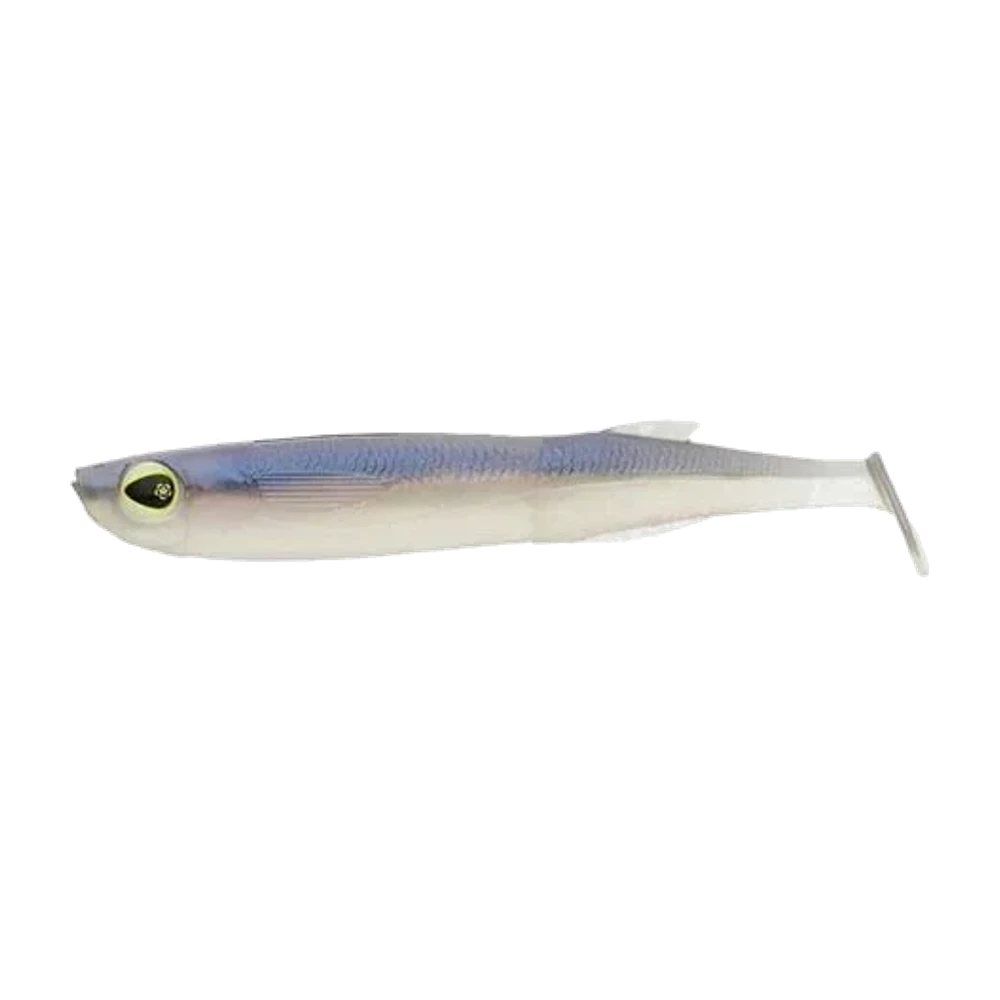
Sakura Flat Shad: the flat side that makes the lure glide on the drop
The right lure in the wrong spot still catches nothing. CarnaFish spots the zone that works, from a single photo.
Watch a standard soft shad on a jig head fall. It goes down in a near-straight line, nose first, quickly, and it reaches the bottom more or less directly below the point where you stopped your lift. The tail beats a little, and that is all. That drop lasts two seconds and gives you almost nothing.
Yet it is the phase that decides the day. Zander hit on the drop, so does a holding pike, so does perch. If your fall lasts two seconds over a metre of travel, you offer a two-second window. If it lasts four seconds over two metres of travel, you offer four — and you cover twice the volume of water.
A flat body exists for exactly that. The Flat Shad does not fall, it planes sideways, and that difference in trajectory is the whole point of the lure.
What a flat flank does during the fall
A round or oval-bodied shad presents the same surface in every direction: it has no reason to deviate, so it drops straight. A laterally flattened body presents a large surface on the side and very little on the edge. As a result, the moment it tilts even slightly, that surface bears on the water like a wing.
Three effects stack up on the way down:
- A sideways glide. The lure sets off to one side, sometimes thirty to sixty centimetres, before flattening out and heading back the other way. It does not descend above the point where you released it.
- Pronounced roll. On every tilt, the whole flank turns up and then down. On a reflective flank that produces a broad, brief flash, very different from the fast flicker of a paddle tail.
- A reduced rate of fall for the same head weight. The lift generated by the flank slows the descent, which mechanically stretches the window for a bite.
On a straight retrieve, that same flat flank produces a marked roll of the whole body rather than a simple appendage beat. This is a lure that sends out flash, not vibration.
The retrieve: stretching the glide instead of putting up with it
The classic mistake is to fish this lure like an ordinary shad, following the drop with the rod tip down. You keep contact, but you keep the line tight, and a tight line cancels the glide: the lure pendulums back towards you instead of planing.
- Cast and let it sink on a free line to the bottom, counting as it goes.
- One wide, slow lift, a metre or more, rod tip rising from nine to twelve o'clock. The lure lifts off cleanly and rolls.
- Drop the rod tip in one movement, faster than the lure falls, to create slack. That slack is what allows the sideways glide.
- Touch nothing during the descent. Watch the line. It should sink steadily; if it stops or moves sideways, you have a bite.
- Take up the slack on the reel, find the bottom again, and start over.
The difference with the controlled retrieve of a standard shad is real: here you trade a little sensitivity for a much more interesting falling trajectory. It is up to you to compensate by watching the line.
On the water: on a vertical spot — a bridge pillar, the edge of a channel, the drop-off of a gravel pit — take a step along between casts, and deliberately alternate a short lift and a wide one. The glide goes one way then the other, and by alternating amplitudes you sweep a whole band of bottom in zigzags instead of covering the same lane again. That is the only way to make the deviation work for you instead of against you.
The head weight decides the length of the glide
This is the main adjustment, more important than size or colour.
| Head weight | Effect on the fall | Situation |
|---|---|---|
| 7 to 10 g | Long glide, very slow descent | 2 to 4 m, calm water, apathetic fish |
| 10 to 14 g | Compromise, clear glide with contact retained | 4 to 7 m, general use |
| 14 to 18 g | Reduced glide, clean descent | 7 to 10 m, or light current |
| Above 20 g | Glide almost eliminated | Avoid, pick another lure |
The principle is the reverse of a classic shad: here, you are not looking for the head weight that keeps you in contact, you are looking for the lightest one the depth allows. An overweighted Flat Shad loses all its point and becomes an ordinary shad, only less lively.
For line, thin 0.12 mm braid with a 0.28 to 0.32 mm fluorocarbon leader. Line that is too thick slows the descent unevenly and blurs the trajectory.
Not sure what to tie on?
Photograph your spot: CarnaFish reads the scene, cross-checks the conditions and gives you the zone, the lure and the retrieve. Free on iOS and Android.
When the flat flank becomes a handicap
You have to be honest about the limits, and they are clear-cut.
In current, the flat flank catches the flow and the lure drifts uncontrollably. In a river with any real push, a round body holds its position better.
In heavily stained water, this lure relies a great deal on flash: if visibility drops below fifty centimetres, that signal no longer carries and a ribbed or strongly vibrating shad takes over.
When fishing vertically from a boat, the glide becomes a fault: the lure drifts under the hull or out of the target zone, and you lose the verticality that makes the technique worth using.
For fast searching, finally, the retrieve demands long cycles, so you cover little ground per hour.
Its home ground, conversely: hard, readable bottoms between three and eight metres, clear to lightly stained water, inactive fish holding on a drop-off, and every situation where you have already located the fish and now have to make it commit.
Flat Shad or round-bodied shad
The distinction is simple. A round-bodied shad works during the retrieve: the tail does the job, and the drop is just dead time you try to make useful. A flat-bodied shad works during the descent: the fall does the job, and the retrieve is only a way of putting the lure back in position.
That changes how you organise a spot. With a round shad, you reel in and cover water. With a Flat Shad, you make ten lifts over five metres of bottom.
If your problem is converting bites rather than presentation, look instead at the Gunki Stinger Shad, whose whole logic revolves around hook placement and the hookset. If your problem is silhouette on fish that have already seen three lures go past, the Westin ShadTeez Slim is the right tool for a second pass.
Our beginner's guide to lure fishing for zander covers reading drop-offs and hard bottoms. And if you are unsure which head weight to fit when you reach the bank, CarnaFish analyses a photo of the spot and answers.
Key takeaways
- The flat flank makes the lure plane sideways instead of letting it drop straight.
- The descent is the retrieve: create slack, do not follow it down with the rod tip.
- Use the lightest head the depth allows, 7 to 18 g in the vast majority of cases.
- The roll produces a broad flank flash, not vibration: a lure for clear to lightly stained water.
- Unsuited to current, to vertical fishing from a boat and to very murky water.
FAQ
Why does a flat-bodied shad glide on the drop?
Because its large lateral surface bears on the water as soon as it tilts, like a wing. Instead of falling vertically, it sets off sideways for thirty to sixty centimetres, flattens out, then goes back the other way.
Should I follow the drop with the rod tip down?
No, and that is the main mistake with this type of lure. A tight line cancels the glide and swings the lure back towards you. Drop the rod tip faster than the lure falls to create slack, and watch the line to spot the bite.
What jig head weight should I choose?
7 to 10 g down to four metres, 10 to 14 g between four and seven metres, 14 to 18 g beyond that. Unlike a classic shad, look for the lightest head possible: too heavy and the glide disappears, and the lure loses its point.
Does it work in rivers?
Poorly, as soon as there is any flow. The flat flank grips the current and the drift becomes uncontrollable. In flowing rivers, a round-bodied shad holds its position and its axis better.
Is it suitable for vertical fishing?
No. The sideways glide sends the lure out of the target zone, sometimes under the boat, and removes the verticality that makes the technique worthwhile. For vertical work, use a round-bodied shad or a dedicated lure.
What is the difference with a classic shad?
A classic shad works on the retrieve thanks to its tail, the drop being nothing but dead time. The Flat Shad works on the drop thanks to its flank, the retrieve serving only to reposition it. They are two opposite ways of organising a spot.
The full zander lure guideSeason-by-season strategy: which family of lure, when, and why.Go from theory to fish
CarnaFish reads your spot from a photo and gives you the game plan: zone, lure, retrieve. Free on iOS and Android.