Savage Gear Ned Minnow: the little soft baitfish built for the ned rig
Not sure this lure fits YOUR spot today? CarnaFish tells you in 10 seconds, from a photo.
There comes a point on pressured water where every standard lure stops producing. The fish are there, you can see them on sonar or you have had three follows, but they refuse the shad, refuse the crank and refuse the spinnerbait. That is where the ned rig earns its place: small volume, a light head, and a presentation so slow that it no longer looks like an attack. The Savage Gear Ned Minnow is one of the few baits in that family shaped like an actual small fish rather than a cut-off piece of worm.
Three inches, and not one measurement more
Let us be clear from the start about what the maker publishes and what it leaves out. Savage Gear states a three-inch minnow profile, which is 7.6 cm. That is all. There is no spec table for this reference: no per-bait weight, no density class, no size range. The retailer lists it five to a pack.
That gap matters for a ned rig plastic, because the weight of the bare bait feeds directly into the balance of the presentation. If you want to work precisely, put one on a kitchen scale before choosing your head — two minutes, and it stops you fitting 7 g to a bait that only ever needed 3.
The T-tail, and what it changes
The Ned Minnow has no paddle. Its tail is a small vertical blade set perpendicular at the end of a slim wrist — what Savage Gear calls a T-Tail. The difference from a standard paddle is obvious in the water: a wide paddle catches the flow, rolls the body and demands a minimum speed before it starts working. A T blade starts vibrating within the first few centimetres of travel, without dragging the body into a roll.
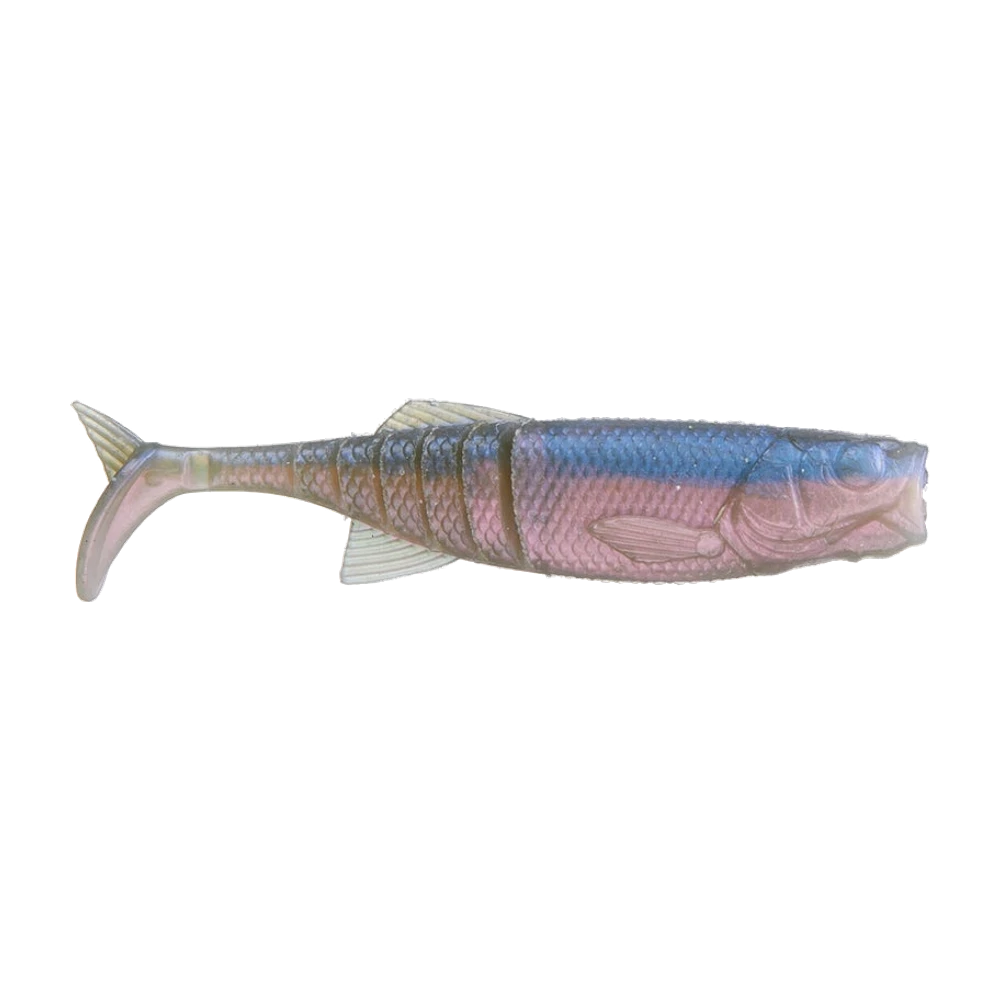
For slow fishing that is exactly what you want. You can drag the bait four inches and the tail has already worked, where a big-paddle shad would still be inert. The body meanwhile keeps a deep profile, fully scaled, with moulded dorsal, anal and pectoral fins and a flat-cut nose — an observation from the product photo rather than a specification, but that flat nose is precisely what seats cleanly against the collar of a ned head.
The ned rig, and the variations that work
On a ned head
This is the rig the bait is designed for, and Savage Gear says so explicitly by pointing to its own ned heads. The principle: a flat-faced head that keeps the bait nose down and tail up on the bottom. Two to four grams is enough on most spots. Drag it eight inches, stop for three to five seconds, repeat — and it is during the stop that the tail keeps quivering at the slightest movement of the line.
On a round head
Savage Gear also mentions pairing it with a plain ball head, and that is no second-best. On active fish you have located feeding, a round head of 3 to 5 g allows a crawling steady retrieve a foot or so off the bottom that turns the Ned Minnow into a micro swimbait. It is the search version of the same lure.
Straight dragging
The maker explicitly cites dragging the bait methodically across the bottom to imitate an unsuspecting baitfish. It is the slowest presentation of all, and the most rewarding in cold water or on fish that have already refused everything else. Keep permanent contact with the bottom and never lift off.
On a ned rig the real adjustment is not the head weight but how much slack you leave during the pause. A tight line holds the bait in line with the rod and stops it standing up. Give it four to six inches after each drag: the bait then tips into a vertical posture, tail in the air, and that silhouette is what the fish comes for.
Buoyancy: what Savage Gear says, and what it does not
Watch out for a point too many write-ups skip over. Savage Gear states that the Duratech plastic carries a precise amount of salt to elicit the desired buoyancy and action. That is a sentence about a setting, not a result: nowhere does the maker write that this bait floats, or that it sinks.
In other words, if you are counting on a buoyant body to stand the tail vertical at rest — the characteristic behaviour of certain ned-rig plastics — verify it yourself in a bucket before building a whole strategy on it. Ten seconds of testing beats a claim copied from elsewhere. The bait is also scent-infused, which the maker credits with triggering feeding and aggression: their argument, not a measurement.
The classic mistake
Working it with the rod. The soft-plastic angler's reflex is the sweeping pull. On a Ned Minnow it lifts the bait a yard, cancels the nose-down posture and turns a finesse presentation into a twitched micro swimbait, which was never the point. Drag with the reel, a quarter turn of the handle at a time, and leave the rod still. If you feel the urge to work it, change baits: it means the fish are active and a Savage Gear Ned Craw or a standard shad will get there faster.
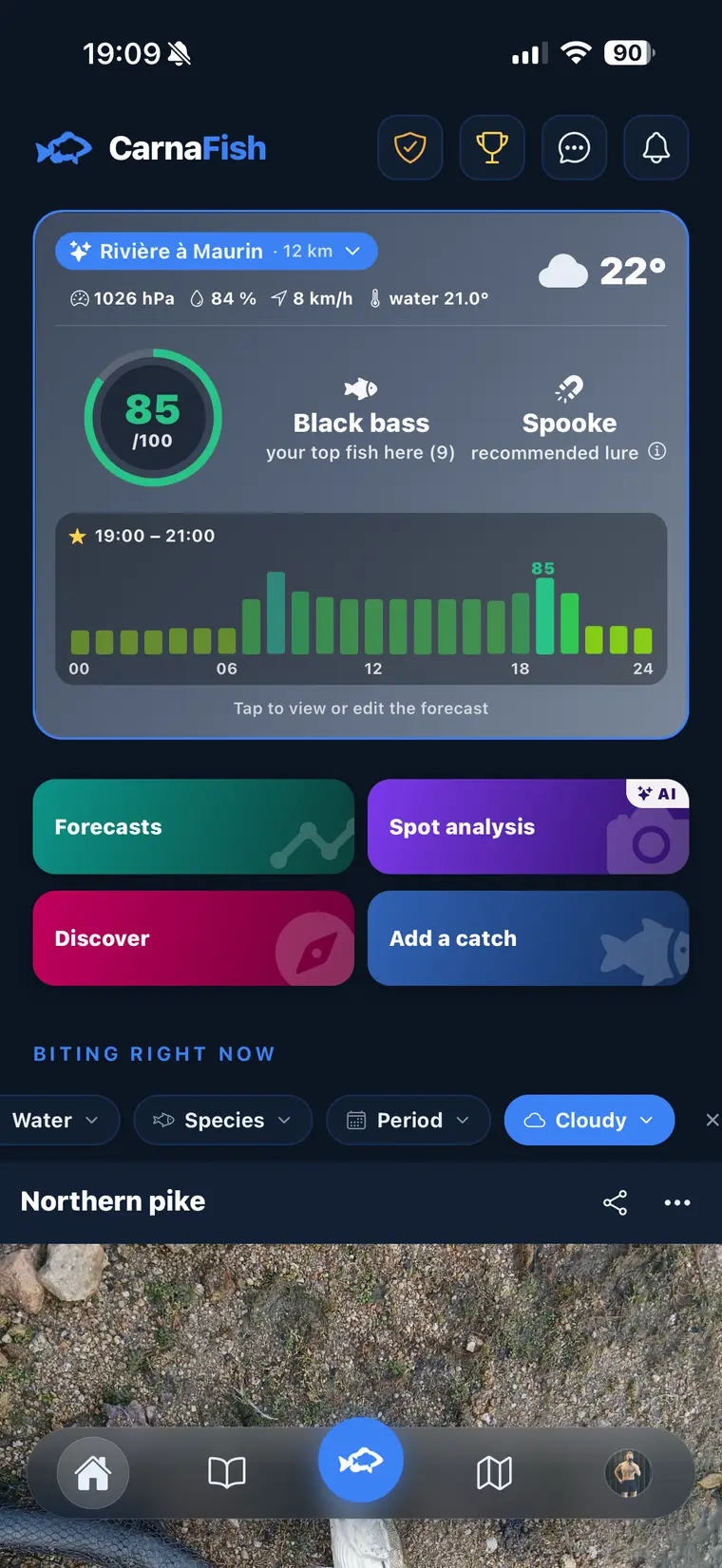
Not sure what to tie on?
Photograph your spot: CarnaFish reads the scene, cross-checks the conditions and gives you the zone, the lure and the retrieve. Free on iOS and Android.
Colors by water condition
- Clear water: the translucent blue back over a pink flank from the photo, with its full scaling, imitating a small baitfish without excess flash.
- Stained water: a clean pearl white, more readable in poor visibility while staying in the baitfish register.
- Hard bottom and low water: green pumpkin or brown, blending into the gravel and avoiding alerting an already wary fish.
On a seven-centimetre bait fished at a crawl, color matters less than silhouette and speed. Change your cadence before you change your color.
Where it sits
The Ned Minnow fills one precise slot: the baitfish silhouette in a family that historically offers mostly worm and creature shapes. Against a Z-Man TRD Ned Rig, which plays the compact neutral-volume card, it brings a recognisable imitation, which can count in clear water where fish see what they are attacking. If the technique is new to you, our ned rig page covers the rig itself before you pick a plastic.
Whether the spot suits fishing this slow is another question, and that is exactly what CarnaFish makes easier: one photo of the swim and the AI suggests the zone, the depth and the presentation that fit the day's conditions. To go deeper into finesse for perch, our guide to lure fishing for perch covers the other approaches.
Key takeaways
- One size only, three inches or 7.6 cm, with no spec table at all: neither weight nor density class is published.
- The T-tail vibrates within the first few centimetres of movement without rolling the body, which is what makes very slow fishing possible.
- Savage Gear talks about a salt dose tuned for the desired buoyancy but never writes that the bait floats: test it before treating that as settled.
- Drag with the reel and leave slack during the pauses; working it with the rod cancels the whole point of the rig.
FAQ
What size is the Savage Gear Ned Minnow?
Savage Gear states a three-inch profile, which is 7.6 cm. That is the only published dimension: there is no size or weight table for this reference, and the retailer offers it five to a pack.
Does the Ned Minnow float?
The maker only writes that the salt dose was set to elicit the desired buoyancy and action, without ever specifying whether the bait floats or sinks. Test it in a bucket of water before building your presentation on an assumption.
What jig head should I use?
A ned head of 2 to 4 g for the reference presentation, which is what Savage Gear recommends by pointing to its own heads. A round head of 3 to 5 g suits a slow steady retrieve above the bottom.
Can it be fished other than on a ned rig?
Yes, the maker itself cites the ball head and dragging the bait along the bottom. It is not built for rod-driven action though: the T-tail works at very low speed, not on sweeping pulls.
Does it work for perch?
Yes, and in Europe that is one of its best applications. A seven-centimetre baitfish profile dragged slowly over hard bottom matches exactly what perch feed on in busy waters.
How does it differ from a standard shad?
The paddle. A shad has a wide tail that catches the flow, rolls the body and needs a minimum speed. The Ned Minnow's T blade vibrates without dragging the body along, which lets you fish far slower while keeping a signal.
The full bass lure guideSeason-by-season strategy: which family of lure, when, and why.Go from theory to fish
CarnaFish reads your spot from a photo and gives you the game plan: zone, lure, retrieve. Free on iOS and Android.