Savage Gear 3D Swim Squid: imitating a prey nobody shows the bass
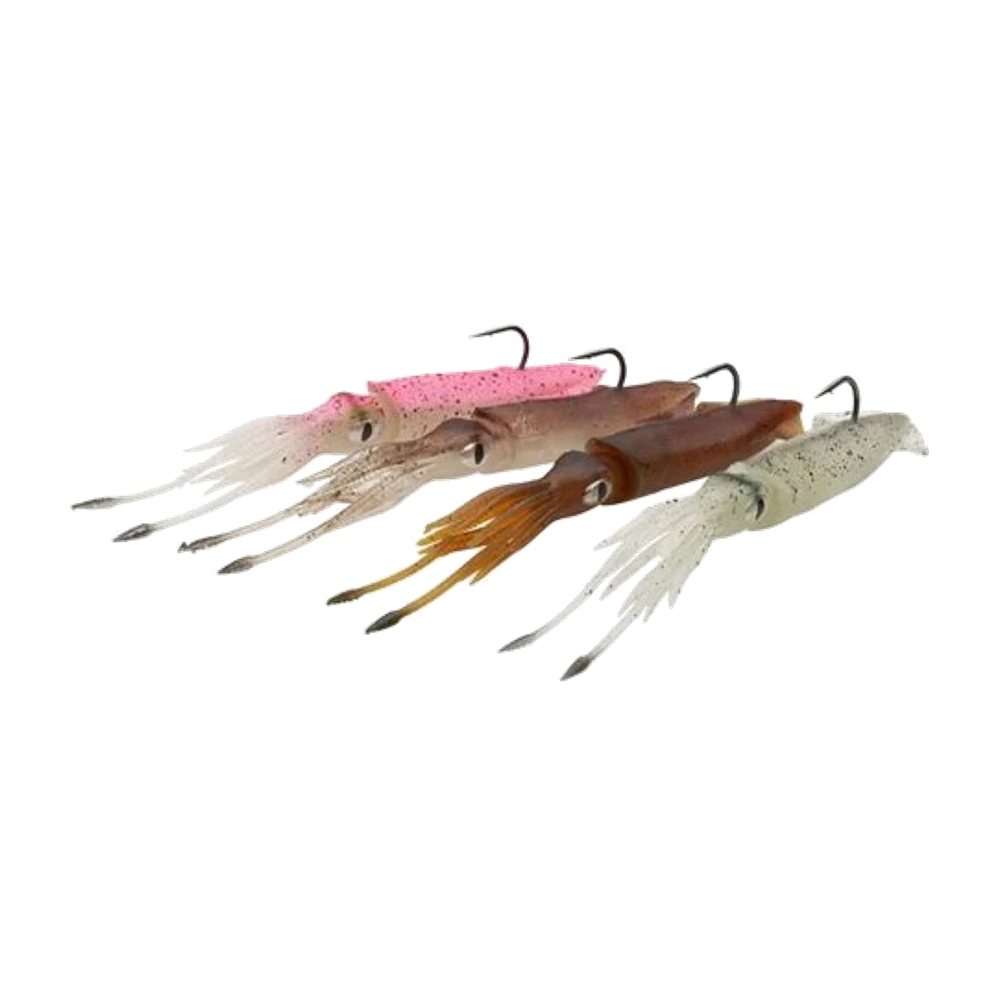
One lure, endless conditions. CarnaFish reads your spot from a photo so you are not just guessing.
Look at what comes out of your box on an October morning: a sandeel, a white shad, a silver minnow. All of them imitate the same thing — a small, torpedo-shaped fish. Now look at what the bass you keep at that time of year spit up: very often cephalopod beaks, pieces of tentacle, sometimes a whole squid. There is a gap there, and you can exploit it.
The 3D Swim Squid plays on exactly that. This is not a lure that does better than the others, it is a lure that offers something else — and on a fish that has watched fifteen shads go past since dawn, "something else" is sometimes the only argument left.
A profile that reverses the logic of the swim
A fish-shaped lure has its moving part at the back: the tail beats, the body follows. A squid works precisely the other way round.
Here, the volume is at the front and the appendages trail behind, gathered into a skirt. In practice that produces two very distinct phases:
- On the pull, the skirt flattens and the lure shoots upwards, mantle first, exactly like a cephalopod jetting water.
- On the drop, the skirt opens like a parachute and slows the fall. The tentacles spread, ripple, then close again. The lure sinks slowly, vibrating on the spot.
That asymmetry is the whole point of the lure. A shad dies on the drop: it sinks straight and silent. This one does its best work at exactly that moment, which gives you a continuous signal through the whole water column, lifts included.
Second technical point: the material. Soft rubber and a hollow body make it lighter than a solid lure of the same volume, which is why an 18 cm stays manageable on a sensible rod.
The retrieve: lift hard, then let it fall slack
The movement is close to a slow jig, but with a difference in rhythm.
- Drop straight to the bottom from a boat or a kayak, or cast and count the fall from the shore. Note the exact depth, you are going to build on it.
- Two sharp rod lifts, 50 to 80 cm each, winding one turn of the handle between them. The lure climbs 1.5 to 2 m.
- Give the line back completely, rod coming down, line just in contact. The lure drops again, opening its skirt. Count three to five seconds.
- Repeat for two or three cycles, then move up a metre in the water column and run the same sequence again. You sweep vertically instead of staying stuck to the bottom.
- On the sixth or seventh cycle, add a long pause of six to eight seconds with the lure simply hanging. That is the trigger on a passive fish.
On the water: the bite almost never comes on the way up. It comes on the drop, and it only shows on the line — a loop that tightens too early, or one that stops running out before you have touched bottom. Always keep the line in line and watch it, not your rod. If you wait to feel a thump, you will never set the hook.
From the shore the logic stays the same but you play it diagonally: cast, let it sink, two lifts, free fall, and work your way gradually up the slope. That is particularly effective along a breakwater or a rocky drop-off.
Choosing the size and the weight
| Setup | Size | Total weight | Use |
|---|---|---|---|
| From the shore, 3 to 8 m of water | 12.5 cm | 25 to 35 g | breakwaters, rocky points, shallow ground |
| Boat, 8 to 15 m, light current | 12.5 to 18 cm | 40 to 60 g | the most versatile setup |
| Boat, 15 to 25 m or strong current | 18 cm | 70 g and up | pure vertical, you have to hold bottom |
The practical rule: take the lightest weight that still lets you feel the bottom. Every extra gram shortens the parachute fall, which is precisely the phase that produces bites. If the current forces you up to a weight where the lure drops like a stone, change your drift rather than your lure.
For hooks, use short assist hooks fixed at the head of the skirt, never a big treble at the back. A cephalopod is attacked head first: that is where the points belong. Two opposed assists are enough, in 1/0 to 3/0 depending on the size.
Not sure what to tie on?
Photograph your spot: CarnaFish reads the scene, cross-checks the conditions and gives you the zone, the lure and the retrieve. Free on iOS and Android.
Where it excels, and where not to expect it to work
Its season is late summer and autumn, when cephalopods are on the coast and bass are feeding on them. Its spots: mixed sand and rock ground, drop-offs, the edges of eelgrass beds, plateaus of 8 to 20 m. It also earns its place on rough days when surface fishing is out of the question: vertical work stays possible when nothing else does.
It is poorly suited, on the other hand, to a visible surface feeding frenzy: by the time you have got down there the fish have moved on, and what you need is a topwater stickbait. It is also of little use in heavily coloured water after a blow, where its silhouette does not stand out. Finally, in less than 3 m of water the lift-and-fall sequence has no room to express itself.
Swim Squid or a fish imitation
Against a Savage Gear 3D Line Thru Sandeel, the difference is not one of quality but of prey. The sandeel works when bass are on sand eels, so mainly in spring and summer over sandy ground, and it is fished on a fast straight retrieve or a tight vertical jig. The Swim Squid targets autumn and mixed ground, with a rhythm built entirely around the fall. These are two lures to own, not two lures to compare.
Against a Fiiish Black Minnow N3, the split is even sharper: the Black Minnow is a Swiss army knife that searches fast and clean, the Swim Squid is a situational lure that plays on novelty and on an active falling phase. When the Black Minnow stops producing after an hour on a mark, the Squid is exactly the change of offer that makes sense.
Our guide to sea bass lure fishing covers the periods when bass switch diet. And if you are torn between vertical and straight retrieve when you reach a zone, CarnaFish analyses a photo of the spot and answers.
Key takeaways
- The volume is at the front and the skirt behind: the lure shoots on the pull and parachutes on the drop.
- The drop is the attack phase. You read it on the line, not on the rod.
- Two sharp lifts, three to five seconds of free fall, then work up the water column step by step.
- Short assist hooks at the head of the skirt: a cephalopod is attacked from the front.
- Its season is autumn over mixed ground, not surface frenzies and not shallow water.
FAQ
Do sea bass really eat squid?
Yes, cephalopods are part of their diet, particularly in late summer and autumn on coasts where cuttlefish and squid are present. It is a prey few anglers imitate, which gives the lure a novelty edge on heavily pressured fish.
Which size should I start with?
The 12.5 cm around 30 to 40 g covers both shore fishing off a breakwater and vertical work over moderate depths. Move up to the 18 cm only if you fish beyond 15 m or in strong current.
How do I detect bites on the drop?
By watching the line, not the rod. A loop that tightens early, or a fall that stops too high, means a fish. Keep the line in line with no slack to the side, and set the hook as soon as the fall is interrupted.
Do I need a treble at the back?
No. Two short assist hooks mounted at the head of the skirt cover the attacks far better, since they come from the front. A rear treble snags the bottom, tangles in the tentacles and does nothing for hookups.
What time of year should I use it?
Mainly from late August to November, when cephalopods are on the coast. The rest of the year it still catches fish, but you will do better with sand eel or small baitfish imitations.
Can it be fished from the shore?
Yes, off breakwaters, rocky points and drop-offs with at least 3 m of water. You cast, let it sink, and apply the same lift-and-fall sequence while working gradually up the slope instead of fishing straight down.
The full sea bass lure guideSeason-by-season strategy: which family of lure, when, and why.Go from theory to fish
CarnaFish reads your spot from a photo and gives you the game plan: zone, lure, retrieve. Free on iOS and Android.