Scum Frog Trophy Series Painted Frog: the frog built to ride low
One lure, endless conditions. CarnaFish reads your spot from a photo so you are not just guessing.
There are two ways to waste a pad edge. The first is casting too deep into it and spending the day peeling salad off your hook. The second, less obvious, is fishing a frog that floats so high it skates across the surface without ever disturbing it: the fish holding two metres under the leaves never even registers it. The Scum Frog Trophy Series Painted Frog is built for the opposite case — a body that settles into the film and shoves water with every twitch.
Riding low is a design decision
Scum Frog states that the body is shaped to sit low and move a lot of water, so it creates more surface disturbance. That is not a catalogue detail: a frog that rides low leaves a wake, makes the film ripple and sends out a low-frequency signal a fish picks up from a distance, even when it is pinned under a mat of duckweed.
The trade-off is worth knowing before you buy: a body that sits low also takes on more water with every missed blow-up. That is what the patented keel hole at the rear answers. The maker explains that it lets the frog self-drain at the start of every cast — the acceleration pushes water out through the back before the lure even hits the surface. In practice it spares you the gesture every frog angler ends up learning: swinging the bait at arm's length to wring it out between casts.
Still get into the habit of squeezing the body between two fingers every ten or fifteen missed strikes. A frog that has taken several swings at nothing often holds a little water ahead of the keel, and that alone is enough to ruin the rhythm of the walk.
A soft body that collapses on the hookset
The historic weak point of frog fishing is the strike-to-landed ratio. The fish engulfs a hollow body, the angler swings, and the hook stays trapped inside the plastic. Scum Frog highlights an ultra soft plastic that collapses under pressure to expose the points. That is a manufacturer claim, not a measurement: what can be said is that body softness remains the decisive variable on this type of lure.
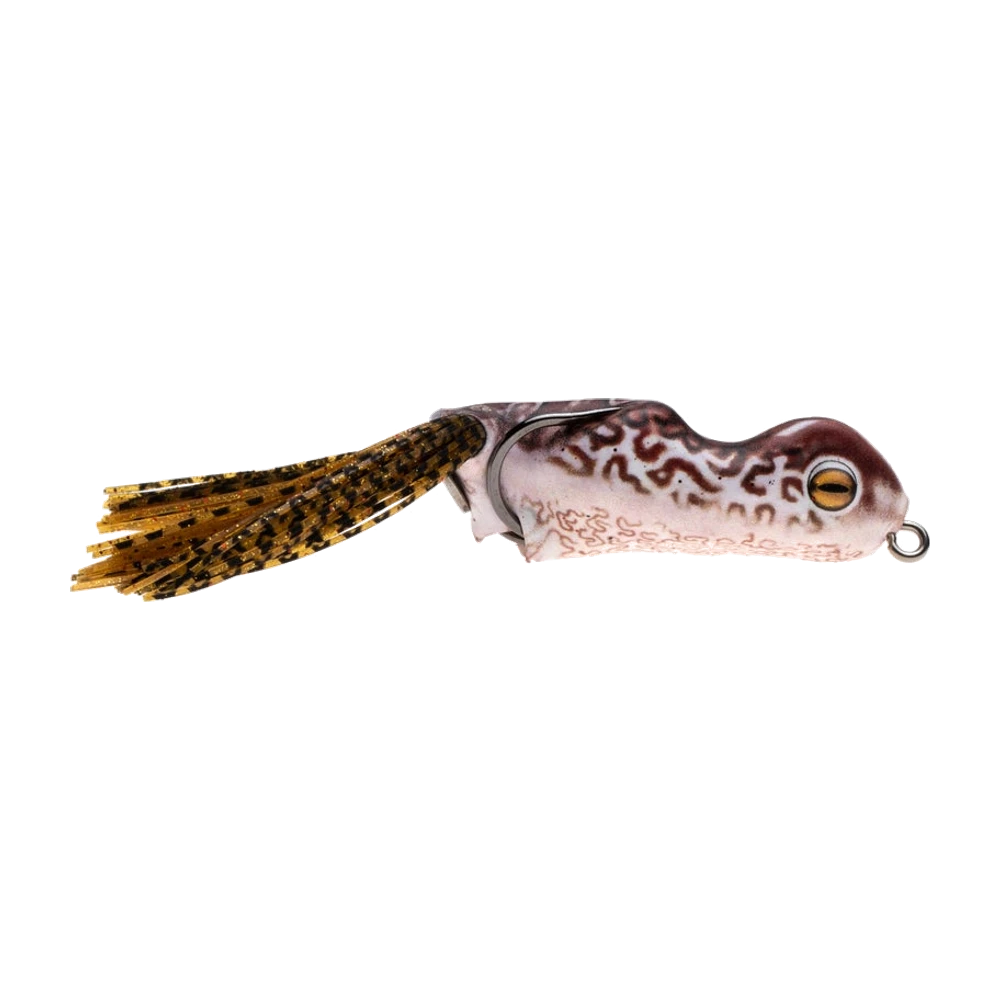
The frog is armed with an Owner hook, again according to the maker. In the product photo you can see one point riding up along the back and facing forward, lying flat against the body — the classic frog setup that lets it slide through vegetation without fouling. The profile shot does not allow the tines to be counted: that is an observation from a product photo, not a specification.
The hookset is where it is won or lost
Never set on the sound. It is the mistake that costs the most frog fish, and it is almost a reflex: the blow-up is spectacular, the hand goes on its own, and the lure comes whistling back over your head. Wait until you feel weight. Count a full second after the explosion, let the line come tight, then sweep sideways: that movement drags the lure into the mouth instead of tearing it out through the top.
The tackle follows the same logic: heavy braid of 0.40 to 0.50 mm tied straight through, with no fluorocarbon leader to soak up the energy of the set, and a powerful fast-action casting rod.
Two sizes, two jobs
The maker lists two versions: 2.25 in for 1/2 oz, roughly 5.7 cm and 14.2 g, and 2.75 in for 5/8 oz, roughly 7 cm and 17.7 g. The gap looks small on paper; it is not on the water.
The smaller one casts shorter but gets eaten more easily, and it walks tighter: it is the format for holes in the pads and for days when fish follow without committing. The bigger one pushes more water, casts better into wind and suits large areas you need to cover, as well as spots where a pike may show up. If you only buy one, buy the big one. For scale, the 6th Sense Vega Frog sits in the same length bracket with a slightly higher stated weight.
Not sure what to tie on?
Photograph your spot: CarnaFish reads the scene, cross-checks the conditions and gives you the zone, the lure and the retrieve. Free on iOS and Android.
Walking the frog down an edge
Scum Frog states that the soft plastic lets the body walk the dog easily. That is the key to using this lure: the frog is not meant to be reeled straight back, it is meant to be stomped in place. The pattern that works almost everywhere comes in three beats. Cast parallel to the edge, forty or fifty centimetres off the vegetation. Two to five short sharp taps, wrist only, with a little slack between each so the body can pivot. Then a pause of two to four seconds, dead still.
Most strikes come during the pause, because a stopped frog stays visible, sunk into the film, and ends up annoying a fish that has followed it. On a wary fish, a five-second pause is not too long.
When an edge produces but the strikes are half-hearted, slow down further, or on the contrary switch to a continuous walk with no pause to trigger a chase. Against a popping frog such as the Deps Buster K, the Trophy Series plays a quieter tune: no water spat forward, but lateral movement and a wake. They do not replace each other, they share a box. If you are coming from a smooth-bodied classic such as the SPRO Bronzeye Frog, the change in attitude shows on the first few casts: the Trophy Series leaves a heavier trail behind it.
Finishes and picking a colour
The Trophy Series Painted Frog carries over, according to Scum Frog, the original Trophy Series body with realistic colours designed by lure artist Andrew Gardner. The maker describes a proprietary process that applies the pattern digitally on the outside of the body, which it presents as highly resistant to wear after several fish. Take that durability for what it is — a brand argument — but the principle is consistent with the beating a frog takes.
On the water, the usual topwater rule applies, and it barely depends on how realistic the pattern is.
- Clear water, educated fish: a natural marbled brown like the one in the photo, which passes for a frog or a small amphibian without flashing.
- Bright sky, fish seeing the lure backlit: solid white, whose outline reads cleanly from underneath.
- Stained water, dawn, low cloud: solid black, the colour that cuts the sharpest silhouette against the sky as light fades.
Frog fishing starts with reading an edge: how thick the vegetation is, how deep it is under the leaves, whether a break runs nearby. That is exactly what CarnaFish makes easier — one photo of the spot, and the AI suggests a zone to work and a presentation suited to the day's conditions. To build the groundwork on tackle and bass structure, our guide to getting started with bass fishing covers the lure families worth knowing before you specialise.
Key takeaways
- A body designed to ride low and push water: more surface signal than a high-floating frog, but also more water to get rid of.
- The patented keel hole drains the lure at the start of the cast, which cuts down the wringing-out chore between series.
- Only two sizes, 5.7 cm for 14.2 g and 7 cm for 17.7 g: the big one to cover water and for pike, the small one for difficult fish.
- Sweep sideways, a full second after the explosion, never on the sound: that is what changes the strike-to-landed ratio.
FAQ
Does the Trophy Series Painted Frog actually float?
Scum Frog does not publish a buoyancy class for this model. The description presents it as a topwater frog built to work the edges of vegetation, with a body that deliberately rides low in the film. So it is a surface lure, but one that sits deeper than a standard frog.
Which size should a beginner pick?
The 7 cm, 17.7 g version. It casts better, pushes more water and stays effective in almost every edge situation. The 5.7 cm, 14.2 g version earns its place when fish follow without committing, or when the vegetation leaves little room.
Do I need a wire leader for pike with this frog?
On a spot where pike are likely, a short 0.60 to 0.80 mm fluorocarbon leader limits break-offs without killing the hookset too much. Wire is the only real insurance, but it stiffens the connection and spoils the walking action, so skip it if bass are the main target.
Why does my frog roll onto its side after a few casts?
In the vast majority of cases it is water left inside the body. Squeeze it out between two fingers before you cast again. If the problem persists with an empty body, check that the hook has not rotated in its seat after a violent set.
Does this frog replace a popping frog?
No, it does something else. A cupped-mouth frog spits water forward and works in place; the Trophy Series moves sideways and pushes water off its flanks. On flat water the popping version calls from further away; through thick vegetation a smooth body like this one tracks better.
Can it be fished anywhere other than lily pads?
Yes, and that use is underrated. Over submerged grass in open water, along a laydown or down a reed edge, the walking action works as well as a topwater stickbait, with the advantage of being able to enter the vegetation as soon as it appears.
The full bass lure guideSeason-by-season strategy: which family of lure, when, and why.Go from theory to fish
CarnaFish reads your spot from a photo and gives you the game plan: zone, lure, retrieve. Free on iOS and Android.