SPRO Essential Series Flappin Frog 65: the frog that buzzes and floats
One lure, endless conditions. CarnaFish reads your spot from a photo so you are not just guessing.
There is a frustration specific to soft kicking-leg frogs: the moment you stop winding, the lure sinks. You have just dragged thirty metres of mat, you finally reach the open hole where the fish is sitting, you want a one-second pause — and the bait drops. SPRO's Flappin Frog 65 solves exactly that problem, and it is the single reason it earns its own slot in a topwater box.
A hollow frog doing a buzzbait's job
SPRO states this frog delivers a kicking and buzzing action meant to trigger ferocious topwater explosions, produced by a hollow body and two large kicker legs. The brand also states it is completely weedless, which gives you a buzzbait-style action through heavy cover without snagging or interrupting the kicking legs.
That is the whole point. A conventional buzzbait, with its metal blade and exposed single hook, cannot cross a pad field without collecting half of it. A frog can. So you get the same signal — a rhythmic kick, a pronounced wake, noise — over ground a buzzbait cannot reach.
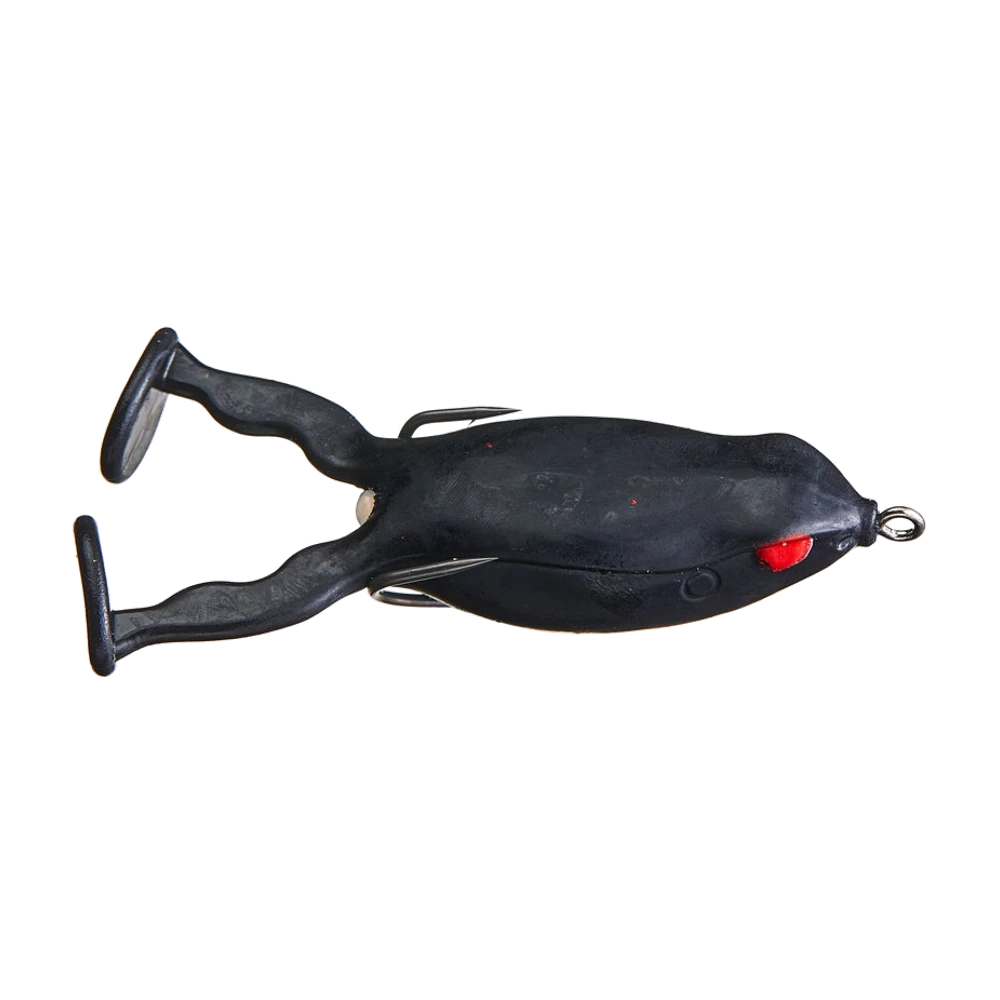
In the product photo, both legs are bent at the knee and finish in a fairly wide flat paddle foot: it is that paddle, pushed by the water, that generates the kick. The photographed sample is all black with a red patch on the side of the head, a small pale eye and a metal ring at the nose; the source does not name this color.
Buoyancy, and why it is written down here
On a lot of topwaters the spec sheet simply says Topwater or Surface, which is a usage category. Here it is different: the retailer's table has a Class column and it reads Floating. That is a stated buoyancy, not a deduction.
The description spells it out too: the hollow body design allows it to float, which lets anglers pause the frog and work it more slowly than a soft plastic kicking frog, which would sink if paused during the retrieve. That comparison comes from the manufacturer, but it describes a genuine behavioural gap you will notice on the first cast.
In practice it changes how you fish a mat. You can wind steadily for the noise, stop dead over the hole that interests you, leave the lure sitting for two or three seconds, then start again. A soft frog would force you to keep winding without a break, or to let it drop under the mat.
A pause is worthless if you put it in a random place. Find a hole in the vegetation, a pad edge, a branch breaking the surface, and time your stop so the lure settles on top of it, not two metres short. Noise that cuts out right above a holding fish is what brings it up.
Specs, material, hook
The table gives a single row under the heading Flappin Frog: 2-1/2 in and 5/8 oz, so about 6.4 cm for 17.7 g, with the class Floating. The 65 in the trade name suggests 65 millimetres while the conversion gives 63.5 mm; the gap is negligible, but you may as well know where it comes from.
The material is stated to be a super tough TPE, chosen so the frog survives the heaviest cover without damage. That is a manufacturer argument, and a testable one: a hollow frog eventually punctures around the hook slots, and the quality of the material decides how many fish it takes before that happens.
The hook is a 4/0 Gamakatsu Nano Smooth Coat double frog hook, presented as providing effortless hooksets. The 4/0 is a hook size: there is nothing to translate into millimetres. In the photo both points rest either side of the back, facing forward, with nothing breaking the profile.
The storage warning nobody reads
The description carries an explicit warning, bottom of the page in small print: the lure includes thermoplastic, and it should not be stored with any frogs other than the Spro Essential Flappin Frog.
That is not legal boilerplate. Two soft plastics of different formulations, pressed together in a box in the sun, degrade one another: tacky surfaces, colors bleeding across, material deforming. Give this frog its own compartment, or keep it in its original packaging.
How to work it
The baseline is a slow straight retrieve. Cast past the zone, lift the rod tip and wind at constant speed, hunting for the point where both legs kick properly. Too slow and they drag without working; too fast and the body lifts out and the kick turns ragged.
Then come the stops, and that is the model's real added value. One to three seconds, placed over a specific target. During the pause the legs stop kicking but keep undulating under line tension, which leaves a residual signal.
The third retrieve, less obvious, is a slow walk across an open hole: two or three soft rod strokes send the lure zigzagging, something a conventional kicking frog does badly. Save it for the clear ground between two mats.
Where to fish it, and on what
Its ground is cover: lily pads, duckweed, emergent weed, flooded timber, reed edges. It peaks in the thirty centimetres of water under a mat in late summer, when bass sit in the shade and refuse to come out.
In Europe, a frog this size worked along a weed edge also catches pike, and the 4/0 double holds a medium fish perfectly well. Fish it on heavy braid; a wire leader, safer on paper, weighs the nose down and spoils the surface trim.
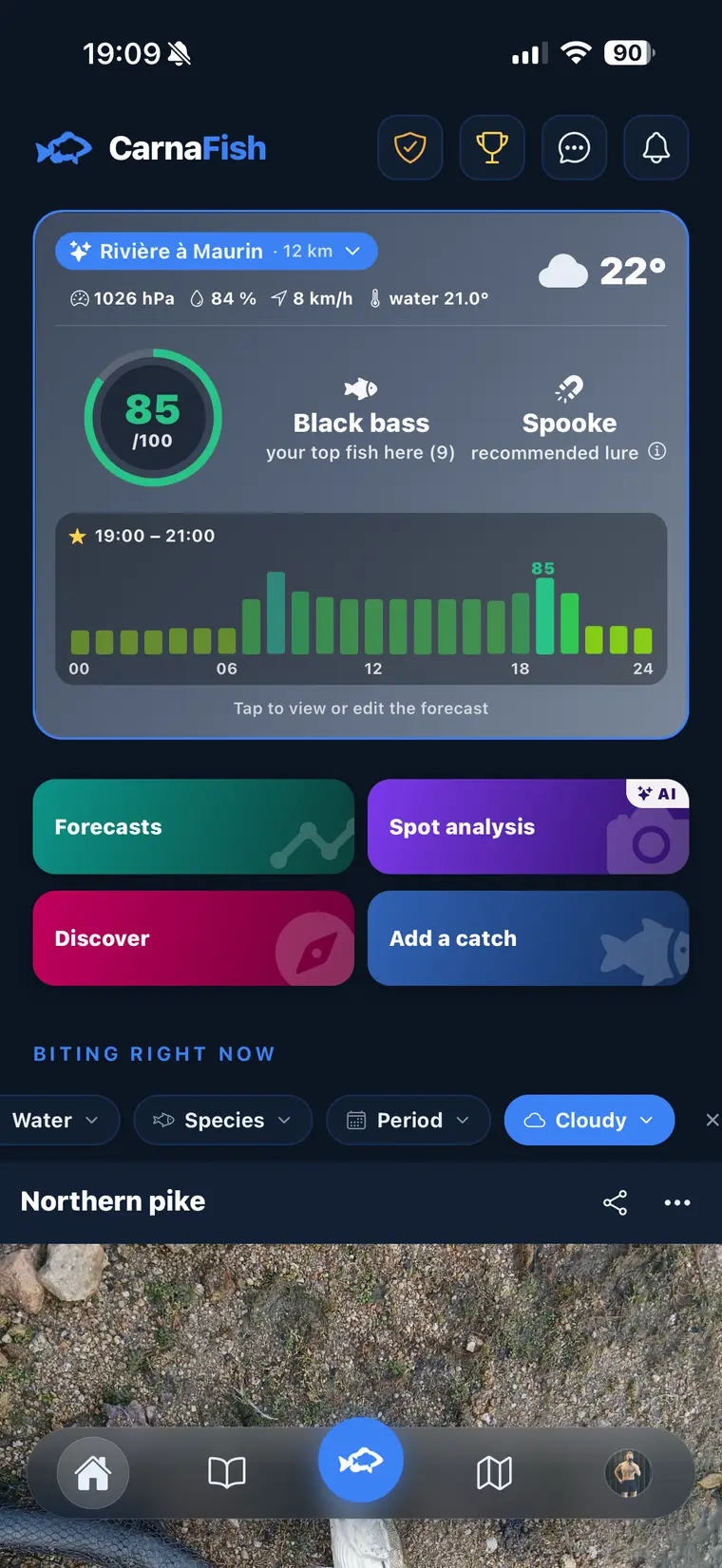
Not sure what to tie on?
Photograph your spot: CarnaFish reads the scene, cross-checks the conditions and gives you the zone, the lure and the retrieve. Free on iOS and Android.
Tackle
A powerful casting rod from 1.95 to 2.15 m, fast action but with body in the butt. Braid in the 50 to 65 lb class tied straight to the ring: no fluorocarbon leader, no snap. A high ratio reel, around 7:1.
The hookset follows the usual frog rule: one second of waiting, long enough to feel the weight, then a firm sideways set. With a kicking-leg frog the strike usually arrives mid-retrieve, so under tension — precisely when the urge to set immediately is strongest. Resist it.
Remember to squeeze the water out regularly: a hollow body that has shipped water through the hook slots loses part of the stated buoyancy, and with it the main benefit of the model.
Colors by light
- Plain black, like the photographed version: under a dense mat or a low sky it is the silhouette that counts, and black draws the cleanest outline from below.
- Natural greens and browns: in clear shallow water, when the fish rises slowly and has time to look before committing.
- Pale belly, white or yellow: for you more than for the fish. Tracking the frog across thirty metres of mat lets you place your pauses properly and see the strike coming.
What it completes in the box
The Flappin Frog 65 fills the slot of the loud, continuous cover bait. If you want flash on top of noise, the SPRO Bronzeye Blade Frog 65 adds two blades on the same continuous-retrieve principle. If you want a stationary bait instead, the SPRO Dean Rojas Bronzeye Poppin' Frog 60 works one precise hole rather than a straight retrieve. And in open water a Booyah Buzz makes even more commotion, wherever it can travel.
That still leaves the question of whether the mat is worth fishing today, and at what hour. That is what CarnaFish offers from a single photo of the spot: a zone, a depth and a lure family suited to the conditions. And if you work the same margins for pike, our guide to choosing a pike lure fills in the rest of the picture.
The short version
- Class Floating, stated in the table: a written buoyancy rather than a deduction, and that is what makes a mid-vegetation pause possible.
- Two large kicking legs delivering a buzzbait action over ground a buzzbait cannot cross.
- About 6.4 cm / 2.5 in for 17.7 g / 5/8 oz, body in a TPE stated to be very tough, factory 4/0 Gamakatsu Nano Smooth Coat double.
- Manufacturer's warning: do not store it with any frogs other than Essential Flappin Frogs.
FAQ
Does this frog really float?
Yes, and it is written down: the Class column in the manufacturer's table reads Floating, and the description specifies that the hollow body design allows it to float so you can pause it. It is one of the few kicking-leg frogs whose buoyancy is stated explicitly.
How does it differ from a soft plastic kicking frog?
Buoyancy and hooks. A soft frog of that type sinks if you stop the retrieve, and it rigs on a Texas hook you pick yourself. This one stays on top when stopped and arrives armed with a 4/0 double built into the hollow body.
How fast should I retrieve it?
At the slowest speed that still has both legs kicking properly. Below that they drag without working; above it the body lifts out and the rhythm turns ragged. Find that point, then vary with pauses rather than with speed.
What hook comes on it?
A 4/0 Gamakatsu Nano Smooth Coat double, stated by the manufacturer to give effortless hooksets. In the product photo both points rest along the back, facing forward, which makes the lure fully weedless.
Why should it not be stored with other frogs?
Because the manufacturer says so explicitly: the lure includes thermoplastic and should not be stored with frogs other than Essential Flappin Frogs. Two soft plastics of different formulations, pressed together and warmed, degrade one another. A dedicated compartment is enough to avoid the problem.
The full bass lure guideSeason-by-season strategy: which family of lure, when, and why.Go from theory to fish
CarnaFish reads your spot from a photo and gives you the game plan: zone, lure, retrieve. Free on iOS and Android.