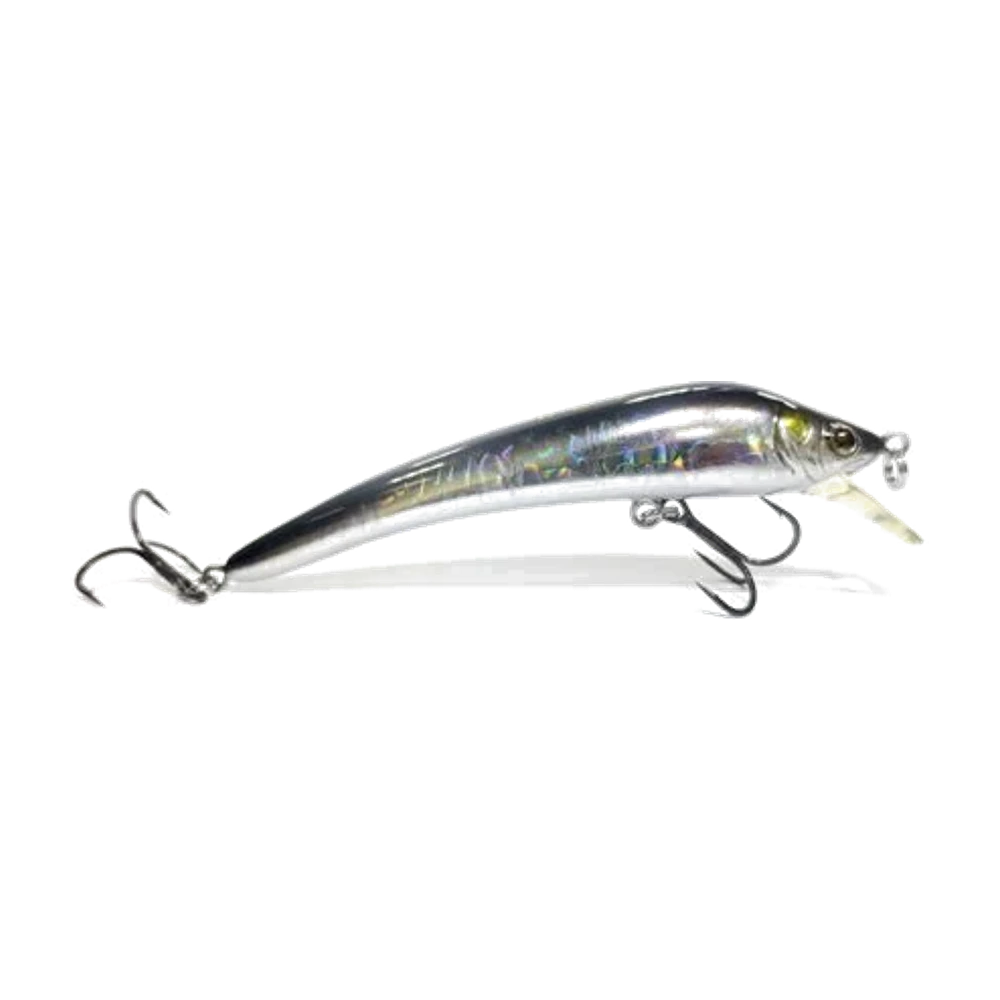
Sebile Koolie Minnow: depth you set with the handle
This lure shines under specific conditions. CarnaFish tells you in 10 seconds if today is one of them.
You arrive at a bay you do not know. There is current, a rocky edge, a sand flat, and you have no idea what depth the bass are at or whether they are feeding. The usual reflex is to change lures three times to explore three water layers — and lose twenty minutes at every change.
The Koolie Minnow answers differently. It is a lipless minnow: nothing forces it down to a set depth. Its swim and its water layer are dictated by two variables you control on the spot, with nothing to unclip: the sink count you give it after the cast, and the retrieve speed. The same lure can work twenty centimetres under the surface or scrape a flat at three metres.
No lip: what that really means
A lip does two things: it forces the dive and it imposes the amplitude of the swim. Removing it has knock-on consequences.
- You get depth back as a variable. The lure sinks when you stop. You decide the number of seconds, and therefore the starting layer.
- The swim becomes a roll rather than a wobble. With no angled plane at the front, the body is not pushed sideways: it rolls on its axis and throws flash off the flanks. The signal is more discreet, closer to a real fish swimming.
- You lose the safety net a lip gives you. A lipped lure warns you when it touches: the lip skips. A lipless lure noses straight into the rock. So you have to fish with an awareness of depth, not at random.
- Casting distance goes through the roof. With no angled plane at the front to brake and destabilise the lure in flight, and with a weight-transfer system that shifts the mass to the tail during the cast, you easily gain ten to fifteen metres over a standard minnow of the same size.
That last point is decisive for shore fishing for bass, where the fish are often beyond the first bar.
The dashboard: sink count and speed
Here is how you use it in practice, over one single area, without changing lures.
| Target layer | Count after impact | Retrieve | What you are after |
|---|---|---|---|
| Subsurface, 0 to 50 cm | 0 seconds, start straight away | Fast and continuous | Feeding bass, scattered fish |
| 1 to 1.5 m | 3 to 5 seconds | Medium, steady | Standard pass, edges |
| 2 to 2.5 m | 8 to 12 seconds | Slow, reel only | Settled fish, high tide |
| Near the bottom, 3 m and more | Until it touches | Very slow, gentle pulls | Cold water, fish sitting tight |
The principle: three casts per layer, then drop one notch. In five minutes you have swept the whole water column of a spot and you know where the fish are. It is a search method as much as a lure.
Working it by layer
- In the subsurface, brisk straight retrieve, rod high at 11 o'clock to keep the lure up. Two or three brief accelerations per cast are enough to trigger active bass.
- In the middle layer, steady straight retrieve, rod at 9 o'clock. Every five or six turns, add a one second stop: the lure breaks out and drops slightly. Bites come almost always on the restart.
- Near the bottom, alternate two turns of the handle with a two second pause. Stay in contact on the fall: on a sinking lure, a bite on the drop shows up as a line that simply stays slack.
- In current, cast upstream and let the lure drift down. You will have almost nothing to do: the flow keeps the roll going by itself.
On the water: genuinely keep the sink count under your breath, and note the one that produced the bite. A bass holding on a flat sits at a precise height above the bottom, often to within fifty centimetres. Finding that count again on the next cast beats changing colour — and it is what most anglers never do.
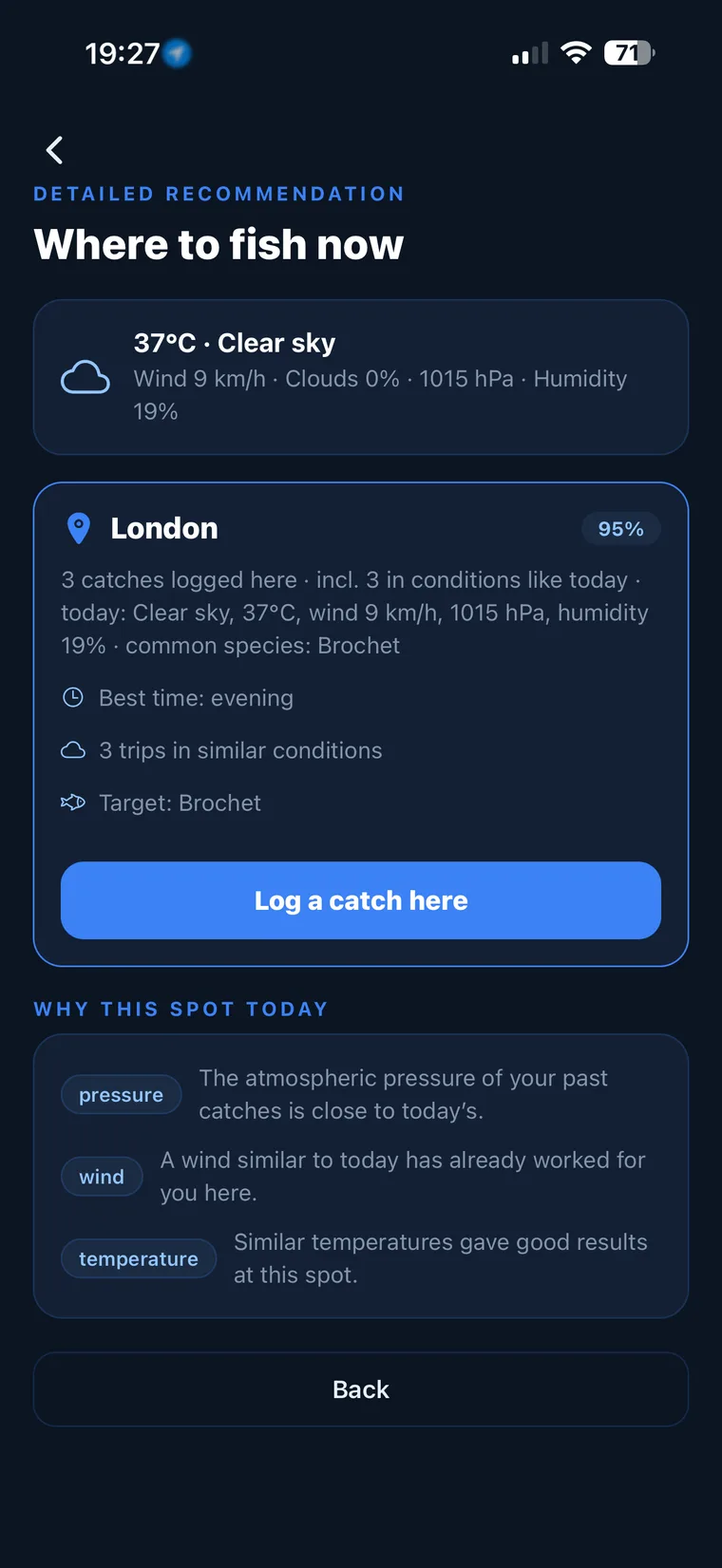
Not sure what to tie on?
Photograph your spot: CarnaFish reads the scene, cross-checks the conditions and gives you the zone, the lure and the retrieve. Free on iOS and Android.
Where it takes the lead, where you need something else
It shines on open, windy spots: beaches, rocky points, breakwaters, river mouths. Long casting and wind penetration are its two real assets, and that is exactly where a lightly lipped minnow is unusable. It is also very good in rough water, because a sinking lure stays in the water instead of coming out of the wave.
It also earns its place in fresh water on pike in big lakes, when you need to reach a distant edge — provided you add a wire leader.
On the other hand, it is poorly suited to snaggy shallow ground: it sinks, so it catches as soon as you slow down over weed or surfacing rock. On ultra-selective fish in perfectly clear, calm water, its fairly neutral roll convinces less than a lure with a marked action. And it does not replace a topwater when bass are visibly sipping on the surface: that calls for a stickbait or a popper.
Koolie Minnow or Magic Swimmer
Both are Sebile lures and both get fished in salt water, but they are two opposite philosophies.
The Sebile Magic Swimmer 128 is a jointed swimbait: its point is the wide S-shaped swim generated by the body sections. It works well at a slow, steady speed, and it imitates a good-sized prey moving calmly. In exchange, its swim is what it is: you cannot change it much with the handle.
The Koolie Minnow is a rigid body whose water layer and swim intensity vary with your speed. It covers more of the water column and casts further, but it produces a more discreet signal. The Sebile Stick Shadd rounds out the set in the register of a lure you glide rather than crank.
A useful summary: Magic Swimmer when you know where the fish are and you want a precise swim, Koolie Minnow when you are still searching and you need to sweep far and wide. Our guide to lure fishing for bass covers reading shoreline spots. And if you are unsure which layer to attack first in front of a rocky point, CarnaFish reads a photo of the spot and answers.
Key takeaways
- No lip: you set the depth with the sink count and the speed, without changing lures.
- The weight transfer buys you ten to fifteen metres of casting over an equivalent lipped minnow.
- Search method: three casts per layer, then drop one notch.
- Note the sink count that produced the bite and repeat it, rather than changing colour.
- Open spots, wind, rough water. Avoid it over snaggy shallow ground where it catches.
FAQ
What depth does the Sebile Koolie Minnow run at?
It has no fixed depth. The lure sinks when you stop, so it is the number of seconds you give it before starting, then your retrieve speed, that decide the water layer — from the subsurface to three metres and beyond.
Does it really cast further than a standard minnow?
Clearly. Having no lip removes the surface that brakes and destabilises the lure in flight, and the weight transfer shifts the mass to the rear on the cast. The gain is commonly ten to fifteen metres at equal size.
What line should you use for shore fishing for bass?
Fine braid for distance, with a fluorocarbon leader of 0.30 to 0.35 mm, about a metre long, for abrasion on rock and shellfish. For pike in fresh water, add a wire or titanium leader.
How do you avoid snagging with a sinking lure?
Always count the sink and stop one notch above the known bottom. Over snaggy shallow ground, start the retrieve immediately after impact and keep the rod high for the first few metres.
Does it work in fresh water?
Yes, particularly on pike in big lakes or gravel pits when you need to reach a distant edge. Fit a bite-proof leader without fail, and target flats and drop-offs rather than weed beds.
What is the difference with the Magic Swimmer?
The Magic Swimmer is jointed and produces a wide S-shaped swim you cannot change much. The Koolie Minnow has a rigid body whose swim intensity and water layer depend on your retrieve. One is a presentation lure, the other a searching lure.
The full sea bass lure guideSeason-by-season strategy: which family of lure, when, and why.Go from theory to fish
CarnaFish reads your spot from a photo and gives you the game plan: zone, lure, retrieve. Free on iOS and Android.