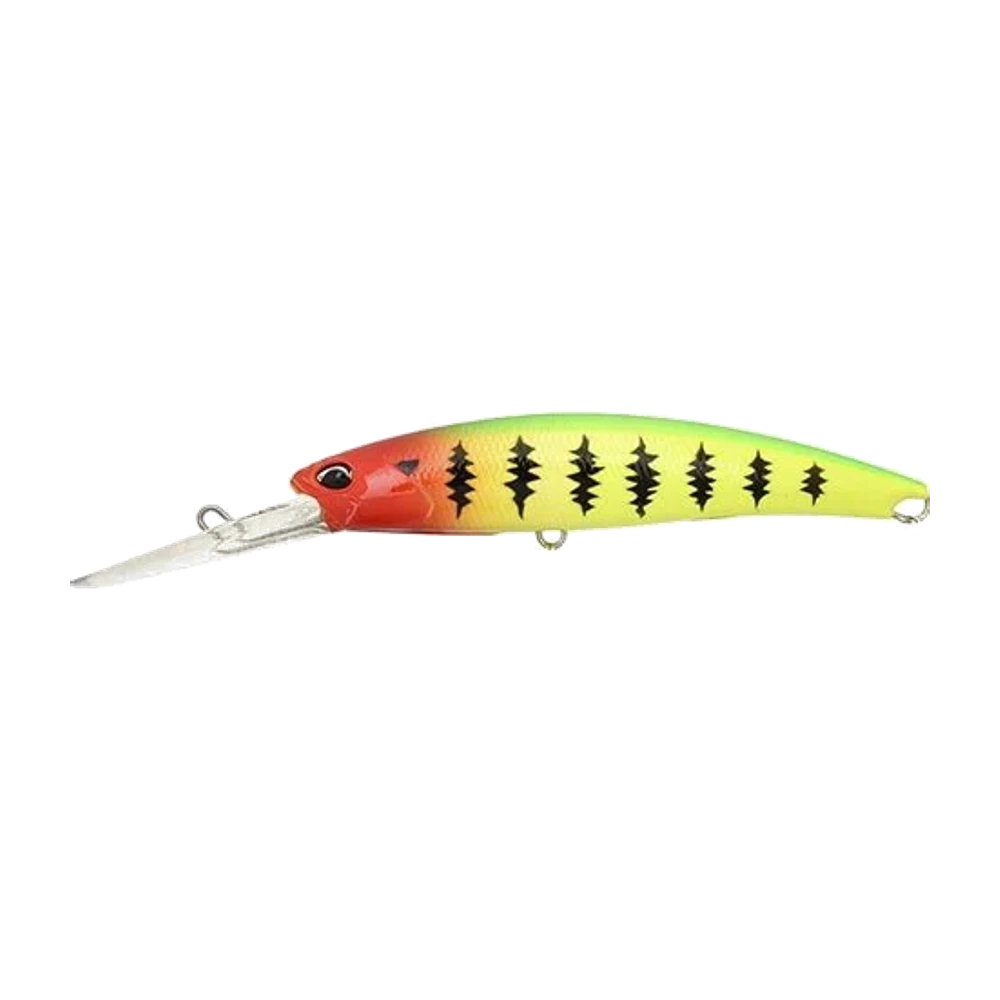
DUO Realis Fangbait 120: the minnow that holds in the waves
Not sure this lure fits YOUR spot today? CarnaFish tells you in 10 seconds, from a photo.
There is a precise moment when a minnow stops fishing: when it comes out of the water. A sea getting up, a tide run pushing through, or simply a wind over your shoulder — the lure lifts off, rolls onto its side, skates along the surface and comes back spinning on itself. What you are retrieving no longer looks remotely like a fish.
The Fangbait 120 is designed around that problem. A short, steeply angled lip, a compact body, transfer weights that settle back at the front from the first turn of the handle: it anchors itself in its layer of water instead of floating on top of it. It is a broken-water minnow, and that is also what makes it effective on pike in a windy autumn.
What stops it blowing out
Three elements work together, and you need to understand them so you do not cancel them out when you rig it.
The lip. Short and angled steeply downwards, it is not looking for depth but for bite: it pulls the nose down and forward and holds the attitude from the first turns of the handle. That is why it swims between 50 cm and 1 m and no deeper — it is not a diver.
The mass transfer system. During the flight the balls run to the rear and stabilise the trajectory, which gives long, flat casts even into the wind. On the first turn of the handle they come back and lock at the front. If you take up the slack too limply as the lure lands, they stay back there for a few seconds and the lure swims sideways: that is the commonest mistake with this type of lure.
The tight roll. The action is relatively contained, with no great sideways amplitude. A minnow with a wide action is more visible in calm water but loses its balance far sooner in turbulence. Here, you trade amplitude for stability.
The retrieve: straight first, twitches after
- Cast long and feather it down, then give two crisp turns of the handle the moment the lure touches the water. That brings the balls forward and gets the action going straight away.
- Retrieve steadily, rod low, tip thirty or forty centimetres above the water. A medium, constant speed, with no attempt to work it.
- On a defined spot — a current seam, a boulder, a weed bed edge — slip in two short twitches from the wrist, then go straight back to the steady retrieve with no stop.
- If a fish follows without biting, cut the retrieve for a second. Being a floater, the lure rises slowly while keeping its attitude. That short rise often triggers.
- In current, cast upstream at 45 degrees and retrieve just fast enough to stay in contact. The lure then works across the flow, which is as natural a presentation as you can get.
On the water: when your minnow starts blowing out in the waves, the reflex is to speed up to "put it back in". You need to do the opposite. Bury the rod tip twenty centimetres into the water and slow down: you change the angle of pull, the lip bites downwards again, and the lure recovers its attitude immediately. Speeding up only pulls it further out.
Sea bass or pike: two different setups
| Parameter | Sea bass from the shore | Pike in lake or river |
|---|---|---|
| Leader | 0.35 to 0.45 mm fluorocarbon | Flexible wire or 0.70 mm fluorocarbon |
| Speed | Medium to brisk | Slow, punctuated with stops |
| Retrieve | Straight, few twitches | Two twitches per spot, marked pauses |
| Colour | Natural or pearl | High contrast, dark back |
| Timing | Flood tide, dawn, rough sea | Autumn, wind, cooling water |
For pike, a stinger makes no sense on a hard lure carrying two trebles; what you should do instead is replace them with trebles of equivalent wire diameter when they blunt. A heavier treble kills the buoyancy and removes the rise on the stop, which is one of this lure's weapons.
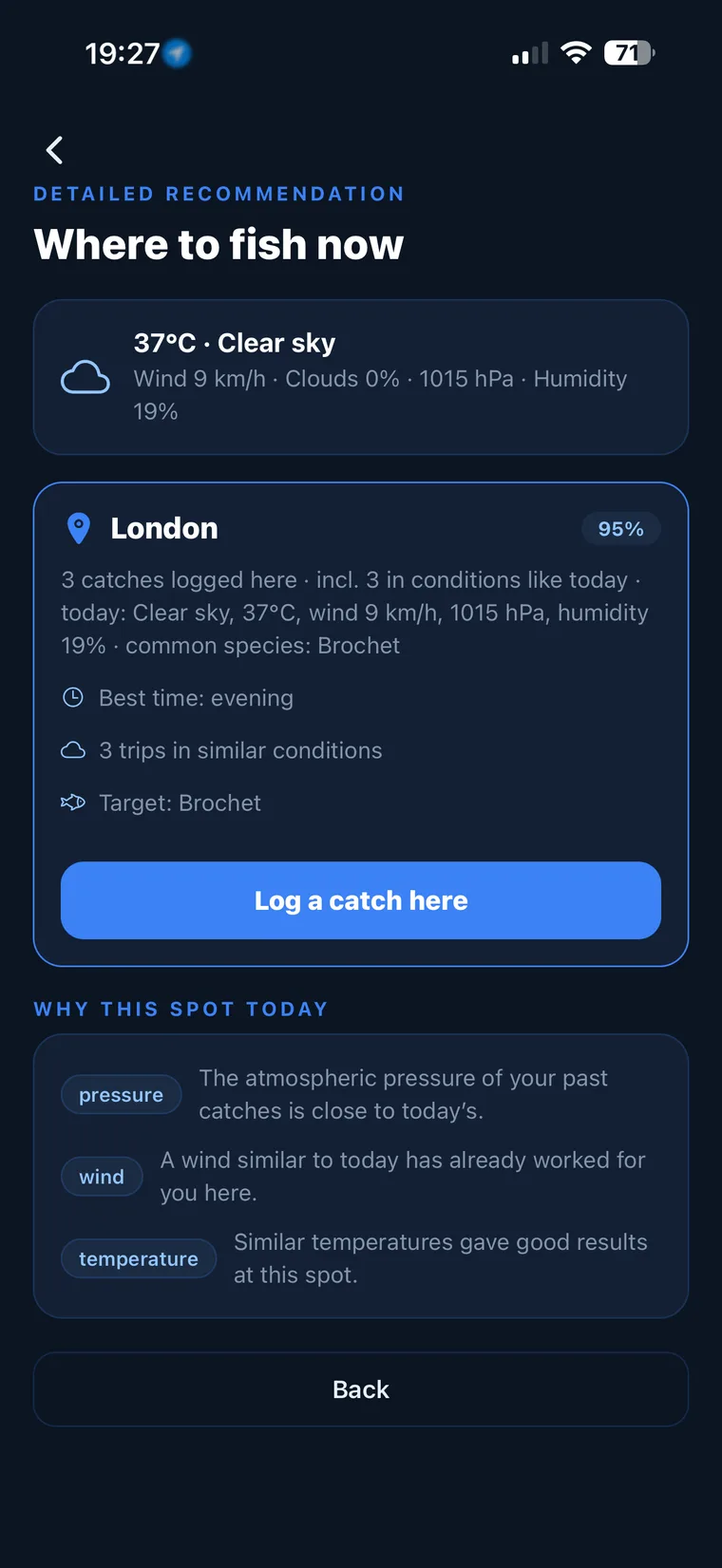
Not sure what to tie on?
Photograph your spot: CarnaFish reads the scene, cross-checks the conditions and gives you the zone, the lure and the retrieve. Free on iOS and Android.
Where it excels, where it is the wrong tool
Its window: broken, shallow water. Surf beaches, jetties, estuary mouths on the flood, current seams in rivers, lake plateaus in a steady wind. It is also very good when you need to cast far without losing control, from a high bank or into a headwind.
It is unsuited to three situations. In deep water, since it will not go below a metre: you need a diver or a weighted approach there. On apathetic fish in cold, clear water, where a suspending jerkbait that can hold dead still does far better — the Fangbait rises as soon as you stop. And in dense weed, where its two exposed trebles collect vegetation constantly.
A word on reading current, because that is where it gives most. Look systematically for breaks: immediately downstream of a boulder, the seam between two bands of different speed, the exit of a channel. Fish sit there out of the flow and watch what comes past above them. Work the lure right on that edge, in the fast water, not in the eddy where it would lose its attitude.
Fangbait 120 or a suspending jerkbait
The most telling comparison is with the DUO Realis Jerkbait 120SP, from the same company and the same length. The Jerkbait is a lure of dead time: it suspends, it waits, it is fished with jerks and long pauses on fish that are not moving. The Fangbait is a lure of movement: it floats, it is fished straight, it covers ground and it keeps its balance where the other one blows out. Cold, calm water for one, churned and running water for the other.
Against a Rapala Max Rap Long Cast, the intent is closer — long casts, wind resistance — but the Fangbait works a little slower and a little deeper, which makes it more versatile when the fish are not clearly right at the surface. The Bomber Long A, meanwhile, remains the subtler option on calm water.
Our guide to sea bass fishing with lures covers reading a mark and picking your moment. And if you are unsure which type of minnow to tie on for the state of the sea, CarnaFish analyses a photo of the spot and answers.
Key takeaways
- A short, angled lip: it anchors itself in broken water instead of blowing out.
- Two crisp turns of the handle on impact to bring the balls back to the front.
- When it comes out of the water, slow down and bury the rod tip: never speed up.
- Floating: the slow rise on the stop is a weapon on following fish.
- Unsuited to depths beyond a metre and to apathetic fish in clear water.
FAQ
How deep does the DUO Realis Fangbait 120 swim?
Between roughly 50 cm and 1 m on a straight retrieve. Its short, steeply angled lip is after stability rather than depth: this is not a diver but a sub-surface minnow built to hold its attitude in churned water.
Why does my minnow swim sideways after the cast?
Usually because the balls in the mass transfer system have not come back to the front. Give two crisp turns of the handle as soon as the lure touches the water: the action sets up immediately instead of starting out skewed.
Is it suitable for pike?
Yes, particularly in autumn over shallow plateaus in a steady wind. Slow down markedly compared with sea bass, put in stops, and fit a flexible wire leader or heavy fluorocarbon without fail.
Does it float or suspend on the stop?
It floats and rises slowly while keeping its attitude. That short rise is useful on a fish that follows without attacking, but it makes it unsuited to cold-water fishing, where a suspending model that can hold still is preferable.
What line should you use from the shore?
Fine braid for distance and detection, with a fluorocarbon leader of 0.35 to 0.45 mm depending on how much rock there is. Finer and you break off on the edges; heavier and you restrict the roll and lose part of your casting distance.
Should you replace the stock hooks?
Only when they are blunt, and always with models of equivalent wire diameter. A heavier treble alone is enough to cancel the lure's buoyancy and remove the rise on the stop, which is part of how it works.
The full pike lure guideSeason-by-season strategy: which family of lure, when, and why.Go from theory to fish
CarnaFish reads your spot from a photo and gives you the game plan: zone, lure, retrieve. Free on iOS and Android.