Megabass i-Slide: the glidebait that pulls fish off their spot
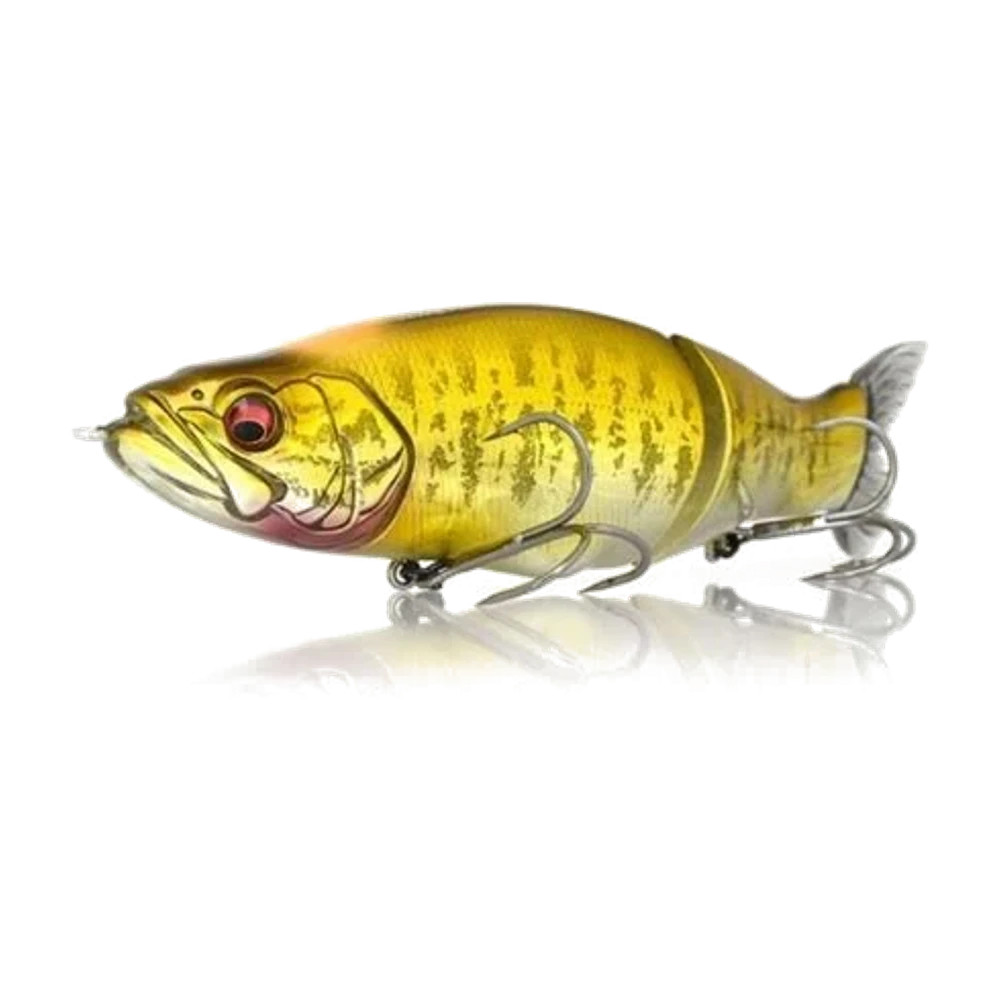
One lure, endless conditions. CarnaFish reads your spot from a photo so you are not just guessing.
There is a category of fish no ordinary lure touches: the ones that are right there, that you have watched follow three times, and that turn around two metres from the bank. These are not inactive fish. They are fish that have decided your lure is not credible, and they are letting you know.
The glidebait was built for them. It is not a numbers lure: it is a lure that provokes a reaction. A body jointed in two parts, serious mass, and a single action — a wide, slow lateral glide that makes the lure trace a broad horizontal S over several tens of centimetres on every input.
The Megabass i-Slide is one of the models that established this family in Europe. It comes in several lengths, from compact sizes up to versions over 25 cm, and it is fished exactly the same way at every size.
What the wide S produces
An ordinary lure travels down a narrow corridor. A glidebait leaves the line of the retrieve regularly and by a long way, then comes back. Three consequences.
It becomes visible side-on. A fish holding at right angles to your path sees a whole flank, then the other, slowly enough to give it time to decide.
It mimics prey that is not fleeing. An injured or disoriented fish does not run straight: it heads off sideways, stops, sets off again. The S reproduces exactly that behaviour, and that is what separates a glidebait from a straight-swimming swimbait.
It creates usable dead time. At the end of each glide, the lure marks a very brief stop before heading back the other way. That is when the vast majority of strikes happen.
The jointed body has no other purpose: the hinge lets the rear follow with a slight delay, which lengthens the glide and gives the lure its characteristic roll.
The retrieve: three rhythms to know
The basic S
- Cast and let the lure settle for a second, long enough for it to find its attitude.
- One slow turn of the handle, then a light twitch of the rod tip, pointed down.
- Let the glide run its full course. Do not restart too soon: that is the commonest mistake.
- Repeat at a steady cadence, one twitch per turn.
In clear water you should see the lure move decisively left, slow down, then set off to the right.
The long glide
On apathetic fish or in cold water, stretch it out: one twitch, then two to three seconds of waiting while the lure finishes its run and starts a slow descent. The lure covers very little ground, but it stays in the fish's field of view for a long time.
The about-turn, for followers
This is the retrieve that justifies the purchase on its own.
- Spot the follower a few metres from the bank.
- Do not speed up. Keep the same rhythm.
- Give two sharp twitches close together that send the lure sideways in one go.
- Let it die for a second, motionless.
That abrupt change of direction at short range turns a follower into a biter far more often than a classic figure-of-eight.
On the water: on a glidebait, your cadence must be set by the end of the glide, not by your arm. If you restart before the lure has finished drifting, you get a choppy action that no longer looks like anything. Watch the lure for the first few casts, then reproduce the timing with your eyes closed.
The gear is not negotiable
| Item | Recommendation |
|---|---|
| Rod | 2.10 to 2.40 m, 60-150 g depending on lure size |
| Reel | large-capacity casting reel, progressive drag |
| Braid | 0.35 to 0.50 mm |
| Leader | titanium or soft steel, 30 to 40 cm for pike |
| Hooks | heavy trebles, checked after every fish |
A 20 cm glidebait weighs over 100 g. With a rod that is too light, you cannot cast properly, you cannot work it cleanly, and you damage your gear. This is heavy-load fishing.
One point often overlooked: these lures have hardware that takes a lot of load. Check the line ties regularly, along with the split rings, which open on a big fish far more often than trebles break.
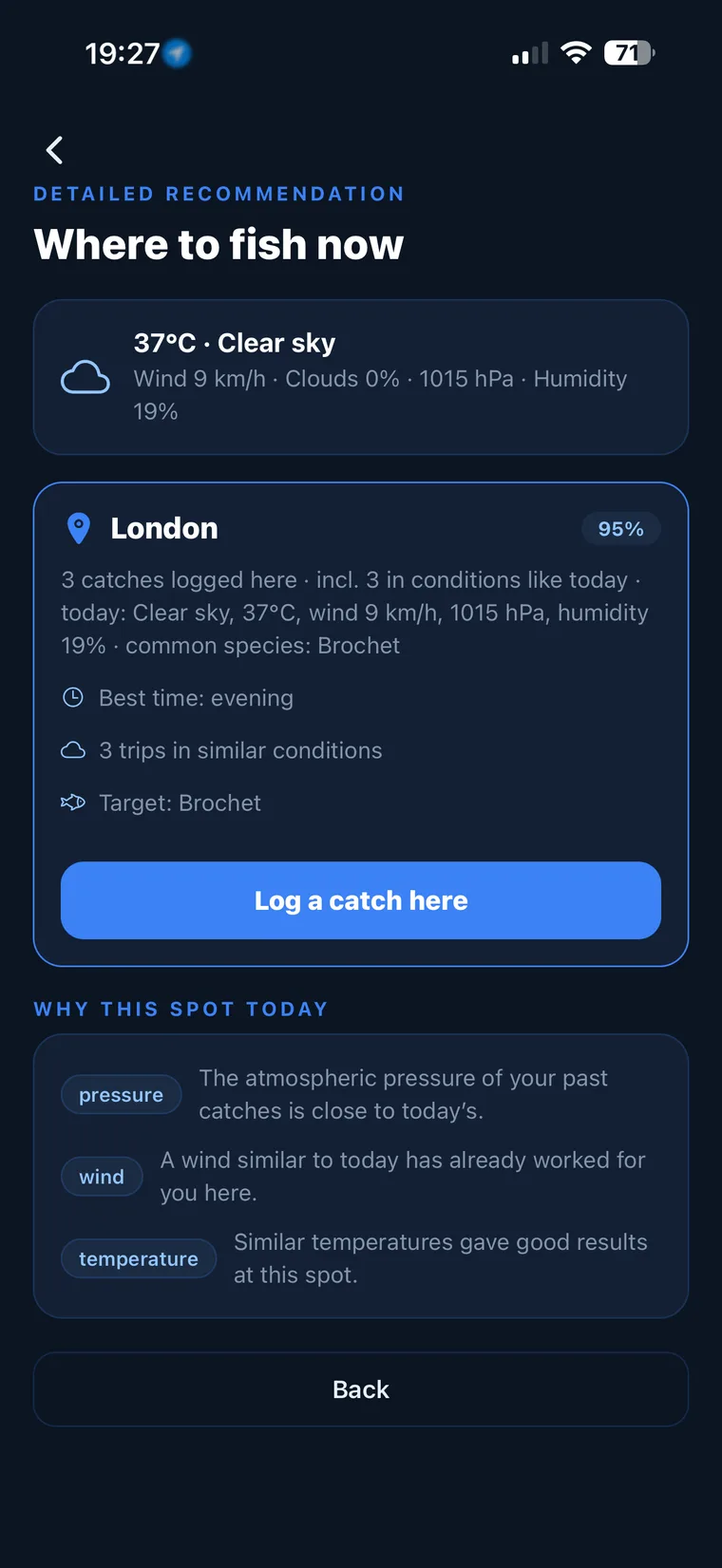
Not sure what to tie on?
Photograph your spot: CarnaFish reads the scene, cross-checks the conditions and gives you the zone, the lure and the retrieve. Free on iOS and Android.
Where it is of no interest
The i-Slide is a lure for precise conditions.
- Very dirty water: it is a visual lure with little vibration. The fish has to see it. In brown water, a chatterbait or a lipless covers far better.
- Searching large areas: too slow, too tiring. This is a lure for a known spot.
- Small fish: you will catch almost no average-sized pike on it, and that is by design.
- Very cluttered zones: two bare trebles on an expensive lure, deep in branches, is a bad bet.
i-Slide or a classic jointed swimbait
Against a Westin Swim Glidebait or a Gan Craft Jointed Claw, the family is the same and the nuances come down to glide width and speed: some models travel farther sideways but demand a slower rhythm, others stay tighter and tolerate a more continuous retrieve. The i-Slide sits in the middle ground, which makes it a good first glidebait.
The real difference in family shows up against a soft-tailed swimbait like the Megabass Magdraft: that one is fished on a straight retrieve, swims in a narrow corridor, and catches fish of all sizes. It is more productive, but it does not provoke. The two complement each other in a pike box.
Our guide to choosing a pike lure places the glidebait within a seasonal strategy. And if you are unsure whether to pull out a big lure on a given spot, CarnaFish analyses a photo of the spot and answers.
Key takeaways
- The wide S pulls the lure off the retrieve line: the fish sees a whole flank, slowly.
- The bite comes as the glide finishes, before the next input.
- Set your cadence by the end of the glide, never by your arm.
- Two sharp twitches on a follower at the bank beat a figure-of-eight.
- A selective lure: few bites, big fish, and suitable gear is compulsory.
FAQ
How do you work a glidebait properly?
A light twitch of the rod tip per turn of the handle, letting each glide develop fully before the next input. The rhythm must be dictated by the end of the lure's run, not by your hand.
What rod for the Megabass i-Slide?
Depending on the model, a casting rod of 2.10 to 2.40 m rated 60 to 150 g. The big versions go over 100 g and demand a heavy-power setup, otherwise casting and working the lure become impossible.
Does the i-Slide catch small pike?
Rarely, and that is not its purpose. It is a selective lure designed to trigger good fish. If you want numbers, a shad on a jig head will be far more productive.
Do you need a steel leader?
Yes for pike, titanium or soft steel, 30 to 40 cm. Also check the split rings and line ties after every fish: on these heavy lures, that is where things give way first.
Does it work in murky water?
Hardly. The glidebait plays on the visual and generates little vibration. In dirty water, a vibrating lure or a chatterbait will cover the ground much better.
What do you do when a pike follows without attacking?
Do not speed up. Give two sharp twitches close together to throw the lure abruptly sideways, then leave it motionless for a second. That change of direction triggers far more than an acceleration.
The full pike lure guideSeason-by-season strategy: which family of lure, when, and why.Go from theory to fish
CarnaFish reads your spot from a photo and gives you the game plan: zone, lure, retrieve. Free on iOS and Android.