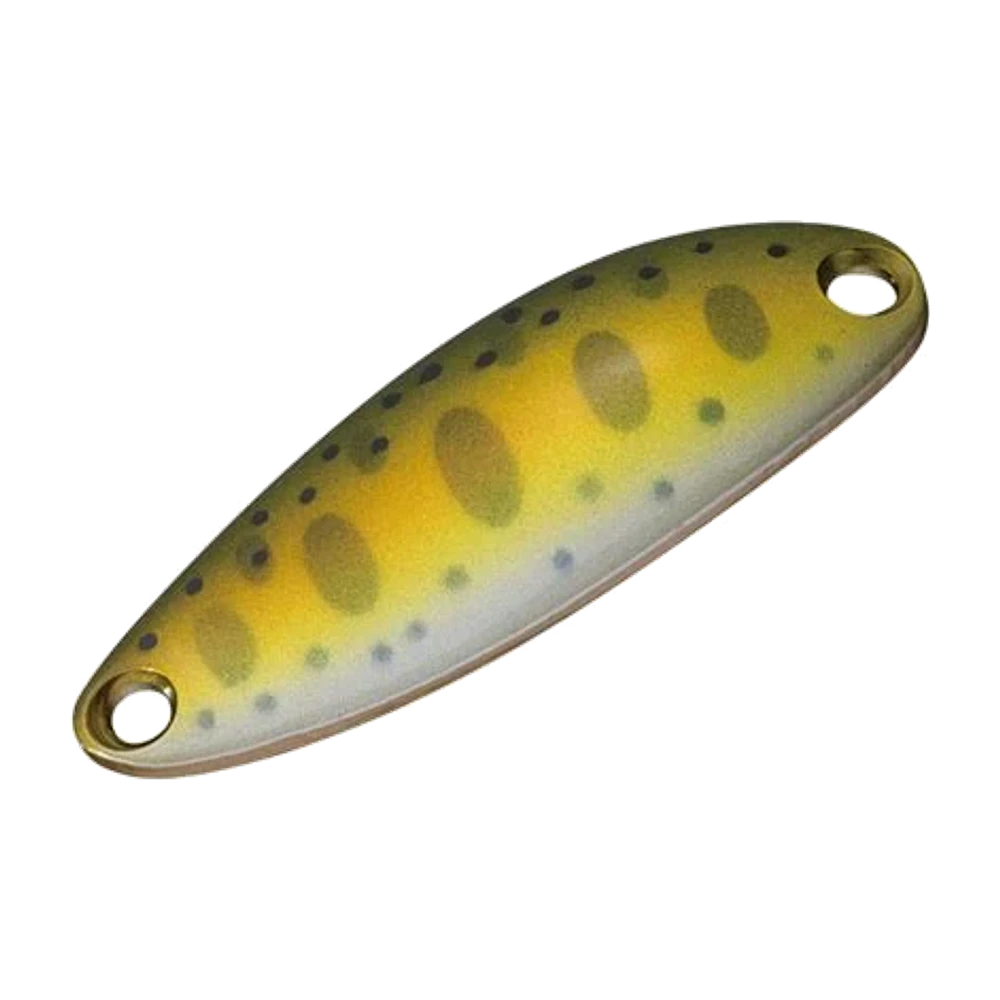
Smith Pure: the river spoon you fish upstream
Rather not fish it blind? Photograph your spot — CarnaFish cross-checks the conditions and points you the right way.
The classic problem with a spoon in a river is the direction you fish it. You cast across or downstream, the current takes the spoon, it lies flat, it spins on itself and rises to the surface like a piece of plastic. Slow down and it stops working. Speed up and it planes out. The result is that most anglers give up on spoons as soon as the river has any gradient and go back to inline spinners.
The Pure is designed for the opposite case: it is fished upstream, with the current, on a fast retrieve. That feels counter-intuitive if you learned spoons fished across, but it is what makes this model interesting on our small trout streams. Do not confuse it with the big pike spoons: neither the same family of tool nor the same motion.
A short rock instead of a wide wobble
A classic spoon works by weaving: it goes out one side, comes back the other, describing wide S shapes. That movement needs room and a restrained speed. As soon as the current gets involved, the path falls apart.
The Pure does something else. Its profile, thicker and less dished than that of a pike spoon, produces a tight roll around the long axis rather than a lateral sweep. In practice:
- The lure stays in a narrow corridor: you can run it thirty centimetres past a rock without it hitting.
- The flash is chopped, not continuous. Each half rotation shows one flank, then the other. It is a blinking, not a mirror gliding past.
- The action holds at high speed. That is the critical point: where a wide spoon gives up, the Pure keeps rolling even when you crank fast to compensate for the current.
On the drop, by contrast, it tips over and flutters. That dead phase is a genuine fishing phase, and we come back to it below.
The upstream cast, step by step
This is the main retrieve on a flowing river. You work your way up the watercourse, fishing in front of you.
- Find the current line and position yourself downstream of the spot, out of the fish's line of sight.
- Cast upstream, slightly at an angle, two to five metres above the target zone.
- Close the bail before the spoon touches down and start retrieving immediately. The current is bringing the lure towards you: wait and you lose contact and the spoon falls flat.
- Crank faster than the current. The lure's apparent speed relative to the water has to stay high enough to maintain the roll. You will feel a continuous vibration in the rod tip: as long as it is there, the action is good.
- Drop the rod tip when the spoon reaches the slow water, so it does not come out at the end of the swing.
- Fish it right to your feet. A lot of bites come in the last metre, as the lure leaves the current.
On the water: if you no longer feel the vibration in the rod tip, the spoon has stopped swimming and is sliding flat. Speed up by half a turn of the handle rather than slowing down. When fishing upstream, the natural reflex of slowing down to "make it last" is exactly the mistake that kills the action.
A second retrieve, useful in a pool or on a deep run: the across cast with a counted drop. Let it sink while counting, then retrieve slowly. During the fall the Pure flutters sideways, and a good share of the trout sitting on the bottom take on that phase, without you feeling anything before you start the retrieve.
Choosing the weight for the river
Weight here is not a distance setting, it is a current-holding setting.
| Context | Indicative weight | Fishing direction |
|---|---|---|
| Small stream, under 3 m wide | 2.7 to 3.5 g | Strictly upstream |
| Medium river, steady current | 3.5 to 5 g | Upstream and across |
| Fast run, deep riffle | 5 to 6.5 g | Across with a counted drop |
| Big river or lake, perch | 6.5 to 9.5 g | Across, straight retrieve |
The principle: take the lightest weight that still holds its action without being pushed up to the surface. If the spoon rises on its own and rips the surface, go up a step. If it snags the bottom on every cast, go down.
The rigging that makes the difference
The line. Fluorocarbon of 0.12 to 0.18 mm depending on the size. On a 3 g spoon, going from 0.18 to 0.14 mm shows up immediately: less drag in the current, so less pressure lifting the lure, so an action that holds deeper.
The split ring. Tie it direct or use a very small split ring. A standard snap, even a small one, weighs enough on a 3 g model to restrict the roll. Avoid a ball-bearing swivel too: unlike an inline spinner, the Pure does not twist the line.
The hook. The stock treble is fine, but on a trout river a barbless single rigged pointing up clearly reduces snagging in the stones. Keep an equivalent wire diameter so as not to unbalance the rear.
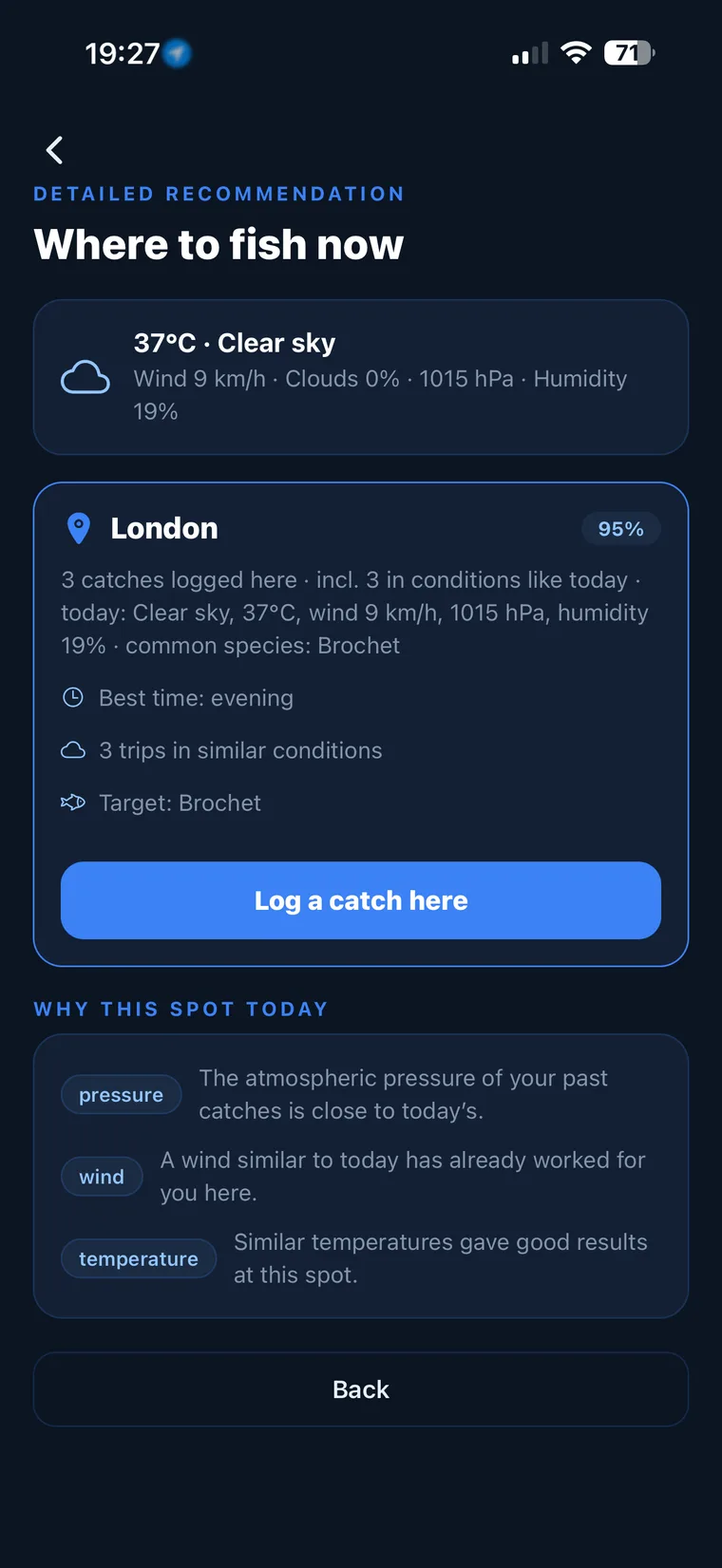
Not sure what to tie on?
Photograph your spot: CarnaFish reads the scene, cross-checks the conditions and gives you the zone, the lure and the retrieve. Free on iOS and Android.
Where it excels, and where it is beside the point
It takes the lead on:
- Small wild trout rivers, cluttered, where you need a lure that swims immediately after the splashdown and within a narrow corridor.
- Riffles and medium currents, where an inline spinner labours and a hard bait lacks the weight to get down.
- Perch along lake margins in clear water, where a chopped, discreet flash works better than a blade churning water.
It is unsuitable:
- For pike. The size is not there, and the fine treble folds on a decent strike.
- For heavily coloured water after a flood. The vibration signal of a compact spoon carries poorly; a large-bladed inline spinner covers better.
- For very long distances. Even at 9.5 g, the compact profile limits range against a longer blade.
Pure, Little Cleo or Miu: three spoons, three jobs
The Acme Little Cleo is a dished, wide spoon, cut to hold hard current fished across and to take pike in the bigger sizes. It moves more water, it falls like a dead leaf, it is fished slowly. It is the tool for powerful rivers and stained water.
The Forest Miu works at the other extreme: trout reservoirs, two grams, a straight retrieve at crawling speed. It lives in calm water.
The Pure fills the gap the other two leave: real current but not violent, wild fish, a fast upstream retrieve. Its argument is neither the volume of water it moves nor extreme slowness, it is the ability to keep a clean action at high speed inside a current line.
If you already fish the Smith D-Contact on the same beats, the two complement each other: the D-Contact works on sharp pulls down in the deep run, while the Pure sweeps the same zone faster on a continuous retrieve. Our guide to river trout fishing goes over how to read the spots this spoon relies on. And if you are unsure which spoon weight to tie on when you arrive on an unfamiliar beat, CarnaFish analyses a photo of the spot and answers.
Key takeaways
- It is fished upstream, retrieving faster than the current: that is its main mode.
- Losing the vibration in the rod tip means losing the action. The fix is to speed up, not slow down.
- A tight roll and a chopped flash inside a narrow corridor: ideal on a cluttered river.
- Weight is set by current-holding, not by casting distance.
- Neither a pike spoon nor a reservoir spoon: this is a trout-river tool.
FAQ
Do you really have to fish the Smith Pure upstream?
It is its most effective mode on a flowing river. You cast upstream, retrieve fast to maintain the vibration, and the lure crosses the spot with the current like prey that has lost its hold. In calm water or on a lake, the classic across retrieve works very well.
What weight for a small stream?
Between 2.7 and 3.5 g. On less than three metres of width, you want a lure that swims from the splashdown and stays high in the column, not one that dives to the bottom between two stones.
Can it be fished with a snap?
Better avoided on the light weights. On a 3 g spoon, a snap is enough to restrict the roll. Tie it direct to the eye or use a fine split ring, and skip the ball-bearing swivel — it does not twist the line.
Is it suitable for pike?
No, not in the common sizes. It is too small and the treble too fine to take a pike's strike. For that species, go for heavier spoons armed accordingly.
What is the difference with a Little Cleo?
The Little Cleo is dished and wide: it moves a lot of water, falls like a dead leaf and is fished slowly across, including in hard current. The Pure rolls tightly and holds its action at high speed, which is what makes it suited to fishing upstream on medium rivers.
Does it catch perch?
Yes, particularly along lake and big-river margins in clear water. Use a 6.5 to 9.5 g model to cast far, and retrieve straight with short accelerations. The brief flash of a small spoon triggers well on wary perch in full sun.
The full trout lure guideSeason-by-season strategy: which family of lure, when, and why.Go from theory to fish
CarnaFish reads your spot from a photo and gives you the game plan: zone, lure, retrieve. Free on iOS and Android.