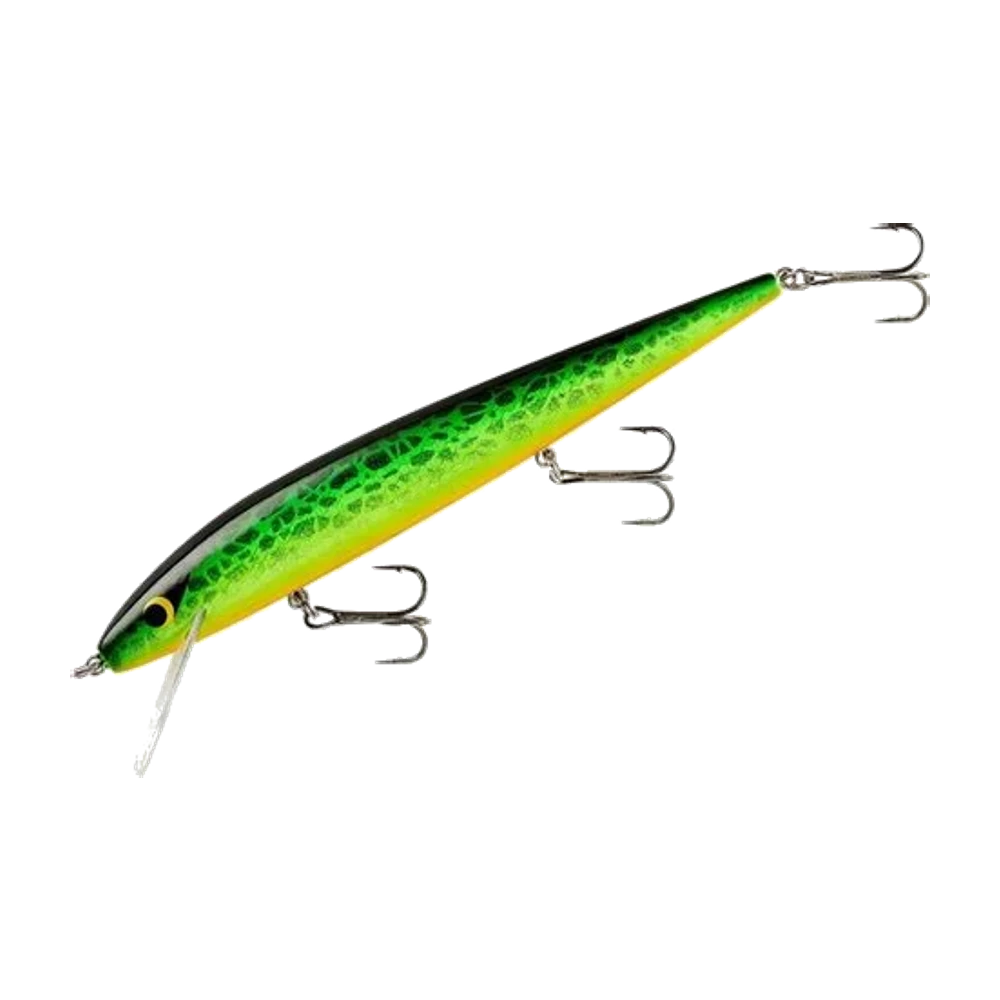
Smithwick Perfect 10 Rogue: a jerkbait that finally reaches 3 metres
Not sure this lure fits YOUR spot today? CarnaFish tells you in 10 seconds, from a photo.
The suspending jerkbait is probably the best cold-water technique there is. It has one structural flaw: almost every model runs between one and two metres. But in February, on a lake or a big river, zander are not sitting at a metre and a half. They are pinned at three metres on a drop-off, and you spend your afternoon flying over them.
The Perfect 10 Rogue is a direct answer to that problem: a longer lip and a reworked mass to reach the 2.5 to 3.2 m layer, while keeping the classic pull-and-pause motion. It is not a deep crankbait — it has neither the vibration nor the path of a crankbait — it is a jerkbait that simply works one storey lower.
That extra metre and a half does not change the lure. It changes the spots you can fish.
What the standard Rogue does not do
The Smithwick Rogue is a slim, light jerkbait from the slender minnow family, working in the first metre and a half. It is excellent at what it does: margins, flats, fish high in the column, shallow water.
The Perfect 10 separates itself on three concrete points.
- A longer, more steeply angled lip, generating a far more pronounced dive angle. The lure reaches its layer in four or five turns instead of two.
- More mass, distributed differently, to offset the pull of the lip and hold a correct attitude at rest.
- Wider, slower lateral darts, a consequence of its size and depth: the lure has more inertia and more water to move.
In other words, this is not an "improved" Rogue. It is the same motion applied to another storey, with a logically heavier action. On high fish or on a small river, the standard Rogue remains the right choice.
Factory tuning: why it matters
A deep jerkbait is far more sensitive to going out of tune than a surface model. The lip works under heavy pressure, and the slightest misalignment sends the lure crabbing: it drifts to one side, rises, and stops holding its depth.
The Perfect 10 is sold tuned, which saves you the eyelet-bending session many anglers dread. But a tuned lure can go out of tune — a fish badly unhooked, a knock on rock armour, or a snap that is too heavy is enough.
How to check. Bring the lure back slowly to two metres in front of you, rod vertical, and watch it. It should swim straight, without pulling off to one side.
How to correct. If the lure pulls right, turn the line-tie eyelet very slightly to the left, and vice versa. An eighth of a turn at a time, no more, with a small pair of pliers. Check after every correction. Three or four iterations almost always do it.
On the water: if your deep jerkbait pulls off to one side, check the snap first, not the eyelet. A deformed or over-heavy snap shifts the axis of pull and produces exactly the same symptom as a lure out of tune — except that here you would be bending an eyelet that was perfectly fine.
The retrieve and the real depth
- Cast long. Maximum depth is only reached over the middle portion of the retrieve: a short cast robs you of the useful zone.
- Four or five firm turns to take the lure down to its layer.
- Two or three sharp pulls, rod tip down and to the side.
- A long pause, keeping the line just taut.
- Start again, never reeling during the pause.
| Water | Pause | Pulls |
|---|---|---|
| 12 to 16 °C | 2 to 4 s | 3, sharp |
| 8 to 12 °C | 5 to 8 s | 2, wide |
| Below 8 °C | 10 to 20 s | 2, slow |
Two levers change the depth: line diameter (0.28 mm gains around 30 cm over 0.35 mm) and rod position. Rod low, tip in the water, you scrape the bottom of the range; rod at 45°, you come up 40 to 50 cm without changing lure — handy when the drop-off rises at the end of the retrieve.
Why zander respond to it
Zander spend most of the year between two and six metres, sitting on or just above a change in the bottom. They hunt upwards, in open water, and react badly to a lure passing too far above them.
The Perfect 10 joins them directly in their layer, with a stillness at rest that is precisely what a cold-water zander wants: it does not rush, it comes and inspects, then inhales. Hence bites that are often very subtle — a weight settling, not a knock.
On pike, the use is more clear-cut: it earns its place when the fish have dropped onto the shelves in midwinter and nothing on the surface or at mid-depth produces a thing.
Not sure what to tie on?
Photograph your spot: CarnaFish reads the scene, cross-checks the conditions and gives you the zone, the lure and the retrieve. Free on iOS and Android.
Colours by turbidity
At this depth, the available light drops fast: a colour that looks obvious in the box can become unreadable at three metres.
- Clear water, over a metre of visibility: perch and roach patterns, translucent flanks, a natural back.
- Moderately coloured water: white and chartreuse, or gold. Gold holds up better than silver when the light falls.
- Heavily coloured water or late in the day: a uniform dark silhouette. At three metres in coloured water, the fish sees a shape, not a pattern.
Perfect 10 or a mid-depth jerkbait
The Bomber Suspending Pro Long A covers the 1 to 1.8 m band with a slimmer profile: it is the tool for high fish, along margins or over flats. The Perfect 10 takes over as soon as the sounder shows fish below two metres.
Against the Megabass Vision 110, the difference is first one of storey and rhythm: the Vision plays on a long glide and a rolling action in the first metre and a half, the Perfect 10 on a heavier dart and a much lower layer.
Our beginner's guide to lure fishing for zander explains how to spot the drop-offs where this technique makes full sense. And if you are unsure which storey to attack when you get to the bank, CarnaFish analyses a photo of the spot and answers.
Key takeaways
- It runs between 2.5 and 3.2 m where a standard jerkbait tops out at 1.5 m.
- Maximum depth is only reached in the middle of the retrieve: cast long.
- It arrives tuned, but check its action after every incident and correct by eighths of a turn.
- A deformed snap imitates a lure out of tune perfectly: check it first.
- Rod position gives you 40 to 50 cm of adjustment without changing lure.
FAQ
How deep does the Perfect 10 Rogue run?
Between 2.5 and 3.2 m depending on line, cast length and rod position. Fluorocarbon of 0.28 mm and a long cast put it at the bottom of the range; rod high and heavy line and you come up half a metre.
Does it need tuning before use?
No, it arrives tuned from the factory. Just check its action two metres in front of you on the first cast, and repeat that check after a difficult unhooking or a knock on the rocks.
How do I correct a jerkbait that pulls to one side?
Check the snap and the split ring first, which are often the culprits. If the problem persists, turn the line-tie eyelet an eighth of a turn against the drift, then check again. Repeat until it swims straight.
What is the difference with the standard Rogue?
The standard Rogue is lighter and works in the first metre and a half. The Perfect 10 has a longer lip, more mass, and targets 2.5 to 3.2 m with a logically heavier and slower action.
How long should the pause be for zander?
2 to 4 seconds in temperate water, 5 to 8 seconds between 8 and 12 °C, and up to 20 seconds in midwinter. Zander bites on the pause are often just a weight settling: set the hook at the slightest doubt.
Can it be used with a snap?
Yes, with a light snap that is not deformed. A heavy one weighs down the front, makes the nose dip at rest and can be enough to send the action off line — it is the main cause of apparent detuning on this kind of lure.
The full zander lure guideSeason-by-season strategy: which family of lure, when, and why.Go from theory to fish
CarnaFish reads your spot from a photo and gives you the game plan: zone, lure, retrieve. Free on iOS and Android.