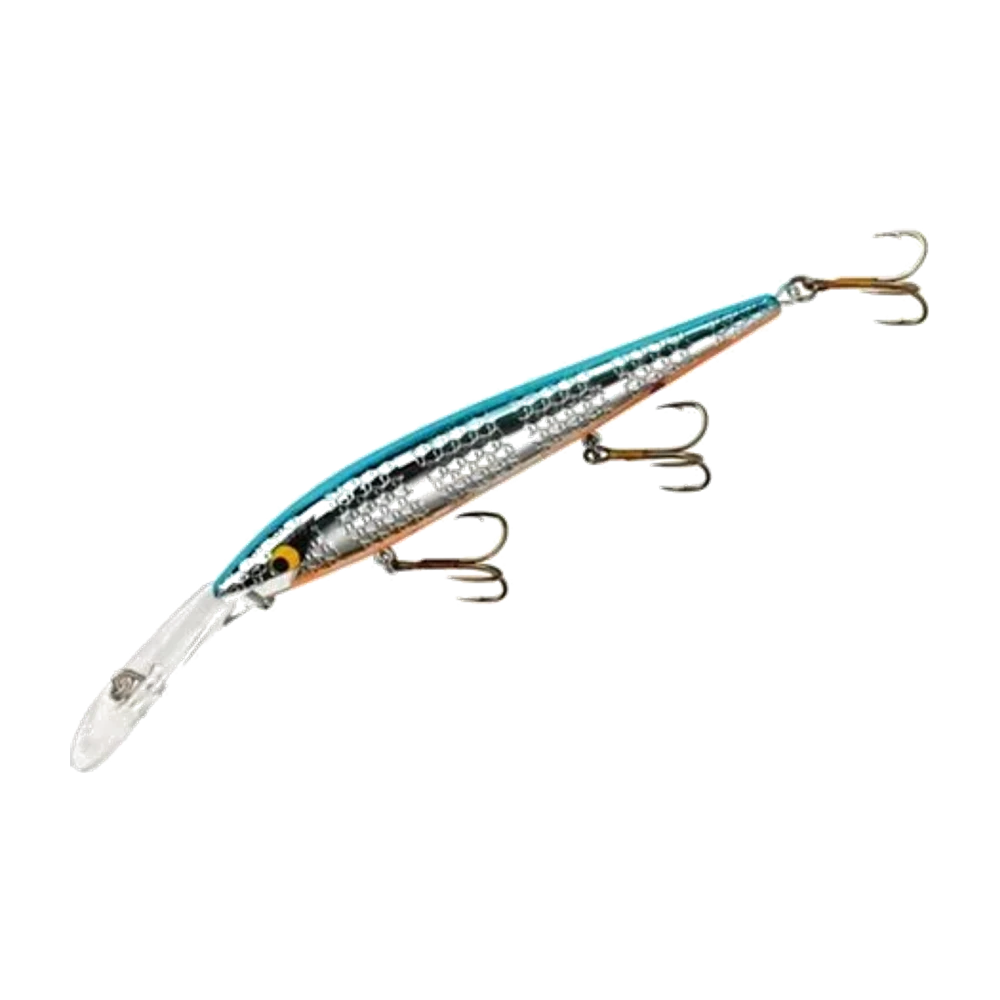
Smithwick Rogue: the jerkbait you tune yourself
Not sure this lure fits YOUR spot today? CarnaFish tells you in 10 seconds, from a photo.
You have almost certainly lived this: the fish is there, you can see it on the sounder or you know it is sitting on a drop-off, it is holding at one metre eighty, and your "suspending" jerkbait runs thirty centimetres too high every single cast. Thirty centimetres, on an inactive zander in February, is a fish that does not move.
Most premium jerkbaits are tuned at the factory, to the finest margin, for one water temperature and one line. When that does not match your water, there is nothing you can do: the lure is what it is.
The Rogue belongs to another school. It is a raw jerkbait, deliberately unsophisticated, that you tune yourself. Its reputation does not come from perfect neutral buoyancy out of the box, but from the fact that you modify it — with lead tape and a change of hooks — to suit your water. It is a tool you finish, and that is what makes it interesting.
A long body built for width
The Rogue is an elongated jerkbait with a fairly round cross-section and a short lip. That shape produces a distinctive action, quite different from flatter Japanese jerkbaits.
The side dart is wide rather than sharp. On the jerk, the lure swings a long way to the side and rolls hard onto its flank. Where a flat jerkbait gives two brief flashes, the Rogue gives a longer, more spread-out flash that shows from a distance in slightly stained water.
The long body stretches the profile without adding bulk. Facing a pike that has refused several 10 cm lures, going up to 12 or 13 cm changes the way it reads: longer, but still slim.
The short lip limits depth. The Rogue works the top layer, typically between one and two metres. That is not a flaw: it is the band where most of the action happens on pike hugging the margins and on zander that have moved up to feed.
The retrieve: two jerks, then count
The rhythm is classic in principle, but the Rogue takes really hard jerks better than most.
- Cast and reel three or four turns to bring the lure down to its running depth.
- Give two firm jerks, rod tip pointed at the water, working from the wrist and forearm. The lure should swing well out to one side, then the other.
- Give line back immediately by pushing the rod tip forward during the glide. Keep the line tight and you choke the dart.
- Pause, actually counting the seconds.
- Start again without snatching the slack back: one slow turn of the handle to come tight, then the next two jerks.
Pause length is set by activity, not by temperature alone:
| Context | Pause | Number of jerks |
|---|---|---|
| Active pike, water above 14 °C | 1 to 2 s | 2 to 3 |
| Zander feeding at dusk | 2 to 3 s | 2 |
| Cold water, fish sitting tight | 6 to 12 s | 2, very sharp |
| Fish following without taking | 0.5 s then a dead stop of 8 s | 4 fast ones |
On the water: on the Rogue, the quality of the dart depends on the slack you give, not on how hard you jerk. Push the rod tip twenty centimetres forward right after the stroke. An angler who pulls hard while staying tight gets a lure that travels in a straight line — exactly the opposite of what he wants.
Tuning with lead tape: the real skill
This is the heart of the matter with this lure. A standard Rogue floats or rises slowly on the stop. You are going to make it neutral, or very slightly sinking, to suit your water.
What you need: a strip of thin lead tape (the kind used for wheel balancing or lure tuning), scissors, a bucket of water.
The method:
- Rig the lure with exactly the line you will fish. A 0.35 mm fluorocarbon pulls the nose down, a fine braid weighs nothing: the tuning is only valid for one given setup.
- Drop it into a bucket filled with water from the venue, not tap water at 20 °C. Density changes with temperature.
- Add pieces of lead a few millimetres long under the belly, between the two trebles, edging progressively towards neutral.
- Aim for almost no rise, or a drop of a few centimetres in ten seconds depending on what you want.
- Mark the amount of lead on the belly with a pen so you can repeat it on your other examples.
There is a second lever: changing the trebles. A model one step heavier distributes the load differently, useful for keeping the lure horizontal on the stop.
Where it wins, and where it disappoints
The Rogue is built for cold to temperate water and readable spots.
- Edges of dying weed beds in late autumn, on pike sitting in ambush.
- Drop-offs and river breaks, running the lure parallel to the slope.
- Zander up on the flats at dusk, in one to two metres of water.
- Slightly stained water, where its strong roll stays visible when a discreet jerkbait disappears.
Conversely, it is a poor fit for very clear, heavily fished water. Its wide action and hard roll make a strong signal: on a fish that has seen everything, that is usually too much. It also has little to offer beyond two metres — a long-lipped jerkbait covers those layers better. And its rough factory tuning is a drawback if you do not want to tinker: straight out of the box, it will not do what a factory-tuned model does immediately.
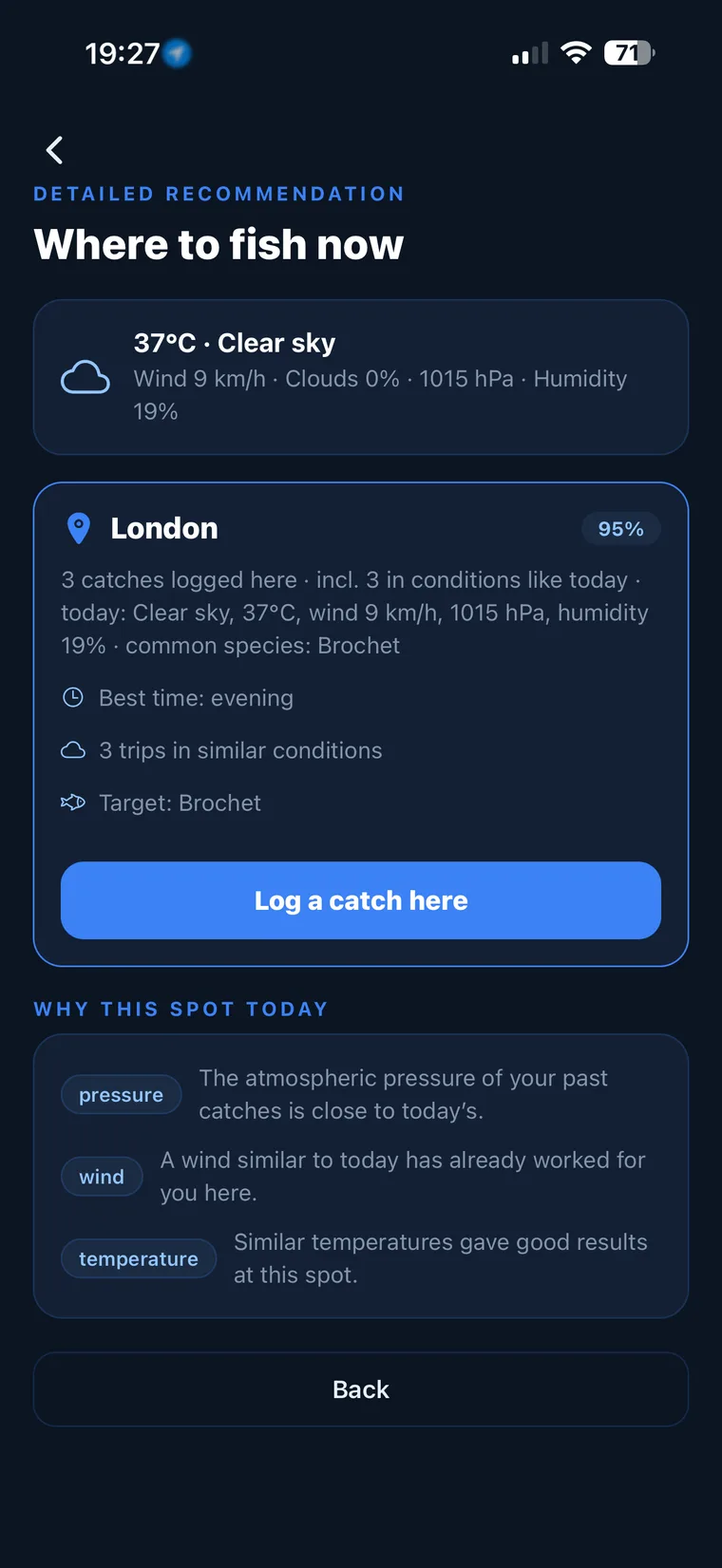
Not sure what to tie on?
Photograph your spot: CarnaFish reads the scene, cross-checks the conditions and gives you the zone, the lure and the retrieve. Free on iOS and Android.
Rogue or a factory-tuned jerkbait
That is the only question that matters when you choose. The Lucky Craft Pointer 100 arrives ready: neutral buoyancy to the finest margin, a sharp dart, a clean dead stop. You take it out, you fish, and it does exactly what it was designed for — provided your water resembles the water it was tuned for.
The Rogue asks for half an hour of work before its first outing, but then gives you something the other cannot: the same lure tuned differently in three boxes, one slightly floating for summer over the weed, one neutral, one slightly sinking for deep winter. That is an adjustment mindset, not plug and play.
In the same vein, the Bomber Long A offers a close action with a slightly narrower body. Our beginner's guide to zander fishing with lures puts the jerkbait back in context among the other cold-season approaches. And if you are unsure what depth to target when you arrive at a drop-off, CarnaFish analyses a photo of the spot and answers.
Rigging for pike
As soon as pike are present, a supple steel or titanium leader of 20 to 25 cm is essential. It adds a little weight up front: fit it at the bucket stage so the tuning accounts for it.
For zander only, in clear water with no pike about, 0.30 to 0.35 mm fluorocarbon is enough and preserves the width of the dart better.
Key takeaways
- A raw jerkbait you finish yourself: tuning with lead tape is the central skill.
- Always tune with the real line and water from the venue, never tap water.
- Wide dart and strong roll: a long flash, visible in slightly stained water.
- Give slack right after the jerk, otherwise the lure runs straight instead of darting.
- Too showy in very clear, heavily fished water, pointless beyond two metres.
FAQ
Is the Smithwick Rogue really a suspending lure?
Not as it comes on most versions: it rises slowly on the stop. That is exactly the point of the model, because you tune it with lead tape to get the precise buoyancy you want, in your water and with your line.
How do you tune a Rogue with lead tape?
Rig it with the line you will fish, drop it into a bucket filled with water from the venue, then add small pieces of lead under the belly between the two trebles until it barely rises at all. Note the amount with a pen so you can repeat it.
How deep does it run?
Between one and two metres depending on the version and the line used. Its short lip confines it to the top layer: beyond two metres, a long-lipped jerkbait makes more sense.
Do you need a steel leader?
Yes, as soon as pike are present — 20 to 25 cm of supple steel or titanium. Fit it before you tune the lure with lead, because it adds a little weight up front and changes the buoyancy.
How long should the pause be?
One to two seconds on active fish, two to three on feeding zander, and six to twelve seconds in cold water on fish sitting tight. Lengthening the pause is almost always the right correction when fish follow without taking.
How does it differ from a premium Japanese jerkbait?
The Japanese model arrives tuned to the finest margin and gives a sharper dart with a cleaner dead stop. The Rogue is wider, showier, less precise as it comes, but you can tune several examples differently to cover three situations.
The full pike lure guideSeason-by-season strategy: which family of lure, when, and why.Go from theory to fish
CarnaFish reads your spot from a photo and gives you the game plan: zone, lure, retrieve. Free on iOS and Android.