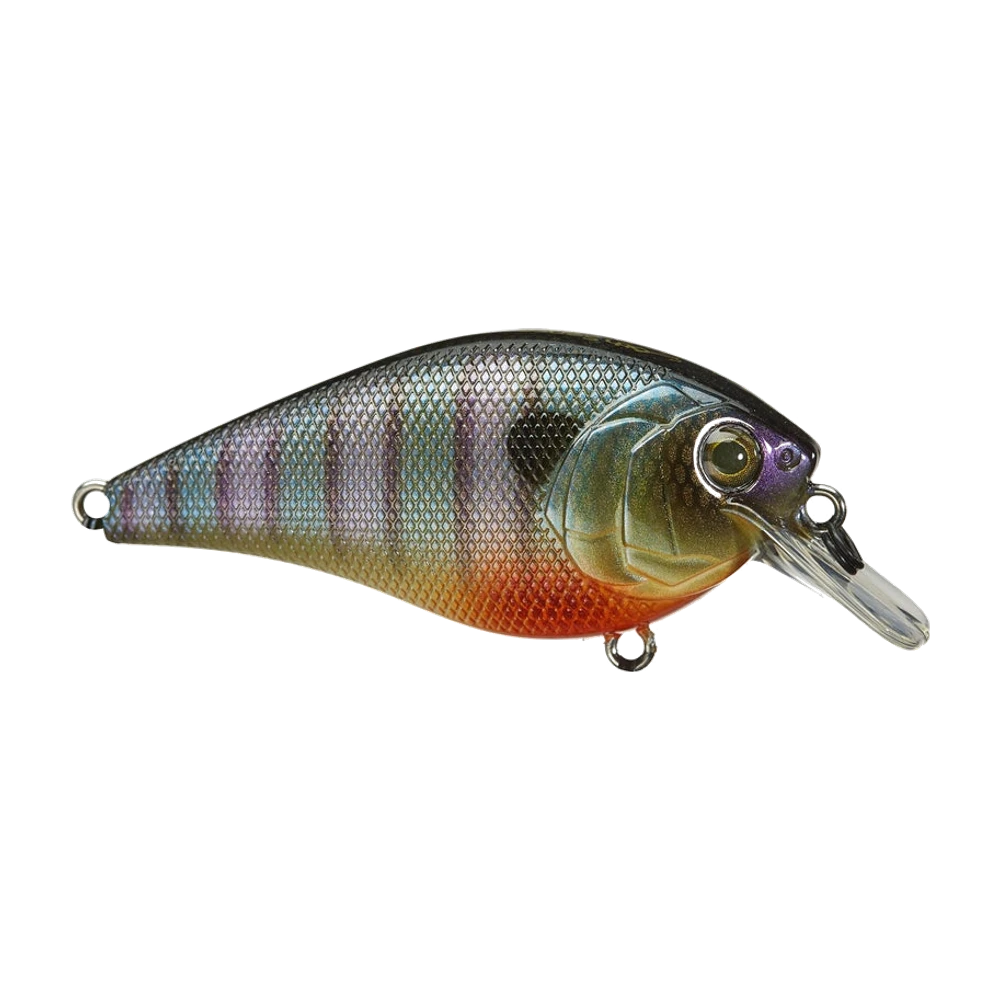
6th Sense Crush Squarebill 50X: the compact crank for flooded timber
Not sure this lure fits YOUR spot today? CarnaFish tells you in 10 seconds, from a photo.
A shoreline choked with stumps, 80 cm (two and a half feet) of water, a crosswind pushing milky water against the bank: that's the exact scenario where a square-billed crankbait outfishes everything else in the box. Not because it swims better, but because it goes looking for the bite where a smooth-nosed lure won't dare. The 6th Sense Crush Squarebill 50X is built for it — 5.7 cm, 10.5 g, wide bill, a body that floats high. The rest is knowing how to fish it without leaving half your box in the wood.
Built to hit things, not avoid them
The square bill isn't there to get deep. With a stated running depth of 0.6 to 1.5 m (2-5 ft), the 50X is a shallow-water tool and makes no apology for it. The bill does something else: on contact with a branch or a rock it kicks the nose up and bounces the lure sideways instead of burying it. That violent deflection — the lure veers off for 20 cm, then recovers its swim — is the real trigger. A bass sitting against a stump won't track a lure for three metres; it reacts to something unpredictable 30 cm from its nose.
The body is deliberately very buoyant, and that has two practical consequences. First, the instant you stop reeling the lure rises rather than wedging under the obstacle, which gets you out of a good share of snags without pulling. Second, that buoyancy exaggerates the rise after each deflection, and the rise is very often where the strike lands.
6th Sense hid a faint rattle chamber inside the body. Don't expect the loud clatter of a lipless: it's a light knock, a close-range signal rather than a long-distance call. On pressured fish — a pond fished every weekend, a reservoir in midsummer — that restrained noise level sits better than a lure announcing itself from ten metres out.
Three speeds, three different kinds of fishing
The same lure does three jobs depending on the speed you impose on it, and mixing the three up is the number one reason anglers blank on a squarebill.
In timber and on rock, reel at a medium clip with the rod low and hunt for contact. Every time it ticks something, give it half a second of slack. This is a feel game: you have to sense the obstacle in the handle before you decide what to do.
In sparse grass or emerging pads, you either run over the top or rip through. Firmer retrieve, and when the lure loads up with weed a sharp snap of the rod tip cleans it. A squarebill takes that treatment far better than a long-billed crank, which lies over and blows out.
In open water, over a shallow flat or along a riprap bank, you can burn it. A fast retrieve flattens the wobble into something tighter and buzzier, and it's an excellent way to cover a hundred metres of bank to find active fish before coming back through more slowly.
The rigging that lets the lure work
Like any billed crankbait, the 50X loses amplitude if you cinch the knot straight to the eye. A loop knot or a small quick-snap leaves the nose free and the deflection gets its snap back. Main line depends on the cover: in dense wood, braid lets you pop a stuck lure free; over clean rock in clear water, 25-30/100 (10-12 lb) fluorocarbon is more discreet and, being denser, lets the lure run a touch deeper.
The factory size 4 black nickel trebles are good hooks. If you fish genuinely filthy wood, plenty of anglers drop the front treble one size: fewer points to grab branches, and the lure frees itself more often on its own.
The habit that changes your bite count: never retrieve a squarebill in a straight line out away from the cover. Cast it deliberately into the obstacle, 30 cm short rather than 30 cm long. A squarebill that touches nothing on a full retrieve is a squarebill that was badly cast.
When and where it takes over
This is a spring and autumn lure above all. In prespawn, when bass push up onto the first rocky banks and the water sits around 12-14 °C (54-57 °F), deflection off rock triggers reaction strikes even from fish that aren't really feeding. In autumn, when the forage stacks up on the banks, the fast open-water version becomes brutal.
Summer keeps it useful but in narrow windows: first light, last hour, and above all on windy days that chop the surface and pin fry against a bank. Under hard sun on flat water you're better off on something slow and soft.
In Europe the 5.7 cm size also opens the door to perch, especially along gravel-pit banks in autumn. It is not a pike lure, though: too small, too light, and without a suitable leader you'll lose it on the first bite.
The classic mistake
Trying to fish a squarebill deep. You regularly see anglers lengthen the cast and slow down hoping to steal another metre of depth — it doesn't work, the bill geometry caps the running depth. If you need 2.5 m, pick a round-billed crank or something deeper like a Strike King 3XD. The 50X owns the 0.5 to 1.5 m band, and nothing beyond it.
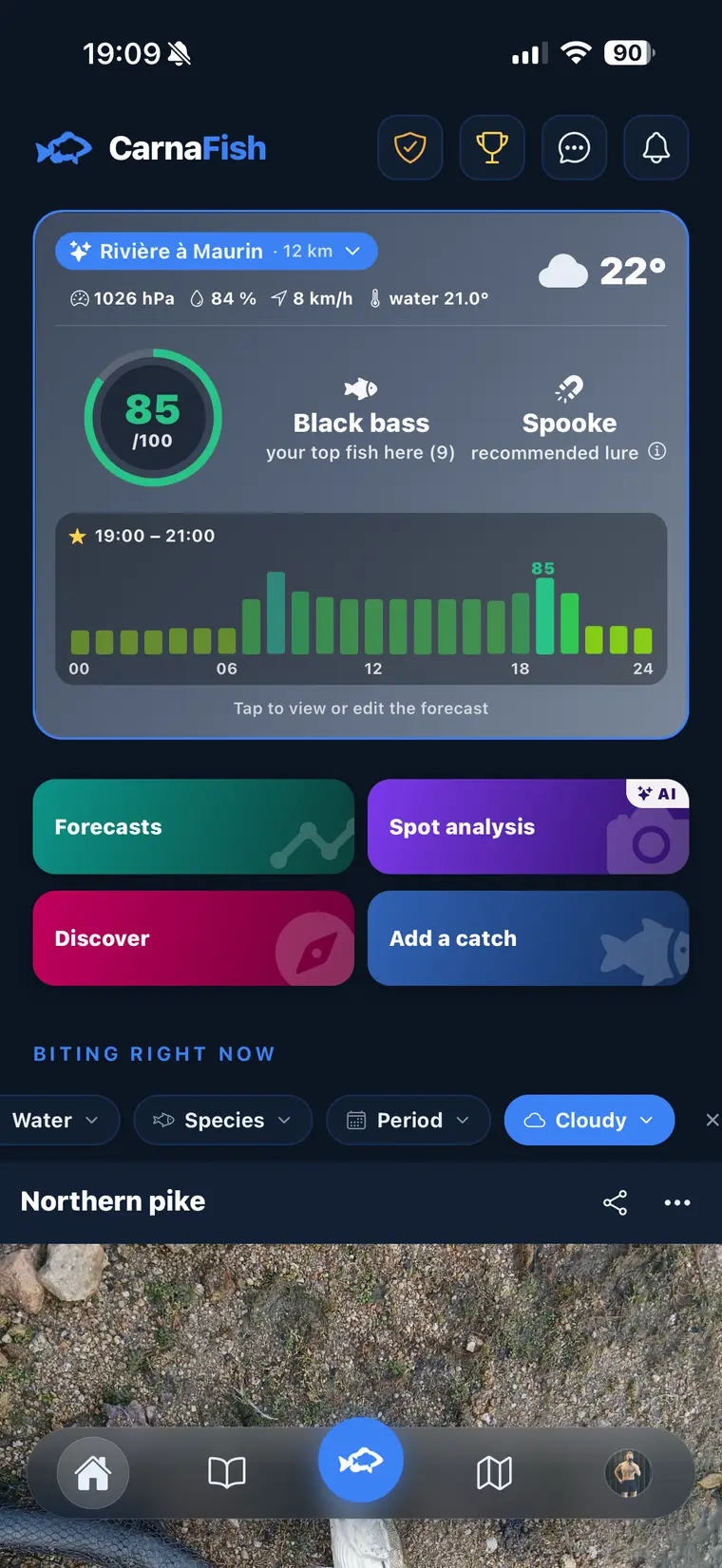
Not sure what to tie on?
Photograph your spot: CarnaFish reads the scene, cross-checks the conditions and gives you the zone, the lure and the retrieve. Free on iOS and Android.
Colors by water clarity
- Clear water: a blue back with silver flanks, imitating a baitfish fry without throwing back too much light. The default on gravel pits and clear reservoirs.
- Spring, cold water: a red or brown-orange craw pattern. At that time of year bass are on crayfish, and red works over rock even in moderately clear water.
- Stained or milky water: black-back chartreuse, the most readable contrast once visibility drops under 50 cm.
One squarebill among the genre's benchmarks
The Crush 50X doesn't reinvent the family. Against a Strike King KVD 1.5 Squarebill, the historical reference, it plays the same game with a slightly stubbier body and a higher level of finish (3D eyes and gill plates, raised scaling). Against a Bomber Square A, older and cheaper, it offers more pronounced buoyancy that helps it climb out of wood. And if you want more bulk for the same job, a SPRO Fat Papa pushes more water. None of these make the others redundant: they're shades of volume, noise and buoyancy to match to the spot.
Picking the right squarebill is worthless if you throw it in the wrong place, which is precisely where CarnaFish comes in: photograph the water and the AI hands you the zone, the depth and the lure family that match today's conditions. For the groundwork on gear and spot types, our beginner's guide to bass fishing covers the rest of the box.
The short version
- Unapologetically a shallow lure: 0.6-1.5 m, and no amount of extra casting distance will change that.
- Its value comes from deflection off cover, not from a straight retrieve — you have to make it hit things.
- Marked buoyancy makes it rise on the pause, which cuts snags and draws a lot of strikes.
- Faint rattle: an advantage on pressured fish, a drawback if you need to call fish from a distance in dirty water.
FAQ
How deep does the Crush Squarebill 50X run?
Between 0.6 and 1.5 m (2-5 ft) depending on cast length and line diameter. It's a shallow tool: if your spot needs 2 m or more, change lure families rather than forcing this one.
Should I retrieve it fast or slow?
Both, depending on cover. Medium speed with pauses in wood and rock to cash in on deflections, fast retrieve in open water to cover ground and locate active fish.
Does the 50X work for perch?
Yes, the 5.7 cm size interests good perch, especially along gravel-pit banks in autumn. It is not a pike lure, however: too light and not armed for it.
Why does my squarebill snag so much?
Usually because it's being retrieved too slowly on contact. A squarebill frees itself through speed and buoyancy: when you feel the obstacle, give it half a second of slack so it can rise, don't pull.
What knot should I use?
A loop knot or a small quick-snap. A knot cinched straight to the eye chokes the bill and noticeably reduces deflection amplitude, which is the whole point of the lure.
What's the difference with a round-billed crankbait?
The square bill deflects and rises on contact; the round bill goes deeper and swims more evenly. The squarebill is the tool for shallow, cluttered cover, the round-billed crank the one for drop-offs and flats in the 2-5 m range.
The full bass lure guideSeason-by-season strategy: which family of lure, when, and why.Go from theory to fish
CarnaFish reads your spot from a photo and gives you the game plan: zone, lure, retrieve. Free on iOS and Android.