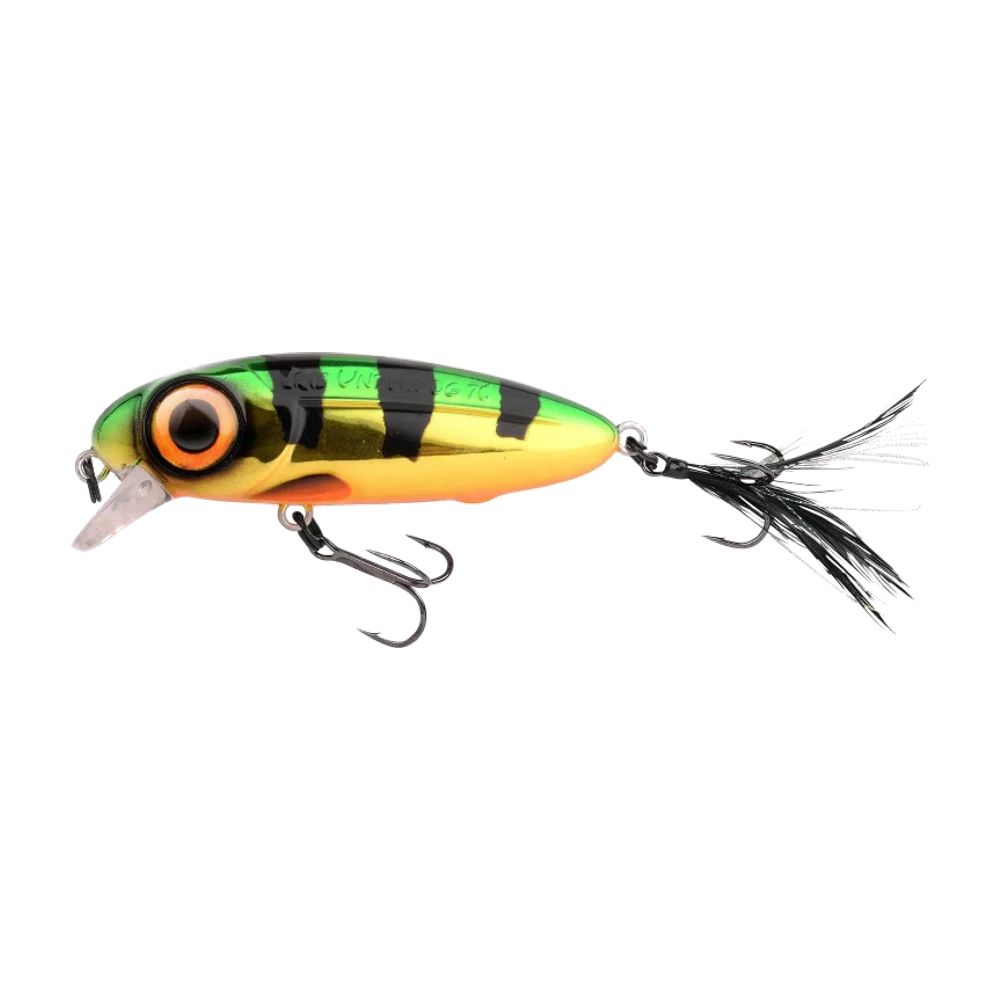
SPRO Iris Underdog: the short glide for tight spots
This lure shines under specific conditions. CarnaFish tells you in 10 seconds if today is one of them.
A canal twelve metres wide, or a cluttered margin between two jetties. You tie on a glidebait, and by the third cast you see the problem: the lure swings so far to the side that it leaves the useful zone on the very first impulse. It glides into empty water, or it ends up pinned against the far bank.
The width of a glidebait is not always an advantage. On open water, a metre of glide creates a spectacular path that pulls fish in from a distance. On a tight spot, that same glide loses you contact with the zone the pike is holding in.
The Iris Underdog answers that through its construction: it is a one-piece glidebait, with no joint. The body does not fold at the end of the stroke, so it does not extend the glide. The S it produces is short and sharp, with a clean turn — and that is exactly what you want when you have to keep the lure inside a three-metre corridor.
One-piece against jointed: what the missing hinge changes
On a two-segment glidebait, the rod impulse sends the head out to the side and the tail follows with a slight delay. That lag extends the run: the lure keeps drifting after the energy of the stroke has died away. Hence the long, soft glides you look for on big open water.
Without a joint, the Iris Underdog loses that extension and gains something else:
- A shorter run, of the order of 30 to 50 cm per impulse depending on size and stroke, against double that on a wide jointed bait.
- A crisper change of direction. The rigid body tips over as one piece: a clean break in direction rather than a curve.
- An immediate response to the rod, with no dead time between impulse and movement.
- Fewer tangles. No hinge, so no segment coming round to catch the front treble on the drop — the classic flaw when you force the cadence on a jointed bait.
The trade-off is honest: it will never produce the theatrical drift of a big jointed bait, and on a large expanse where you need to call from a distance, it is less convincing.
The retrieve: short cadence, no dead time
The commonest mistake is to apply the slow rhythm of a big glidebait to this lure. The result is a lure that stops between every stroke and loses its point.
- Cast and let it sink for as long as the depth of the spot calls for, counting the seconds on a semi-tight line.
- Give a short rod-tip impulse, downward and slightly to the side, over 20 to 30 cm of rod travel. Not a big sweep of the arm.
- Give the slack back immediately by pushing the tip towards the lure while it glides. Without that slack it stops dead after ten centimetres.
- Take the slack up on the reel — half a turn to a full turn of the handle — while you bring the tip back into position.
- Link the strokes every one to two seconds, without pausing, to get a continuous zigzag path.
Two variations that pay. On a following fish, break the cadence: two very closely spaced impulses, then a three-second stop during which the lure sinks while drifting. In cold water, lengthen the pauses to four or five seconds, letting the lure sink between two glides.
On the water: on a short glide, it is the length of slack line you give, not the force of the stroke, that sets the width. If you want to widen the S, push the rod tip ten centimetres further forward instead of pulling harder. Pulling harder only lifts the lure out of the water or rolls it onto its flank.
Setting size and depth
| Approximate size | Indicative weight | Use |
|---|---|---|
| 10 cm | 25 to 30 g | Canals, small ponds, average pike, very clear and pressured water |
| 12 cm | 40 to 50 g | The all-round format: river margins, weed beds, gravel pits |
| 15 cm | 70 to 80 g | Big pike, searching on lakes, wind, stained water |
On the sinking versions, reckon on roughly one second per 30 to 50 cm of fall. On a spot with 2.5 m of water, five to six seconds put you in the lower half of the column: often the right starting point at the beginning and end of the season. In summer on pike in the margins, two seconds is enough.
Where it wins — and where not to take it
Its window is that of confined spaces and close fish:
- Canals, backwaters, small rivers where the useful width is no more than a few metres.
- Cluttered margins: between jetties, along a wall, on a narrow strip of weed you have to follow without straying from it.
- Fish already located, seen or marked, when you want to come through the same place several times without sweeping wide.
- Bank fishing, where you do not have a boat's freedom of placement and every cast has to stay useful over its whole run.
It is a poor choice, on the other hand, for searching a large expanse: its short run covers little ground per cast and its signal does not carry far enough. It is also a poor fit beyond 3 or 4 m, where a lure designed to hold the lower layer does the job better.

Not sure what to tie on?
Photograph your spot: CarnaFish reads the scene, cross-checks the conditions and gives you the zone, the lure and the retrieve. Free on iOS and Android.
Tackle: the point beginners overlook
A compact glidebait is still a heavy lure worked in strokes. Three requirements:
The rod. A medium-heavy of 2.10 to 2.30 m whose tip takes the stroke without bouncing. A rod that is too soft absorbs the impulse and kills the change of direction.
The leader. Titanium or steel, with a round clip: a right-angled clip restricts the way the body tips over and clearly reduces the width.
The drag. Set moderately. Bites often come on the stop, on slack line, and a locked drag on a close-range strike loses more fish than it holds.
Iris Underdog or a wide glidebait
The Deps Slide Swimmer 250 is its exact opposite: over a metre of glide per stroke, a weight that demands dedicated tackle, and a wide-searching logic for big lakes. The Megabass i-Slide sits in between, with a wide S aimed at converting followers on open water. The Iris Underdog does not compete with them: it covers the situation where those two are too bulky or too wide for the spot.
The Savage Gear 3D Bleak Glide Swimmer is the closest in size, but its joint gives it a longer, softer glide — easier for a beginner to produce, less incisive in a narrow corridor. If you are new to glide baits, start with the jointed one; if you mostly fish canals and margins, the Underdog will serve you better.
Our guide to choosing a pike lure sets out how this kind of lure fits into a season. And if you are unsure how wide a glide suits a given margin, CarnaFish analyses a photo of the spot and answers.
Key takeaways
- A one-piece body: the glide is short (30 to 50 cm) and the change of direction crisp, where a jointed bait extends the run.
- Width is set by the length of slack you give, never by the force of the stroke.
- A close cadence of one to two seconds, without pauses, for a continuous zigzag.
- A lure for tight spots and close fish: canals, margins, bank fishing.
- Not very effective for wide searching or beyond 3 to 4 m of water.
FAQ
What is the difference between a one-piece and a jointed glidebait?
The joint extends the glide: the tail follows the head with a delay that lengthens the run. A one-piece bait tips over as a block, gives a shorter S and a crisper turn, and responds instantly to the rod. The first covers more ground, the second stays in a narrow corridor.
How long should you let it sink before working it?
Reckon on roughly one second per 30 to 50 cm of fall depending on the size of the model. On a spot of 2.5 m, five to six seconds put you in the lower half of the column. In summer on fish in the margins, two seconds is plenty.
Why does my Iris Underdog barely glide?
Almost always because you are not giving enough slack after the impulse. The lure glides as long as the line is slack and stops the moment it comes tight. Push the tip towards the lure during the glide instead of pulling harder on the stroke.
Do you need a steel leader for this lure?
Yes. It is a pike lure that gets taken across the body, and fluorocarbon, even in a heavy diameter, eventually gives way. Add a round clip rather than a right-angled one, which restricts the way the body tips over and reduces the width.
What size should I start with?
The middle format around 12 cm: light enough to cast with a standard medium-heavy rod, bulky enough to interest good-sized pike. The 15 cm calls for heavier tackle and mainly earns its place when searching or in wind.
Can it be fished in open lakes?
Yes, but that is not where it is at its best. Its short run covers little ground per cast, which makes it slow for searching. On a lake it regains the advantage on a fish you have already located, when you need to come through the same precise place several times.
The full pike lure guideSeason-by-season strategy: which family of lure, when, and why.Go from theory to fish
CarnaFish reads your spot from a photo and gives you the game plan: zone, lure, retrieve. Free on iOS and Android.