SPRO Megalojohn: the soft swimbait with a magnet-held harness
One lure, endless conditions. CarnaFish reads your spot from a photo so you are not just guessing.
The real problem with big soft swimbaits was never the swim. It's the hookset. Bury the point in the back to make the bait weedless and you stick one fish in three. Hang a treble freely under the belly and it fouls the bait on every cast. The Megalojohn, designed by John Crews for SPRO, resolves that dilemma with a simple mechanical answer, and that is the only real subject of this bait.
A magnet in the belly, and a harness that lets go at the right moment
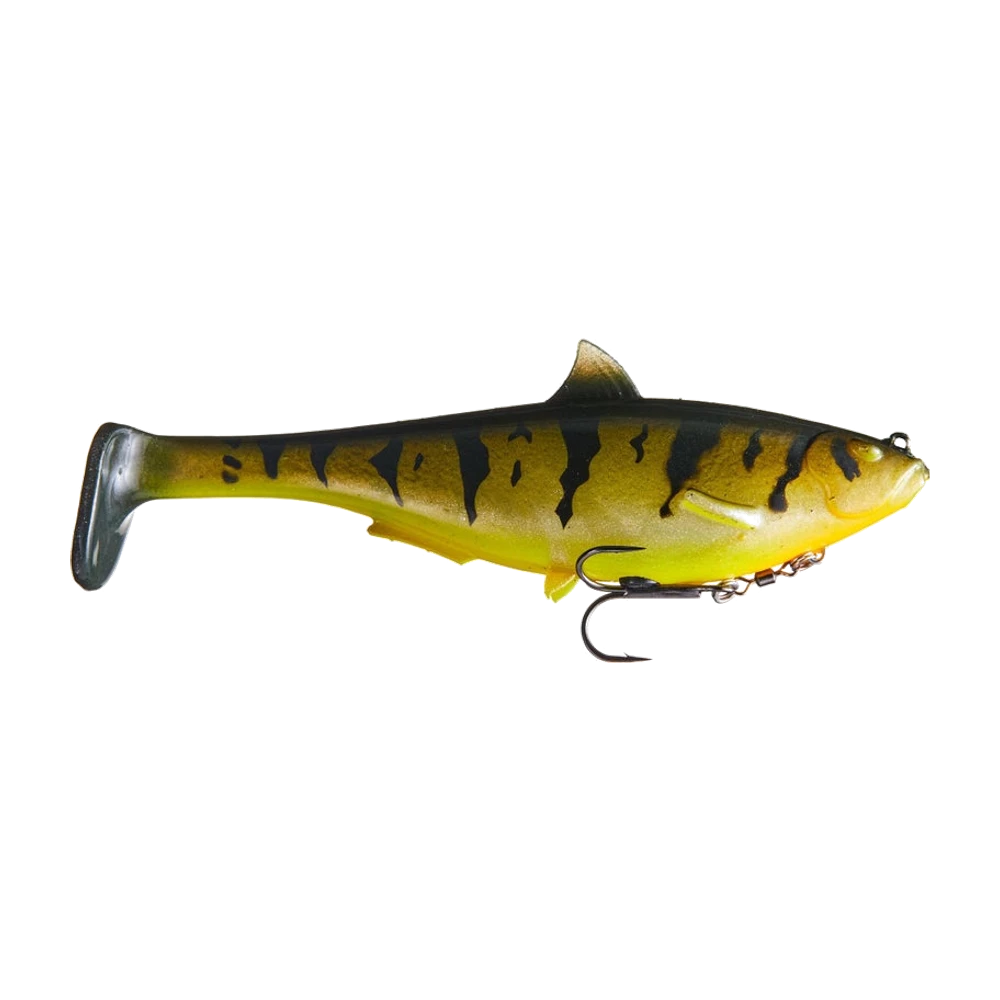
SPRO states the build as follows: a wire harness runs through the inside of the bait and connects to a SPRO split ring, then a barrel swivel, then a size 2 black nickel Gamakatsu treble. So far, that's a conventional swimbait harness. The difference is a hook keeper magnet moulded into the belly: it holds the treble flat against the body without anyone having to push the point into the plastic.
The consequence is twofold. On the cast and the retrieve, the treble stays tucked along the belly and doesn't foul the bait. On the hookset, the fish rips the treble off the magnet: the hook is then free, linked to the body only by the swivel and the harness. SPRO explains that this freedom cuts the leverage a fish has to throw the hook, and the argument stands up — a treble fixed rigidly to a fifteen-centimetre body gives a fish a mass to shake against, whereas a treble hanging on a swivel gives it nothing to work with.
In the product photo this build is in place and perfectly visible: black treble, barrel swivel, split ring and the harness exiting under the belly. It's one of the rare baits in this batch photographed fully rigged.
Check the magnet's grip as soon as you unwrap it, dry. Lay the treble along the belly and shake the bait. If it holds, you can cast without thinking about it. If it drops off by itself, you'll have to reset the treble after every cast — not a deal-breaker, but better to know before you're on the water at dawn.
The numbers, and a weight to take seriously
The maker's table stops at two columns here: 6 in, which is 15.2 cm, and 1-3/4 oz, roughly 50 g.
That figure deserves a pause. Fifty grams on fifteen centimetres is very dense for a soft swimbait; plenty of baits that length sit between 25 and 35 g. SPRO offers a single size, so there's no internal progression to cross-check the value against, and no buoyancy class or running depth is published. Take the order of magnitude rather than the decimal: this is a heavy bait, well past the comfortable casting weight of an all-round rod.
In practice you need a heavy rod of 2.10-2.30 m rated to at least 60 g, a baitcaster with a properly set brake, and 0.30-0.40 mm braid with a heavy fluorocarbon leader. This isn't a bait you slip into the box for an all-purpose day: it's a dedicated outfit.
With no class stated, the behaviour can be deduced without being guessed: at that density the bait sinks. The maker aims it at open-water, mid-column fishing anyway, which obviously implies a descent. But no sink rate is published, so run your own count-down on the first cast and write it down.
Very soft plastic: what it gives, what it costs
SPRO stresses how soft the plastic is and draws two effects from it. First a clean, dull tail thump, because a soft tail on a thin hinge works at low speed. Second, and this is the interesting part, a tail that folds away easily when a bass engulfs the whole bait: nothing levers against the jaw, and the treble goes where it should. The maker also describes moulded fins that quiver slightly as the bait swims.
The price is obvious and should be stated. Very soft plastic tears faster. On pike water three strikes are enough to open a flank, and you can't swap the body alone as you can on a Keitech Fat Swing Impact 4.8 rigged on a jighead. Count this bait as a consumable, not as equipment.
Where to fish it
The maker targets open water: docks, sea walls and vertical riprap, and mid-column fishing with forward-facing sonar. That last mention tells you a lot about the intended use: mark a fish, send the bait to it, let it drop to its level, then retrieve slowly past its nose.
In Europe the same logic applies on a reservoir or a deep gravel pit, with an added bonus: fifteen centimetres and a dull thump is exactly a pike profile. On that kind of water a leader isn't optional, and a perch finish like the one in the photo makes complete sense.
The classic mistake
Working it with the rod. This isn't a shad to be twitched: its tail starts on the first turns of the handle, and a rod stroke only breaks the rhythm of the thump and pops the treble off its magnet for nothing. Retrieve straight, slowly, and let the tail work. If you want to provoke, do it with a clean pause and a restart, not with a jerk.
Not sure what to tie on?
Photograph your spot: CarnaFish reads the scene, cross-checks the conditions and gives you the zone, the lure and the retrieve. Free on iOS and Android.
Where it sits among other swimbaits
The Megalojohn's niche is the ready-to-fish soft swimbait with a belly treble, as opposed to a swimbait rigged on a jighead. That's the same family as the Megabass Magdraft, with a different approach to holding the hook. The advantage over a jighead is the hook-up rate on side-on strikes; the drawback is that you can't change the weight, and therefore can't change the sink rate.
If you want a lighter, more adjustable and cheaper-to-run presentation, a paddle tail on a jighead stays more flexible. If you're after a bait that sticks the fish that follow and nip, this is where you look.
Colour by water clarity
- Clear water, perch-rich lakes: the perch pattern photographed here, golden black-barred flanks over an orange-yellow belly. On a lake where perch are the main forage, it's the first pick.
- Lightly stained water: a silver roach with a grey-green back, more neutral, which works anywhere when you don't know the dominant forage.
- Dirty water or low light: a solid black back. In open water a fish sees the bait from below, against the light — silhouette matters more than detail.
A 50 g swimbait isn't thrown at random: it requires knowing what depth and what kind of structure the fish are holding on before you even rig the rod. That's exactly the service CarnaFish provides: a photo of the spot, and the app suggests a zone, a depth and a lure family suited to the conditions. And if your water holds pike, our guide to choosing a pike lure rounds out the leader and size questions.
Key takeaways
- 15.2 cm for a stated 50 g: a high density for a soft swimbait, which demands a dedicated heavy outfit.
- The belly magnet holds the treble without the point being buried in plastic, and releases it on the hookset.
- A size 2 black nickel Gamakatsu treble, linked by a barrel swivel and split ring to an internal harness.
- Very soft plastic: excellent tail and good hooksets, but a short life as soon as teeth are involved.
FAQ
How much does the SPRO Megalojohn weigh?
The maker's table states 1-3/4 oz, roughly 50 g for 15.2 cm. That's heavy for a soft swimbait of that length, and since SPRO offers only one size there's no second row in the table to cross-check it against. Plan your tackle around that order of magnitude.
How deep does it fish?
The maker publishes neither a depth nor a buoyancy class. The bait is aimed at mid-column fishing, and its density implies it sinks, but no sink rate is given: run your own count-down on the first cast.
What is the belly magnet for?
To hold the treble flat against the body without burying the point in the plastic. On the hookset the fish rips the treble off the magnet, and the hook stays linked to the bait only by the swivel, which leaves the fish less purchase to throw it.
What tackle do I need?
A heavy rod of 2.10-2.30 m rated to at least 60 g, a sturdy baitcaster, 0.30-0.40 mm braid and a heavy leader. Fifty grams punishes an all-round outfit on the first firm cast.
Is it a good pike bait?
Yes, the 15.2 cm size and the dull thump suit pike in open water well. Fit a leader without exception: without one you'll lose an expensive bait and leave a treble in a fish's mouth.
Should I work it with the rod?
No. The tail works from the first turns of the handle, and a jerk breaks the rhythm while popping the treble off its magnet. A slow straight retrieve is enough; to convert a follower, prefer a clean pause and a restart.
The full bass lure guideSeason-by-season strategy: which family of lure, when, and why.Go from theory to fish
CarnaFish reads your spot from a photo and gives you the game plan: zone, lure, retrieve. Free on iOS and Android.