Strike King Bitsy Bug Jig: the small jig for clear water and pressured bass
Rather not fish it blind? Photograph your spot — CarnaFish cross-checks the conditions and points you the right way.
There are days when the fish are right there, visible, sitting on a rock break in ten feet of water, and they refuse everything. Clear water, blue sky, no wind, a lake that sees traffic every weekend. The half-ounce jig that worked in spring now only pushes them back a metre. That is exactly the situation Strike King drew the Bitsy Bug for: a reduced-profile casting jig aimed, in the maker's own words, at clear water and finicky or heavily pressured bass.
A casting jig, not a flipping jig
That distinction matters more than it sounds. Strike King presents the Bitsy Bug as a casting jig, meaning a jig you throw at distance and work back along a slope, a laydown edge or a rock flat. It is not the same gesture as flipping, where you drop the bait vertically into a hole in the vegetation six metres away.
The practical consequence: you fish the Bitsy Bug over twenty to thirty metres, in permanent contact with the bottom, and it is line reading rather than eyesight that makes the difference. In the same catalogue, the Strike King Bitsy Flip Jig answers the other need, heavy cover attacked at close range. They look alike from a distance; they do not do the same job.
Three design details, and what they change
Strike King describes a special snagless and weedless head design meant to navigate both rocks and weeds, a fiber weedguard, and an inverted line tie presented as protection against damaging abrasion. Add a premium silicone skirt, a hook described as razor sharp and a barbed bait keeper, and the list is short, but every item shows up on the water.
The recessed line tie
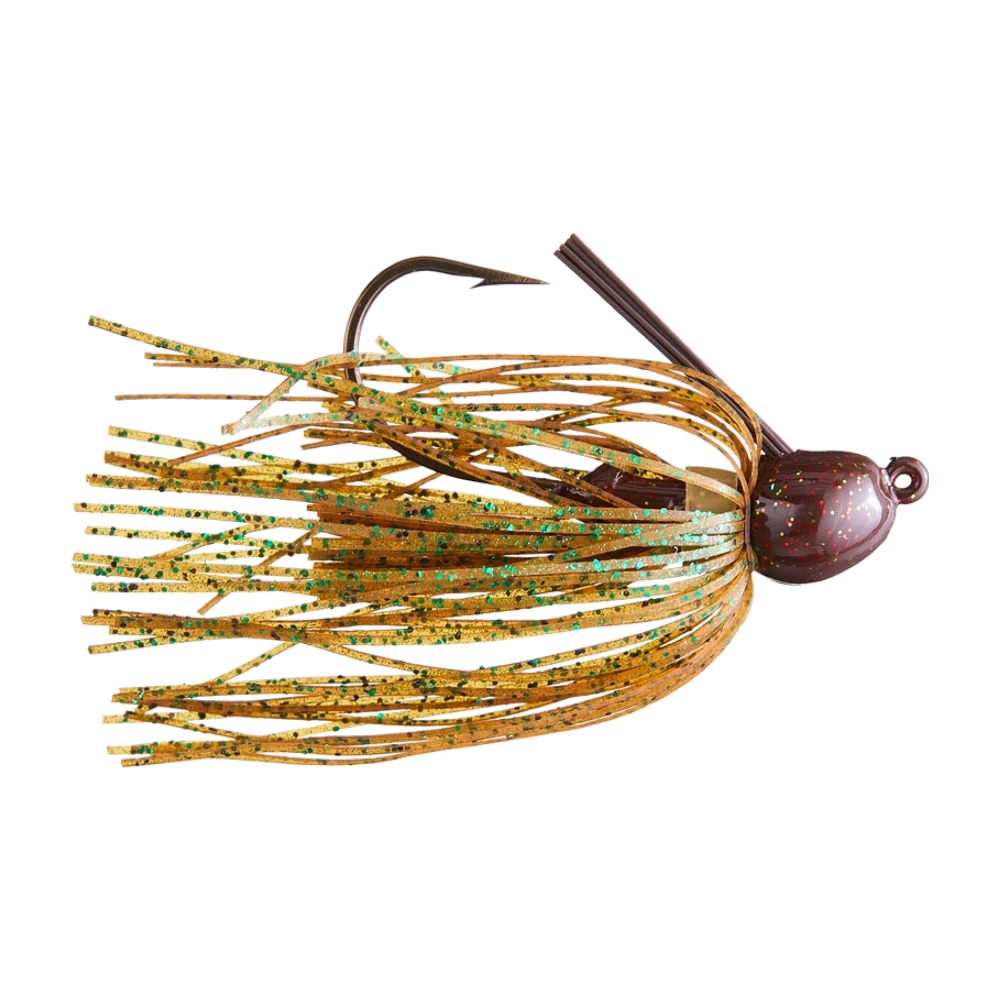
In the photo the eye does not come out of the tip of the nose the way it does on a classic jig: it emerges behind the point of the head, laid slightly back. Strike King's stated intent is to shelter the knot from rubbing on rock. In practice you still check your knot every ten or fifteen fish, because a bottom jig eats fluorocarbon, but you retie markedly less often than with an exposed eye.
The fiber weedguard
It is thin, brown and fanned toward the hook point. A fiber guard does not block the hookset the way an over-stiff wire guard would: it collapses under jaw pressure. On the other hand it opens up with use. Before your first cast, spread the fibers into a fan with your thumb, and trim them back to the height of the hook point if they stand well proud of it. A guard that is too long costs you missed bites.
The real setup on a fiber-guard jig takes ten seconds on the first cast: open the fan, check that the guard springs back on its own, and cut two millimetres off if it towers over the point. Almost nobody does it, and it is the difference between a hookset and a fish that simply lets go.
Weight, the number the description does not give
Let us be straight about it: the manufacturer's description in front of us contains no length, no weight and no size table. So we will not quote a figure. The Bitsy Bug exists in several versions, and the weight is printed on the bag. That is where you read it before buying.
What can be said without inventing anything is the selection logic. On a compact jig you take the lightest weight that still lets you feel the bottom. Too heavy and the jig wedges between two rocks and you lose contact the moment you pull. Too light and you no longer know where it is as soon as there is wind or another metre of depth. If you hesitate between two neighbouring weights, take the lighter one: in clear water on wary fish, a slow fall always pays better than a fast one.
Working it in clear water
Fishing the Bitsy Bug is the opposite of fishing a reaction bait. Cast, let it drop on a tight line and watch that line: a good share of the bites come during the fall, with nothing at all reaching your hand. Once it is on the bottom, drag the jig thirty or forty centimetres with the rod, slowly, then set it down and wait. The silicone skirt keeps breathing through the pause, which is precisely its job, and the decision usually comes while the jig is still.
Over rock, let the jig bump into the stones and release immediately: that small stall followed by a twenty centimetre drop reads like a crayfish folding back. Along a weed edge, do the opposite and lift it in short sharp hops to clear the vegetation instead of burying in it.
The classic mistake
Over-working it. Plenty of anglers turn the jig into a reaction bait with long sweeps and a continuous retrieve. On pressured fish in clear water that is exactly the behaviour that backs them off. A compact jig is fished sparingly: two inputs, then ten seconds of nothing.
Not sure what to tie on?
Photograph your spot: CarnaFish reads the scene, cross-checks the conditions and gives you the zone, the lure and the retrieve. Free on iOS and Android.
The trailer does half the work
The barbed keeper moulded on the shank is there to hold a trailer. On a jig this size there is no point mounting a big craw with huge claws: you would cancel the reduced profile that makes the bait interesting. A short craw or creature is enough, such as a Strike King Rage Craw cut back to its front half if the large size is all you have.
The trailer also sets the fall rate. Wide flat claws slow the drop and make the jig glide, which is what you want in clear water over sitting fish. A slim compact body speeds the fall, which is what you want to reach five metres quickly. For a heavier, deeper jig, the Strike King Tungsten Football Jig covers that ground with a football head that stands up on rock.
Colors by water clarity
- Clear water over rock: brown with green and copper flake, like the sample in the photo. That is the default crayfish tone, and it is not up for debate on a rocky break.
- Stained water: black and blue, a pairing that looks like nothing in nature but gives the cleanest silhouette once visibility drops below a metre.
- When in doubt: green pumpkin, the all-rounder of weedy water, which blends into the bottom without disappearing entirely.
A patience bait
The Bitsy Bug works no miracles on active fish: a search bait will cover water faster and get more bites. It earns its place when the fast approach has failed, when the water is clear and the fish are visible but unreachable. It is a second-pass bait.
What is left is knowing where to put that jig, and that is exactly the time CarnaFish saves you: a photo of the bank, and the AI suggests the zone, the depth and the lure type that fit the day's conditions. For the wider method around this species, our guide to getting started on bass lays out the tackle and the spots worth looking for.
What to remember
- A casting jig for clear water and pressured fish, not a heavy-cover jig: the Bitsy Flip Jig is the right tool for that.
- Fiber weedguard, snagless head and recessed line tie to protect the knot: three Strike King choices that all show up on the water.
- The manufacturer's description gives neither length nor weight: read the size on the bag, and always take the lightest one that keeps bottom contact.
- The trailer sets the fall rate as much as the profile: wide claws to glide, slim body to drop fast.
FAQ
Which Bitsy Bug weight should I choose?
Strike King does not publish a weight in this description, so read it on the bag. The rule is the same whatever the brand: the lightest weight that still lets you feel the bottom, especially in clear water where a slow fall pays more.
Do I need a trailer on this jig?
It is not compulsory, but the barbed keeper is there for it and a trailer brings two things: bulk during the pause and control over the fall rate. Keep it short so you do not cancel the compact profile of the bait.
How is it different from the Bitsy Flip Jig?
The Bitsy Bug is a casting jig for clear water and wary fish. The Strike King Bitsy Flip Jig is optimised to slip into heavy cover and gets a beefier weedguard plus a hook the maker describes as more muscular.
Does the fiber weedguard hurt hooksets?
No. A fiber guard collapses under jaw pressure, unlike a thick wire guard. It only asks to be fanned open before you fish, and trimmed if it stands well above the hook point.
Can I fish this jig in weeds?
Yes, the maker describes a head designed to navigate both rock and vegetation. In genuinely dense grass, though, a flipping head with a fuller weedguard stays the better option.
What line should I use with a compact jig?
Straight fluorocarbon, 10 to 14 lb, for discretion in clear water and abrasion resistance over rock. Braid is only justified if you fish against laydowns and have to haul fish out under power.
The full bass lure guideSeason-by-season strategy: which family of lure, when, and why.Go from theory to fish
CarnaFish reads your spot from a photo and gives you the game plan: zone, lure, retrieve. Free on iOS and Android.