Strike King KVD Sexy Dawg: the walking bait that walks fast and tight
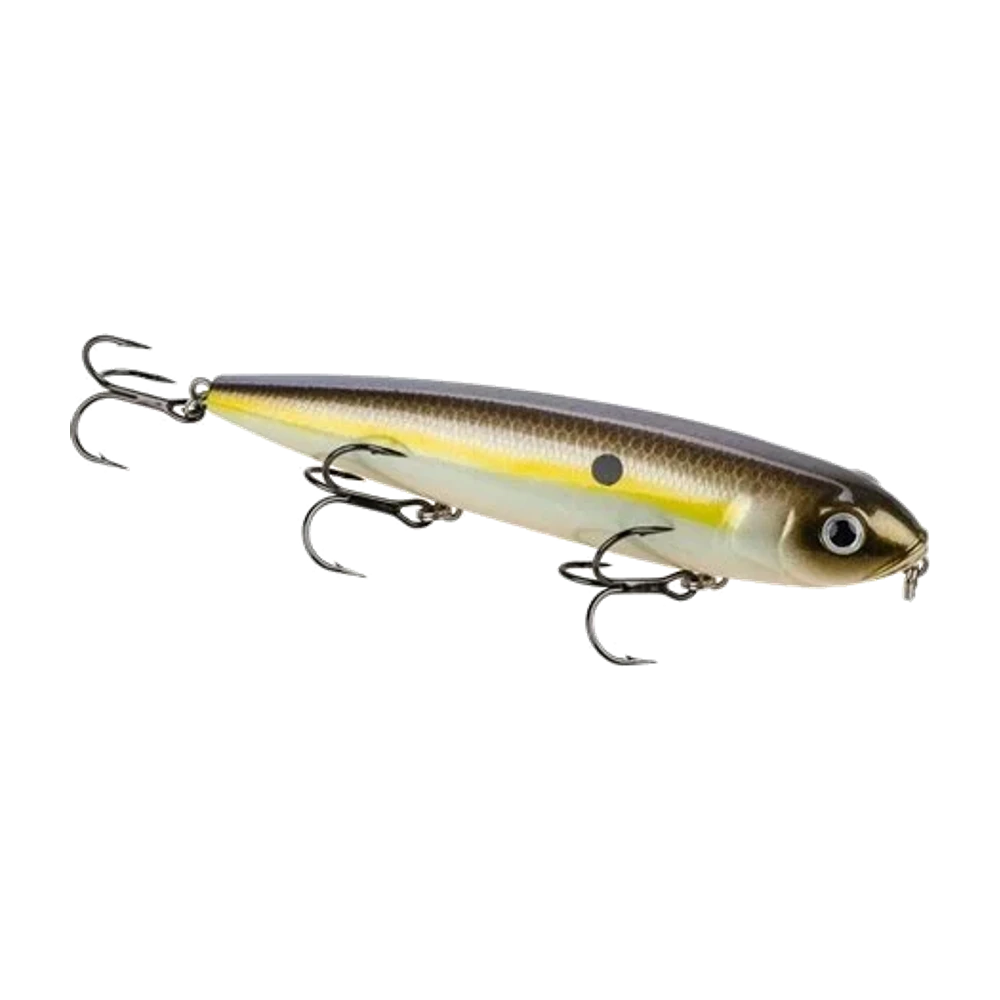
Not sure this lure fits YOUR spot today? CarnaFish tells you in 10 seconds, from a photo.
Every topwater angler knows the scene: a shoal of baitfish showering forty metres out, swirls, sometimes a back rolling over. You cast, you start a clean, wide walk the dog — and by the time your lure arrives the feeding fish have moved twenty metres. You do it again, same result. You finish the sequence without a single bite while the water was boiling under your nose.
The problem is almost never the lure itself. It is ground speed: a wide-striding walking bait travels slowly across the water, because every sideways sweep uses up line without moving the lure towards you. When the fish are moving fast, you need a lure that crosses the zone fast while keeping a complete surface signal.
The Sexy Dawg is built on that compromise. Its zigzag is deliberately short, its natural cadence is high, and its internal ballast resets it on the very first pull. It is a walking bait for catching up, not for patience.
Why a short stride changes the fishing
A wide-striding walking bait — the Heddon Super Spook being the textbook example — sometimes sweeps sixty to eighty centimetres wide on every step. It looks superb, it calls from a long way off, and it moves slowly.
The Sexy Dawg works over a far narrower width, on the order of thirty centimetres, with an immediate return to the centre line. Three concrete consequences:
- It covers ground twice as fast for the same number of wrist strokes. On mobile feeding fish, that is the difference between arriving in it and arriving behind it.
- It stays in a narrow corridor. Along a weed edge, a quay or a breakwater, you can walk it a metre off the edge for the whole length of the cast without it wandering away.
- It takes less effort. The wrist works over a short amplitude. Over a three-hour surface session that counts more than you would think.
The body is heavy at the rear, which gives it a nose-slightly-up resting position: from below, the fish sees a broad silhouette and a clear, readable pale belly, which offsets the smaller amplitude of movement.
The rattle does not do the same job as on a big spook
The Sexy Dawg's internal beads ring higher and denser than those of a 22 g walking bait. That is not a finishing detail, it changes what the noise does.
A low-pitched signal carries far and calls a fish posted at a distance. A high-pitched signal carries less far but cuts through background noise better: fish actively feeding, chop on a breakwater, current rubbing over rock. On flat, silent water, low wins. In the racket of a shoal busting the surface, high gets through.
That is why this lure is at its best on active fish and churned water, and why it is rarely the right call for a perfectly calm dawn on a clear pond.
The retrieve: maintain the cadence, do not restart it
- Cast beyond the zone, five to ten metres past the feeding fish or the edge you are targeting. The first third of the retrieve is for settling the rhythm.
- Drop the rod tip towards the water, rod pointed down at forty-five degrees, and leave twenty to thirty centimetres of slack.
- Link short, regular wrist strokes, two to three per second, taking half a turn of the handle between each. The slack must re-form every time: it is what lets the lure pivot.
- Do not pause at the start. Until you get a follow, continuous cadence does all the searching work.
- As soon as a fish misses or makes a swirl, break everything: a dead two-second stop, then two very fast steps. It is that contrast that turns the miss into a hookup, not going back to the normal rhythm.
On the water: if your zigzag veers off or turns into a straight swim, it is not the lure's fault, it is that you are taking up too much line between strokes. Count half-turns of the handle rather than strokes — one half-turn per wrist stroke, and the stride sorts itself out.
Settings by situation
| Situation | Cadence | Leader | Note |
|---|---|---|---|
| Mobile feeding fish in open water | 3 steps/second | 0.30 mm fluoro | Cast ahead of the fish, never into them |
| Weed or reed edge | 2 steps/second | 0.35 mm fluoro | Stay 50 cm off the edge, not over it |
| Breakwater, quay, rock for sea bass | 2 to 3 steps/second | 0.35 to 0.40 mm fluoro | Follow the line of the blocks in parallel |
| Flat water and wary fish | 1 to 2 steps/second with pauses | 0.25 mm fluoro | This is not its home ground |
Two rigging points that genuinely make a difference:
Braid beats monofilament. Mono floats and stretches; it cushions the wrist stroke and the stride goes soft. Fine braid transmits every impulse sharply, and a one-metre fluorocarbon leader is enough to absorb the stiffness on the hookset.
The stock split rings deform quickly on a lure taking violent surface attacks. On rock for sea bass, move up to heavier rings after the first serious fish — without changing the trebles, or you will tip the lure off balance at rest.
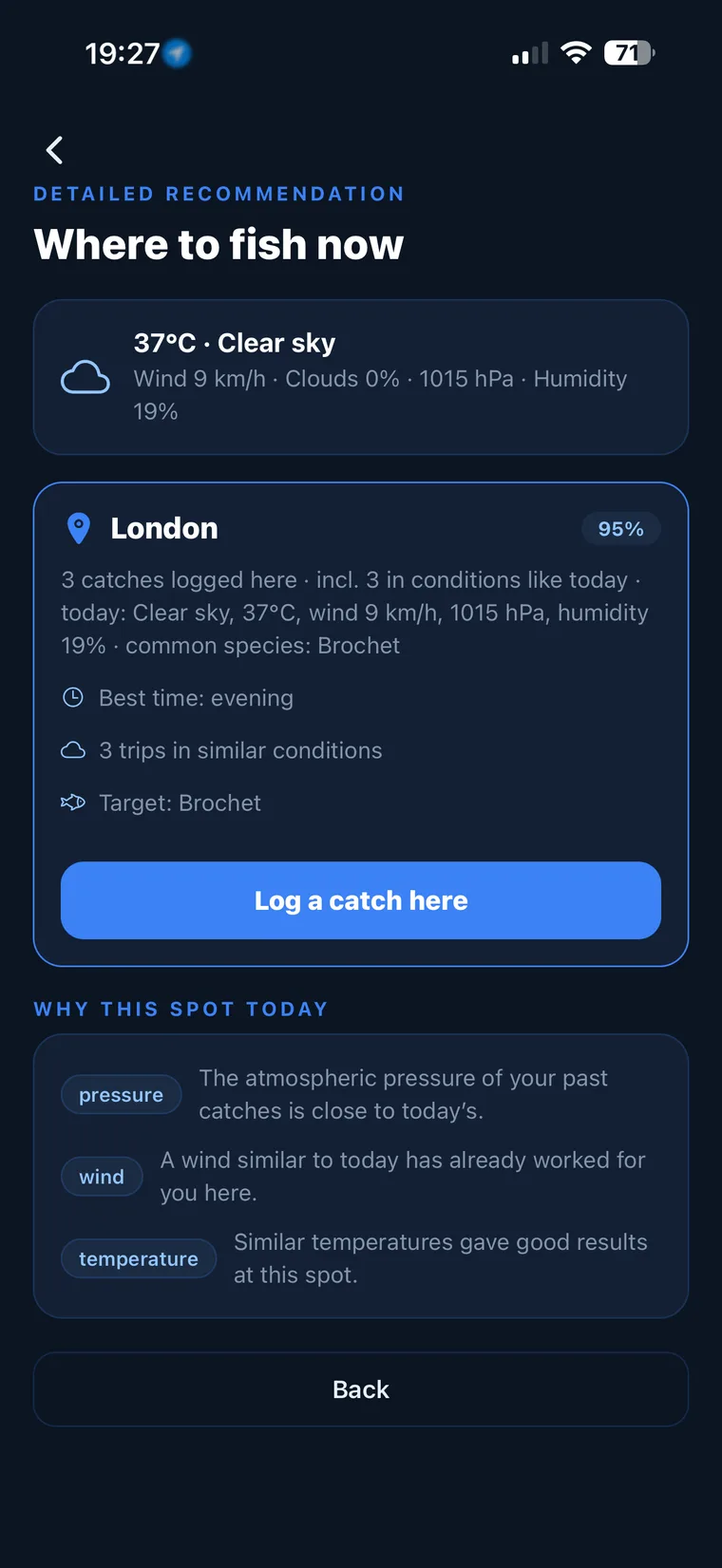
Not sure what to tie on?
Photograph your spot: CarnaFish reads the scene, cross-checks the conditions and gives you the zone, the lure and the retrieve. Free on iOS and Android.
Where it excels, and where not to expect it
Its real windows:
- Late summer and early autumn, when the bait shoals gather and predators feed on the surface in unpredictable bursts.
- Rough water: chop, crosswind, current swirls. The tight stride and the high-pitched noise stay readable where a slower lure gets drowned out.
- Long straight edges to sweep quickly, finding the active fish before coming back to work them finely.
Its limits are clear. On mirror-flat water with educated fish, its fast cadence becomes a fault: it never gives them time to decide. It does not like tiny spots either — a one-square-metre hole under a branch is popper water, not a lure that needs room to run.
Sexy Dawg, Super Spook or Sammy
Three walking baits, three uses that barely overlap.
The Heddon Super Spook is the tool of distance and of the low-pitched signal: big expanses, scattered fish, the need to call from far off. Its Super Spook Jr version shrinks the format without changing the philosophy.
The Lucky Craft Sammy 100 plays on modulation: depending on rod angle and tension, you widen or tighten the stride at will. It is a lure for fine control, for visible fish and clear water.
The Sexy Dawg goes after neither. It does one thing and does it fast: cross a zone in a tight zigzag, making noise, at a rhythm few surface lures can hold. It is the lure for the moving fish, not the posted one. Our beginner's guide to bass fishing puts these windows back into the season. And if you are unsure what surface rhythm to adopt when you reach the bank, CarnaFish analyses a photo of the spot and answers.
Key takeaways
- Short stride, around thirty centimetres wide, and fast progress: a catch-up lure for mobile fish.
- High-pitched beads that cut through the background noise of feeding fish or chop, unlike the low note of a big spook.
- One wrist stroke per half-turn of the handle: that is the setting that makes the zigzag regular.
- Fine braid plus a one-metre fluoro leader, or the stride goes soft.
- A poor choice on mirror water, educated fish and tiny spots.
FAQ
What line size for the Sexy Dawg?
Braid of 0.15 to 0.20 mm with a fluorocarbon leader of 0.30 to 0.35 mm, taken up to 0.40 mm over rock for sea bass. Straight mono is best avoided: its stretch cushions the wrist stroke and makes the zigzag irregular.
Why does my Sexy Dawg not zigzag?
In the vast majority of cases you are taking up too much line between strokes and the lure stays tight. Always let twenty to thirty centimetres of slack re-form, and settle into half a turn of the handle per wrist stroke.
Should I pause?
Not when searching: the continuous cadence is exactly the point of the lure. But as soon as a fish misses or makes a swirl, a dead two-second stop followed by two very fast steps often triggers the second attack.
Does it work in the sea for bass?
Yes, particularly along breakwaters and rock and in churned water, where its tight stride holds better than a wide-amplitude lure. Move to reinforced split rings and a 0.35 to 0.40 mm leader.
What is the difference with a Super Spook?
The Super Spook has a wider stride, a deeper sound and carries further: it calls scattered fish across a large area. The Sexy Dawg travels faster over a narrower width, which makes it better on mobile feeding fish or in a narrow corridor.
What season is it most effective?
From late summer to mid-autumn, when the bait shoals gather and predators feed at the surface in scattered bursts. It stays usable as soon as the water passes twenty degrees or so, but its value falls away on very calm water.
The full bass lure guideSeason-by-season strategy: which family of lure, when, and why.Go from theory to fish
CarnaFish reads your spot from a photo and gives you the game plan: zone, lure, retrieve. Free on iOS and Android.