Strike King Clickin Chickin: the plopper with a metal tail that clicks
The right lure in the wrong spot still catches nothing. CarnaFish spots the zone that works, from a single photo.
Everyone knows what a plopper is: a stick body, a soft tail that spins, and that steady gurgle that pulls fish in from a long way off. The trouble is that on pressured water, that particular noise has become as familiar to the fish as an outboard motor. The Clickin Chickin sets out to break away from that sound signature — with a metal tail and a click on top of the churn.
Two signals instead of one
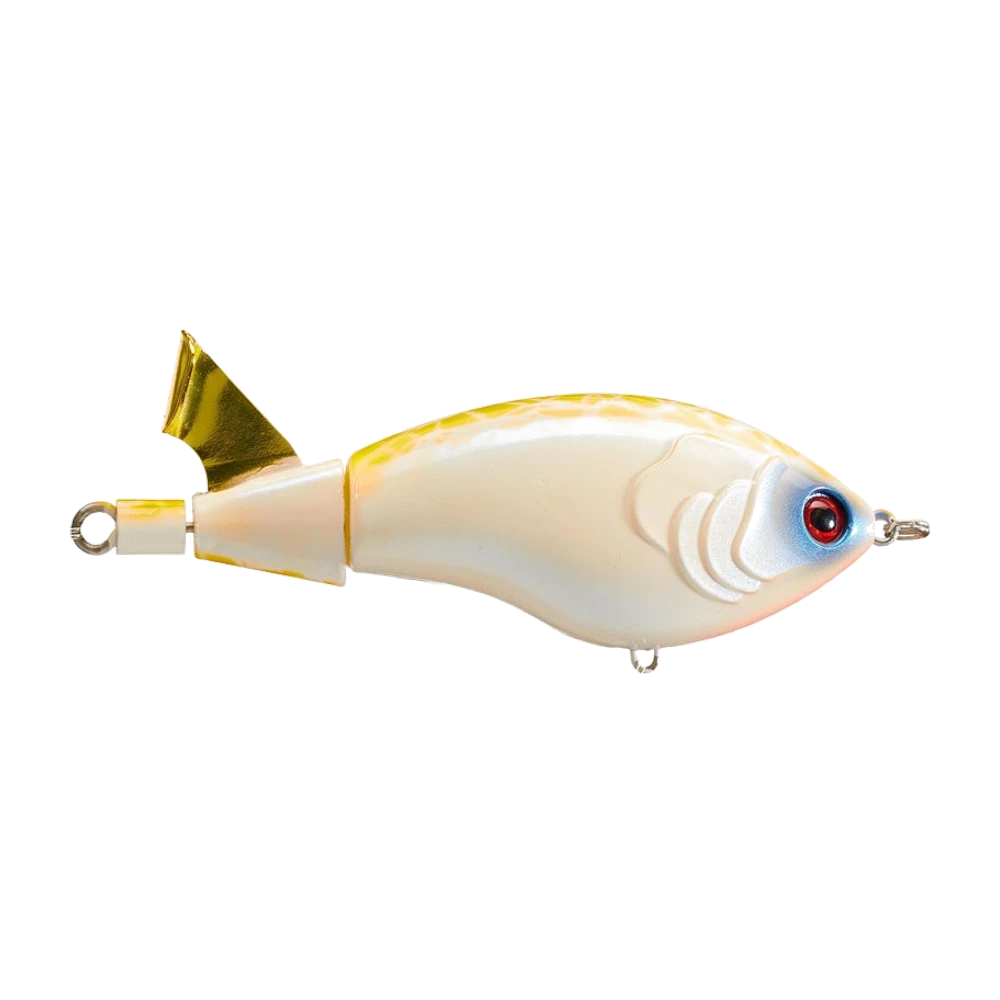
The manufacturer claims two features a standard plopper does not have. The first is the tail construction: a metal part rather than soft rubber, said to produce extra flash as it turns. On the product photo, that tail is a gold-coloured blade on a thin shaft, behind a tail cone articulated from the body — a rigid part that throws light back on every half turn.
The second is a magnetic chamber that Strike King calls MagTap and describes as patent-pending. It is presented as emitting a clicking sound during the retrieve. The manufacturer gives no detail on the mechanism; we take the stated fact — a click layered over the churning of the tail — without trying to explain what is not documented.
What matters on the water is the consequence: you are no longer putting out a single repetitive signal, but two of different natures, a low churning noise and a sharp metallic click. On water where the River2Sea Whopper Plopper 130 and its imitators go past every weekend, that difference in timbre is the only argument that really holds up.
The numbers, and what the chart leaves out
Two sizes in the catalogue: 7.6 cm (3 in) for 21 g (3/4 oz), and 10.2 cm (4 in) for about 39 g. One honest note on that second figure: the manufacturer gives it as an unusual fraction, one and three-eighths of an ounce, which lands almost exactly on a round 39 g. That is the kind of value that betrays a conversion from metric rather than a weight conceived in ounces. Take it as an order of magnitude, not as a reading off a scale.
The other point worth flagging is what the chart does not contain: there is no class column. No floating or sinking designation is published for this model. The description calls it a topwater lure, a plopper, and that is all anyone can honestly state on the subject. The number and size of the trebles are not documented either: on the product photo, the belly eyelet and the rear ring are visible but no hook is fitted — an observation from a product photo, not a specification.
Speed is the only adjustment that counts
A plopper has one parameter, the retrieve speed, and it is not negotiable. Too slow and the tail stalls and stops turning; the bait just drags across the surface producing nothing. Too fast and the tail over-spins, the body starts rolling and the bait skips out of the water. Between the two there is a fairly narrow window where the rotation is continuous and the noise is steady, and that is where you have to stay.
Find it on the first cast, by eye: retrieve along the bank watching the tail, locate the slowest speed at which it turns without stuttering, then add a touch. That speed changes with the size of the bait — the 10.2 cm model needs fewer turns of the handle than the 7.6 cm one to get its tail going.
The hookset that fails, and why
This is the universal plopper mistake: striking on sight, the moment the water blows up. The fish does not have the bait in its mouth yet, you pull everything away and you will not get a second chance. The rule is simple and counter-intuitive: keep reeling at the same speed until you feel the weight in the rod, and only then set, pulling sideways rather than up. On a 39 g bait on a powerful rod, an upward strike usually launches the lure clean over the fish.
Count one full second in your head between the blow-up and your move. It feels endless in the moment, but it is exactly how long a bass or a pike needs to close its jaws on a bait this size.
Not sure what to tie on?
Photograph your spot: CarnaFish reads the scene, cross-checks the conditions and gives you the zone, the lure and the retrieve. Free on iOS and Android.
Where to throw it, and on what tackle
A plopper is a search bait, not a precision bait. You throw it along vegetated banks, over submerged weed beds, across shallow flats at either end of the day, and anywhere the surface is calm enough for the noise to carry. It loses a great deal as soon as the wind ripples the water.
On tackle, the weight sets the tone. At 21 or 39 g, a medium-heavy to heavy casting rod, 0.30 to 0.40 mm braid and a direct knot or a strong snap are the minimum. In Europe, as soon as the stretch holds pike — and a 10.2 cm plopper inevitably attracts them — a wire leader or heavy fluorocarbon is not optional. A pike coming up on a topwater rarely takes it from behind.
If you want a slimmer profile and a zigzag walk rather than a churn, the Strike King KVD Sexy Dawg covers the other half of the surface register. The two do not replace each other: one calls fish in from a distance, the other convinces them up close.
Colours by light and water
- Clear water, bright light: the pattern in the photo, pearl white flanks and a mottled gold back, which plays on the reflection of the metal tail more than on the body colour.
- Heavy skies, dawn, dusk: solid black. On the surface a fish reads a backlit silhouette, and black stands out best.
- Stained water: chartreuse or an orange belly, paired with the 10.2 cm size to maximise the volume of water displaced.
Whether the spot justifies a topwater at all, or whether you should be fishing down the column, is decided before you tie anything on. That is what CarnaFish is for: one photo of the spot, and the AI suggests the zone, the depth and the lure family that fit the day's conditions. For the rest of the approach on this fish, our guide to choosing a pike lure covers the families worth carrying.
What to remember
- Two signals instead of one: the churn of the metal tail and a click claimed by the manufacturer, produced by a magnetic chamber.
- Two sizes, 7.6 cm for 21 g and 10.2 cm for about 39 g, that second figure coming from a fraction that smells of conversion.
- No buoyancy class is published: the size chart simply has no column for it.
- Set the hook on the weight felt in the rod, never on the sight of the blow-up.
FAQ
Does the Clickin Chickin float at rest?
The manufacturer does not say: the size chart for this model has no class column. It is described as a topwater plopper, but no floating or sinking designation is published.
How is it different from a standard plopper?
Two things claimed by Strike King: a metal tail rather than a rubber one, said to add flash, and a magnetic chamber that produces a click on top of the usual churn.
Which size should you pick, 7.6 or 10.2 cm?
The 7.6 cm for bass and enclosed waters, the 10.2 cm when you need to cast far and interest pike. The larger model demands a noticeably heavier rod and braid.
How fast should you retrieve it?
At the slowest speed that keeps the tail turning without stuttering, plus a touch. Find it by eye on the first cast: it changes with the size of the bait and with the current.
Why do I miss so many fish on a plopper?
Because you are striking at the sight of the blow-up. Keep reeling at the same speed until you feel the weight in the rod, then set sideways: the conversion rate changes completely.
Do you need a wire leader with this bait?
In Europe, yes as soon as pike are in the area, and a plopper this size attracts them. Pike rarely attack a topwater from behind, and thin fluorocarbon does not survive the teeth.
The full bass lure guideSeason-by-season strategy: which family of lure, when, and why.Go from theory to fish
CarnaFish reads your spot from a photo and gives you the game plan: zone, lure, retrieve. Free on iOS and Android.