Strike King Fat Baby Finesse Worm: finesse on real tackle
This lure shines under specific conditions. CarnaFish tells you in 10 seconds if today is one of them.
The finesse worm has a flaw few anglers own up to: it forces you onto light tackle. A body a few millimetres across, a thin-wire hook, twenty-hundredths fluorocarbon — and the day a fish buries itself in a laydown, you watch the line come back on its own. Strike King's Fat Baby Finesse Worm answers that exact problem: keep the discretion of a finesse worm on a body thick enough to carry serious terminal tackle.
A thicker body for a stronger rig
Strike King describes this worm as having a slightly larger body than a traditional finesse worm, with a bigger diameter that lets you step up your tackle. That is the whole argument of the bait, and it is a genuine practical issue.
When you fish finesse, what limits you is not the size of the bait but its diameter. A very thin worm only takes a light-wire hook: anything heavier tears through the plastic on the first hookset, or the point comes out crooked. You end up fishing a cluttered spot with a hook built for open water. Thickening the body means going one gauge up on the wire, and by extension one step up on the fluorocarbon, because a strong hook is useless behind line that breaks first.
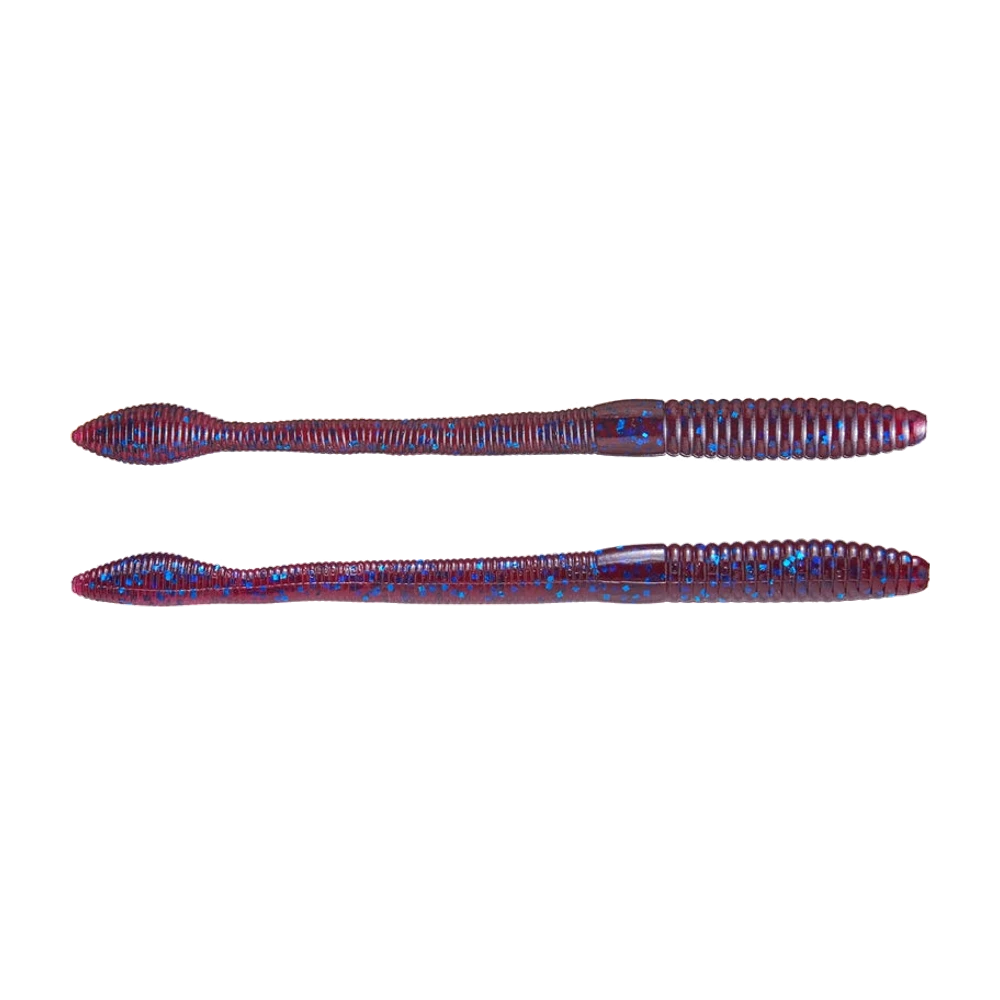
In the product photo the two baits are shown bare, with no hook and no jighead: there is nothing to conclude about terminal tackle. The body is ringed along its whole length. One end swells into a spindle before tapering to a point, the other keeps a more even section and finishes in a rounded tip preceded by a short smooth band. These are observations from a product photo, not specifications: the description mentions an oversized swollen tail without saying which of the two ends it means, and the photo does not settle it either.
What the spec table publishes, and what it leaves out
The spec table attached to the description holds four values, and you have to read its header in full before interpreting it: the columns announced are length and quantity, not length and weight. So it gives a single size, 5 in or 12.7 cm, and a pack of 12. No weight is published, and no diameter either — all the more annoying since the whole argument of this worm rests on its diameter. If weight matters for your rig, put one on a scale yourself.
There is a worse snag. The description claims this worm is shorter than a classic finesse worm, and the only published length is 5 in. But finesse worms are commonly found between 4 and 6 in: 12.7 cm is in no way a short length in this family. Prose and table contradict each other head-on, and we will not pick a side. Keep the figure, which is the only verifiable element.
The plastic: soft, salty, coffee-scented
Strike King files this worm under its Perfect Plastic formulation and presents it as one of the softest and saltiest plastics ever produced — that is the manufacturer's claim, not a measurement. What can be said objectively about salt in a soft plastic is that it adds a little weight, so it speeds up the fall and lengthens the cast, and that it gives a taste a fish holds in its mouth a second or two longer. The trade-off is that a heavily salted plastic tears faster at the hook point.
The manufacturer adds a coffee scent of its own on top. No attractant pulls a bass in from ten metres away: on a bait fished very slowly, what counts is not long-range attraction but retention time. One extra second in the mouth is often the difference between a planted hookset and a bait that comes back twisted.
The rigs, from most claimed to most marginal
Drop shot
The rig the manufacturer names first. Nose-hooked worm, weight 30 to 60 cm below, and an action reduced to quivers of the rod tip. The ringed body and swollen tail react to tiny inputs: you do not need to move the bait to make it live. This is the rig for a vertical target, a bridge piling, a sharp break.
Shaky head
The other rig on the label, and the one where body diameter really pays. A 3-7 g jighead with a vertical hook, the worm threaded straight, and an action worked on the spot: the bait stands up off the bottom, tail in the air, and shivers at every micro-tension on the line. The thickened body lets you use a standard-gauge hook here instead of the usual thin wire, so you can fish the same spot on 25 or 30 hundredths instead of 18.
Light Texas and wacky
Two rigs the description does not mention but the shape allows. Texas-rigged with a 3-7 g tungsten bullet, point tucked into the back, it slips through light vegetation. Wacky, hooked through the middle, both ends flutter independently on the fall, with an O-ring to spare the plastic.
The classic mistake: working it like a baitfish lure
The reflex that ruins this worm is pulling on it. A finesse worm is not retrieved, it is left to work. Cast, let it drop until the line stops paying out, wait three more seconds, give one tiny input, and wait again. Blank days on a finesse worm are almost always days when the rod moved too much.
On a shaky head, never crank the bait back in after a missed bite. Drop it on exactly the same spot and leave it there ten seconds doing nothing. A bass that refused once very often comes back on a bait that sits still, never on one that runs away.
Not sure what to tie on?
Photograph your spot: CarnaFish reads the scene, cross-checks the conditions and gives you the zone, the lure and the retrieve. Free on iOS and Android.
Colour by water clarity
- Clear water: green pumpkin, the do-anything colour of soft plastics for bass, neutral enough to pass for a small baitfish or a bottom invertebrate.
- Stained water: translucent plum with blue flake, exactly the finish shown in the product photo. A dark silhouette that stays readable, with flake that catches what little light there is.
- Dark water or low light: black and blue, maximum contrast, the one you keep for the tightest conditions.
What it brings next to other worms
Next to a Zoom Finesse Worm, the yardstick of the family, the Fat Baby plays the opposite card: less slender, more volume, more material for the hook. Against a Yamamoto Senko 4, built for a slow fall and a side-to-side glide, it leans instead on a tail that moves water on a stationary action. For something even shorter and stubbier on a pure ned rig, the Zman TRD Ned Rig stays the logical pick. In Europe this worm also draws perch on a drop shot along structures and banks, with a hook one size down.
A finesse worm forgives no error in reading the spot: it is too slow to make up for a bad choice of zone. That is where CarnaFish helps, with a photo of the spot and a suggested zone, depth and presentation matched to the day's conditions. To lay down tackle and spot-reading fundamentals, our beginner's guide to bass fishing is still the right way in.
Key takeaways
- The real argument is body diameter, which allows a stronger hook and heavier line without leaving the finesse approach.
- The table publishes one size figure, 5 in or 12.7 cm, and a pack of 12: no weight, no diameter.
- The description claims a worm shorter than the norm while the only published spec is not: the contradiction sits in the source.
- Drop shot and shaky head are the two claimed rigs, and the ones where the thickened body genuinely changes something.
FAQ
What is the exact length of the Fat Baby Finesse Worm?
The manufacturer publishes a single size, 5 in or 12.7 cm, in packs of 12. Watch the original table: the second column is a quantity, not a weight, and no unit weight is given.
Is it really shorter than a classic finesse worm?
The description says so, but the only published length sits in the upper half of the family, where 4 to 6 in is common. We flag the contradiction between prose and table without choosing: if length is a criterion for you, trust the figure.
What hook should I use on this worm?
That is the whole point of the model: its diameter lets you go one wire gauge above what an ordinary finesse worm takes. On a shaky head, a standard hook rather than thin wire; on a Texas rig, a wide-gap hook sized to the body thickness, point tucked into the back.
Does the coffee scent actually do anything?
It is an addition claimed by Strike King, and it does not pull fish in from a distance. Its value shows at the bite: a bait that has a taste is held a second or two longer, which gives you time to set the hook properly on a slow rig.
Is this worm good for anything other than bass?
The description points it clearly at bass. In Europe it also takes perch on a drop shot along structures and banks, with a smaller hook. For zander or pike, other families of soft plastics suit better.
How many fish does one bait last?
Not many, like all heavily salted plastics: the body tears at the hook point after a few fish. The 12-per-pack format fits that reality.
The full bass lure guideSeason-by-season strategy: which family of lure, when, and why.Go from theory to fish
CarnaFish reads your spot from a photo and gives you the game plan: zone, lure, retrieve. Free on iOS and Android.