Teckel Bladewaker: the bladed jig that also fishes on top
One lure, endless conditions. CarnaFish reads your spot from a photo so you are not just guessing.
There is a moment in summer when bass are pinned under the weed mat and refuse both the classic topwater, too slow in their eyes, and the chatterbait, which runs too deep. The Teckel Bladewaker was drawn for that exact gap: a bladed jig you can lift until it churns the surface simply by raising the rod, then drop back down without changing lure. The idea is not new in itself, but the part that makes it possible is.
A blade like no other
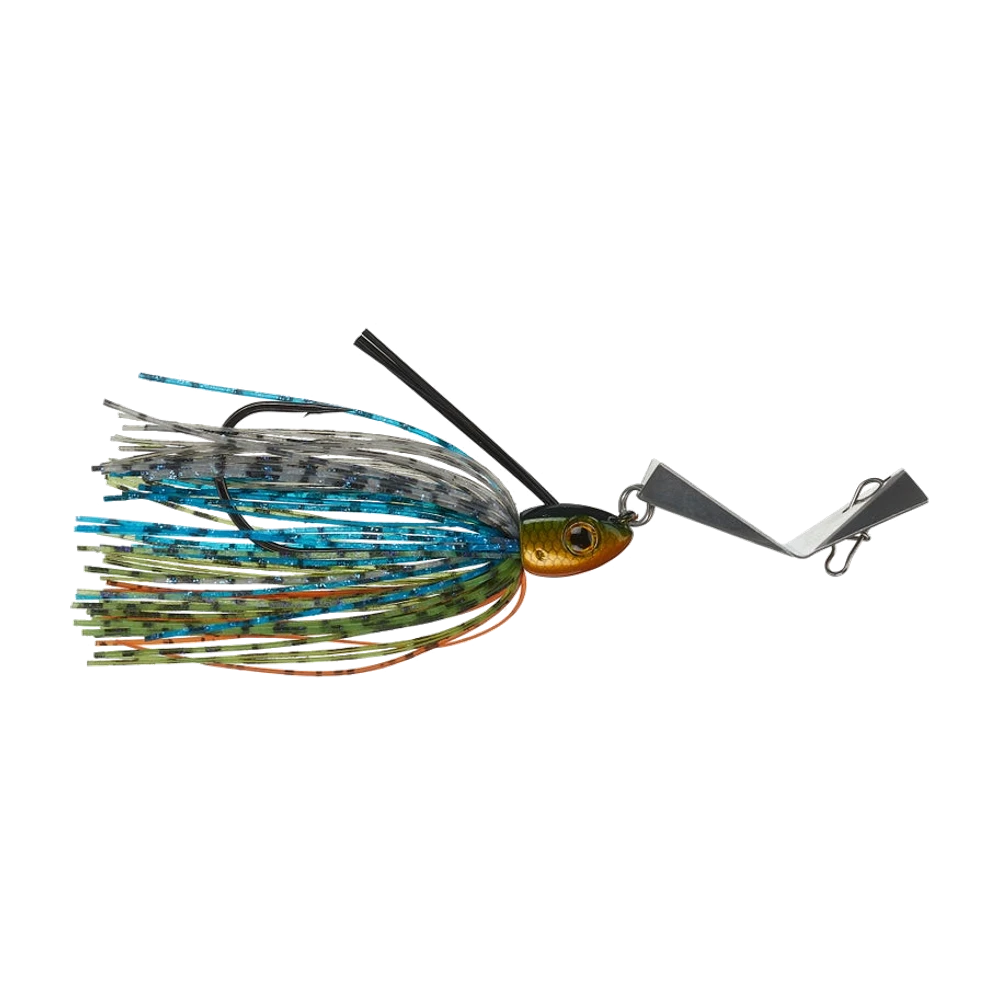
The whole difference sits in the blade. On a conventional bladed jig it is a flat hexagonal plate, clipped to the nose by a ring, that swings side to side and passes the wobble to the body. On the Bladewaker the product photo shows something else: a long tapered metal plate, folded into a V towards the rear, with a small metal clip at the fold. It attaches to the head's line tie through a plain split ring — an observation from a product photo, not a specification.
Teckel describes the part as a one-of-a-kind hybrid blade. That is the manufacturer's wording, but the visible geometry makes it plausible: the long flat front section works like a chatterbait blade, while the upswept folded section grabs more of the surface film and creates buzzbait-style commotion. One component, two behaviours depending on attitude.
The rest of the lure is a serious cover jig: lead head painted in a bluegill pattern with scales and a raised eye, a dense silicone skirt mixing blue, silver, olive and orange strands, a black fibre weed guard set in front of the point, and a wide-gap single hook. The whole thing is built to move through vegetation, not to be thrown in open water.
Three retrieves, one lure
This is the heart of the description, and it is also what takes a little discipline in use: the Bladewaker's action is set by rod angle, not by speed alone.
Tip high, rod raised. The lure climbs and works on the surface, churning water like a buzzbait. It is the most spectacular position and the most demanding: slow down and it falls through. A true buzzbait such as the Booyah Buzz holds the surface more easily at low speed, but it cannot do anything else.
Tip slightly lowered. The Bladewaker shifts into waking mode: it stays just under the film, pushes water ahead of it and leaves a wake behind. At that pace the manufacturer describes a broken, shuddering vibration rather than a smooth wobble. It is often the most productive setting on bass that rise without committing.
Tip pointed at the water. The lure drops below the surface and becomes a conventional bladed jig, able to bang into cover and deflect off an obstacle. Teckel highlights this register when fish are locked onto fast-moving baits.
Do not confuse the terms: waking and topwater are not stated depths, they are swimming registers. The manufacturer publishes no depth figure in metres, and there is no size chart in the description.
What is published, and what is not
The only figure available sits in the model name: half an ounce, that is 14.2 g. It is a weight, not a length, and it comes from the commercial designation, not from a specification table, which does not exist here. No body length, no hook size and no blade dimension are given.
For a lure whose entire point rests on the balance between head weight and blade area, that is a shame. In practice 14.2 g is a standard bladed jig weight, easy to cast on a medium-heavy casting rod and heavy enough to punch through wind.
The adjustment that changes everything is not speed, it is the height of your hand. Keep your elbow fixed and move the rod tip by a few centimetres: you will go from surface to subsurface without touching the reel. Along a weed edge, run the retrieve lifting gradually — a lot of bites land exactly as the lure breaks through the film.
Where to use it, and on which species
This is a shallow cover lure: weed mats, scattered lily pads, flooded wood, reed edges. The weed guard and the point-up single hook let you keep working water where a treble-hooked lure would be lost on the third cast.
On bass the use is obvious, and that is what the manufacturer targets. In Europe the same lure earns its place on pike in summer and early autumn, over weedy flats of one to two metres: the heavy vibration and the surface pass match very well how pike ambush under vegetation. With one important caveat: use a suitable leader. Bare line on a lure that gets engulfed right in the weed means a pike lost with the lure.
For perch, on the other hand, 14.2 g is too big to be a regular choice.
The classic mistake
Fishing the Bladewaker like a chatterbait, that is flat and at constant speed with the rod tip at mid-height. The lure works, but you then have a mediocre chatterbait and you miss the whole reason the product exists. Decide before the cast which register you want, then hold the matching rod angle through the entire retrieve.
Second mistake: adding too bulky a trailer. A big craw or a wide paddle-tail shad adds drag that prevents the lure from climbing to the surface. If you want the topwater register, stay on a slim trailer or run no trailer at all.
Not sure what to tie on?
Photograph your spot: CarnaFish reads the scene, cross-checks the conditions and gives you the zone, the lure and the retrieve. Free on iOS and Android.
Colours by water clarity
- Clear water over weed: the bluegill pattern shown in this page's photo, with a dark back, scaled green-gold flanks and an orange belly. It is the dress that best matches the small panfish and bottom fish bass find under vegetation.
- Silvery open-water forage: a plain silver white, more legible at the surface when the lure is backlit against the sky.
- Dirty water or overcast sky: black and blue. In poor visibility it is silhouette contrast and vibration that work, not the finesse of the finish.
Knowing what depth to hold the lure at depends first on what the spot is telling you, and that is exactly what CarnaFish makes easier: a photo of the spot, and the AI suggests a zone, a depth and a presentation suited to the day's conditions. If you are targeting pike over weed, our guide to choosing a pike lure is a useful companion to this page.
Key takeaways
- The blade is not a conventional hexagonal plate but a long plate folded into a V, hung on a split ring.
- Three swimming registers set by rod angle: surface, waking just under the film, and subsurface with cover contact.
- The only published figure is half an ounce, 14.2 g, and it comes from the model name, not a specification table.
- Weed guard and point-up single hook: this is a cover lure, not an open-water lure.
FAQ
How much does the Teckel Bladewaker weigh?
Half an ounce, about 14.2 g. That figure appears in the model designation; Teckel publishes no specification table for this lure, and neither the body length nor the hook size is given.
How is it different from a conventional chatterbait?
The blade. On a Zman Chatterbait Jackhammer or a Strike King Thunder Cricket it is a flat hexagonal plate swinging sideways. Here the plate is elongated and folded into a V, which also lets it grab the surface. The Bladewaker therefore covers a register those two do not.
Can you really fish it on the surface?
Yes, that is the manufacturer's claim: rod tip up and a brisk retrieve, and the lure climbs and churns like a buzzbait. It takes tempo to keep it up there — as soon as you slow down, it drops back.
Should you add a soft trailer?
It is not required and none is fitted in the product photo. A slim trailer can lengthen the silhouette without hurting, but a big craw adds drag that stops the lure holding the surface. If you want the topwater register, fish it bare.
Is it a good pike lure in Europe?
Over weedy flats in summer, yes. The heavy vibration and the pass just under the film match the way pike ambush. Fit a proper leader without fail: on a lure engulfed right in the weed, bare line does not hold.
Does it go through dense weed?
It is built for it: a black fibre weed guard ahead of the point and a point-up single hook. In a genuinely matted canopy a hollow-body frog is still the better tool; the Bladewaker is made for edges and sparse weed, not for a thick mat.
The full bass lure guideSeason-by-season strategy: which family of lure, when, and why.Go from theory to fish
CarnaFish reads your spot from a photo and gives you the game plan: zone, lure, retrieve. Free on iOS and Android.