War Eagle Jiu-Jigsu Flipping Jig: winching bass out of cover
Rather not fish it blind? Photograph your spot — CarnaFish cross-checks the conditions and points you the right way.
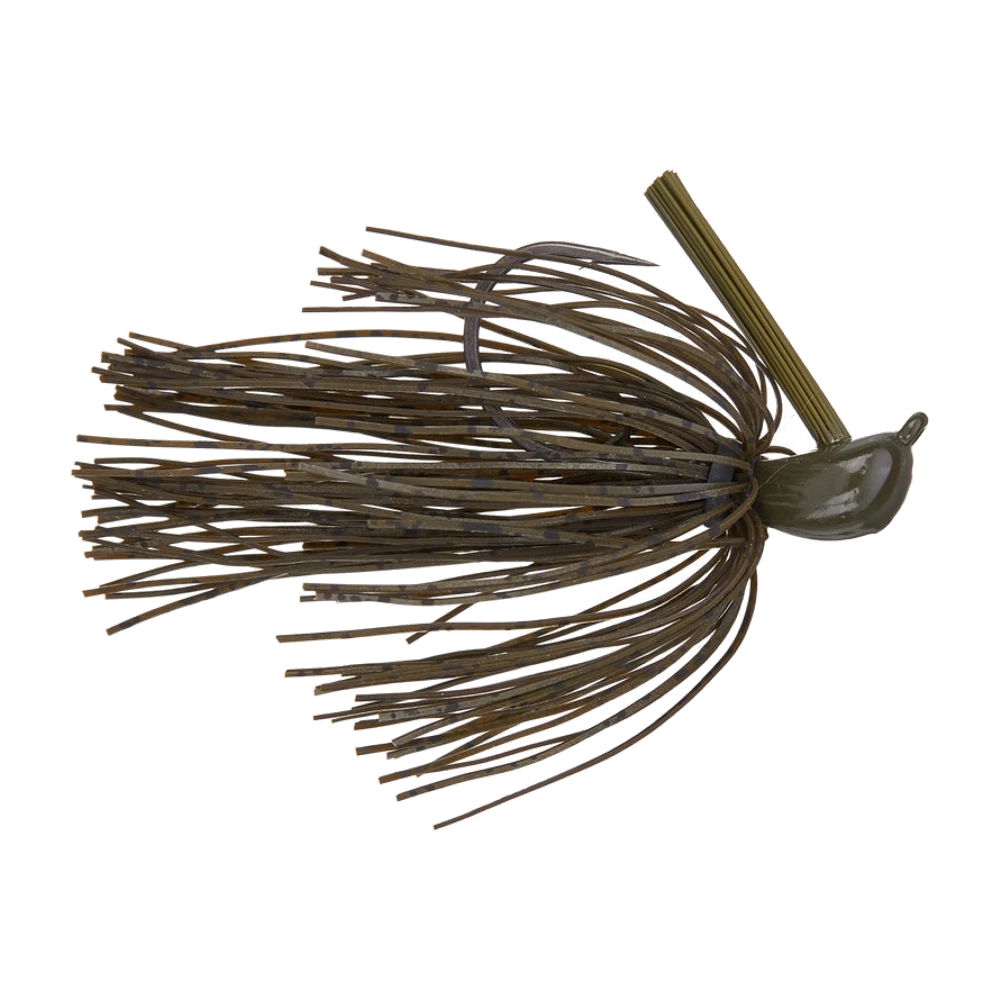
There comes a point on a cluttered pond where casting and winding stops being useful. The fish are under laydowns, pinned against a fallen trunk, in a foot of water and two metres of dead wood. A crankbait cannot get in there, and a shad on a jighead leaves its hook behind. That is flipping-jig territory, and the War Eagle Jiu-Jigsu was drawn for that job and nothing else.
A modified Arkie head that crawls instead of hanging up
The Arkie shape is an American jig classic: a flattened cone, wide at the base, that lands the lure flat on the bottom instead of letting it roll over. War Eagle builds a modified version of it, with one detail that matters more than it looks: the line tie is recessed into the lead, not soldered proud of the head. In practice the knot and the loop of line sit flush, so there is no little metal hook sticking out to wedge between two branches or under a rock.
That changes how you fish it. With a standard line tie you edge forward in small hops and hope it clears. With a recessed one you can genuinely crawl the head along a sunken trunk, keeping contact, without the jig stopping dead every foot. The gain is modest in open water and obvious the moment you fish dense wood.
The weedguard follows the same logic: stiff enough to shield the point while the head drags, soft enough to collapse on the hookset. That balance is the hardest thing to get right on a jig. Too stiff and you miss fish, too soft and the point grabs everything. On this one you can still fine-tune it: if it feels too strong, fan the fibres out with your fingers rather than cutting any away.
The hook is what justifies the price
This is the point the maker leads with, and for once it is not packaging talk: the Jiu-Jigsu carries an Owner ZO-Wire flipping hook. That wire is thick and barely deformable, which is exactly what you want from a jig hook in heavy cover. The reason is simple: in that kind of spot you do not play the fish, you lift it. You set hard, you lock up, and you pull the bass out of the branch before it wraps you. A fine-wire hook opens in that situation. Heavy wire does not.
The trade-off is that thick wire needs more force to drive home. That means a rod with real backbone — heavy power, roughly 3/4 to 2 oz casting range — and braid, not mono. On a rod that is too soft you will drop fish and blame the lure, when the hookset simply never happened.
Fishing the jig: three moves, not thirty
The pitch
This is the base move. You hold the jig in your free hand, let a metre of line hang, and swing it under the branches with your thumb on the spool. The lure should enter the water without a splash, almost silently. The whole efficiency of flipping lives there: a quiet entry and an immediate vertical fall.
The controlled fall
Never let the line go completely slack. Follow the drop with the rod tip, line just taut: those two or three seconds of fall produce about 70% of the bites, and they almost never feel like bites. You will see the line move sideways instead, or stop a little earlier than the depth should allow. When in doubt, set the hook.
Two or three hops, then move
Once it is down, two or three small 20 cm / 8 in lifts with a full pause between each — the silicone skirt keeps opening and closing while the jig sits still, and that is what is working. If nothing comes after three hops, reel in and pitch the next target. A flipping jig is not a search bait, it is a precision bait: you fish fifty spots in a morning, not fifty casts on the same one.
Not sure what to tie on?
Photograph your spot: CarnaFish reads the scene, cross-checks the conditions and gives you the zone, the lure and the retrieve. Free on iOS and Android.
The trailer does half the work
The Jiu-Jigsu comes with a silicone skirt of mixed-length strands and a wire soft-plastics keeper on the shank. That detail is not cosmetic: without it a trailer slides up the hook after three casts and throws the whole lure out of balance.
Two families of trailers, two uses. A craw with thick pincers like the Strike King Rage Craw or the Zoom Z Craw adds bulk, slows the fall and pushes water: that is the pick in stained water or on active fish. A compact, subtle trailer with thin claws does the opposite, speeding the drop, and suits clear water or sulking fish better. Change trailers before you change jigs — the effect on fall rate is far more noticeable.
If you want a direct comparison, the Strike King Hack Attack Flipping Jig plays in the same class with a different head philosophy.
Colours by water clarity
- Clear water, weedy bottom: Green Pumpkin, the universal crawfish tone in Europe as in North America. It is the colour of the sample photographed, with blue flake running through the skirt.
- Stained water, heavy cloud, night fishing: Black and Blue. It is not a colour you see, it is a silhouette that stands out from below.
- Rock and boulder bottoms: Brown Craw, which matches the crawfish living in the blocks.
A jig never replaces reading the spot: you first need to know where the wood is, how deep it sits and which way the wind is pushing. That is precisely what CarnaFish does: one photo of the spot, and the AI suggests the zone and the presentation that fit the day's conditions. To build the groundwork before going after big fish in cover, our beginner's guide to bass fishing covers the spots and the tackle.
What to remember
- The recessed line tie on the modified Arkie head removes the most annoying snag point of a conventional jig.
- The Owner ZO-Wire hook demands a heavy rod and braid: on light tackle you will lose fish.
- The bite almost always comes on the fall, with the line followed and the tip high, and you see it more than you feel it.
- The trailer sets the fall rate and the bulk: that is the first thing to change when nothing happens.
FAQ
Which weight of Jiu-Jigsu should I pick?
The maker description does not list weights and the range varies by retailer, so check the packaging. In practice a flipping jig around 10-14 g / 3/8-1/2 oz covers shallow work under branches, and you step up to 18 or 21 g / 5/8 or 3/4 oz as soon as you have to punch thick grass or fish deeper than 4 m / 13 ft.
Do I really need a trailer on this jig?
Yes, in almost every case. The skirt alone works on the pause but creates neither bulk nor vibration on the drop. The wire keeper on the shank is there precisely to hold a soft plastic in place cast after cast.
Can you catch pike on a flipping jig?
Yes, along cluttered margins and surface weed, where pike hold in the same places as bass. Add a thick fluorocarbon leader or a short length of supple wire: an unprotected jig gets cut off on the first proper strike.
Why does my jig still hang up in wood?
Check the weedguard: the fibres flatten and lie down with use. Straighten them and fan them out. Check the hook point too — a dull point grabs bark instead of sliding over it.
Braid or fluorocarbon for flipping?
Braid in 40-60 lb for dense wood: it does not stretch, which makes the hookset immediate, and it survives rubbing on bark. Heavy fluorocarbon still makes sense in very clear water on isolated cover, at the cost of a slightly less direct hookset.
Does this jig work in clear, open water?
It works, but that is not its ground: a heavy hook and a weedguard are dead weight when there is nothing to protect. Over clean bottom, a finesse jig with a finer hook and a shorter skirt will get more bites.
The full bass lure guideSeason-by-season strategy: which family of lure, when, and why.Go from theory to fish
CarnaFish reads your spot from a photo and gives you the game plan: zone, lure, retrieve. Free on iOS and Android.