X Zone Ned Zone Stickbait: the floating stick that stands up
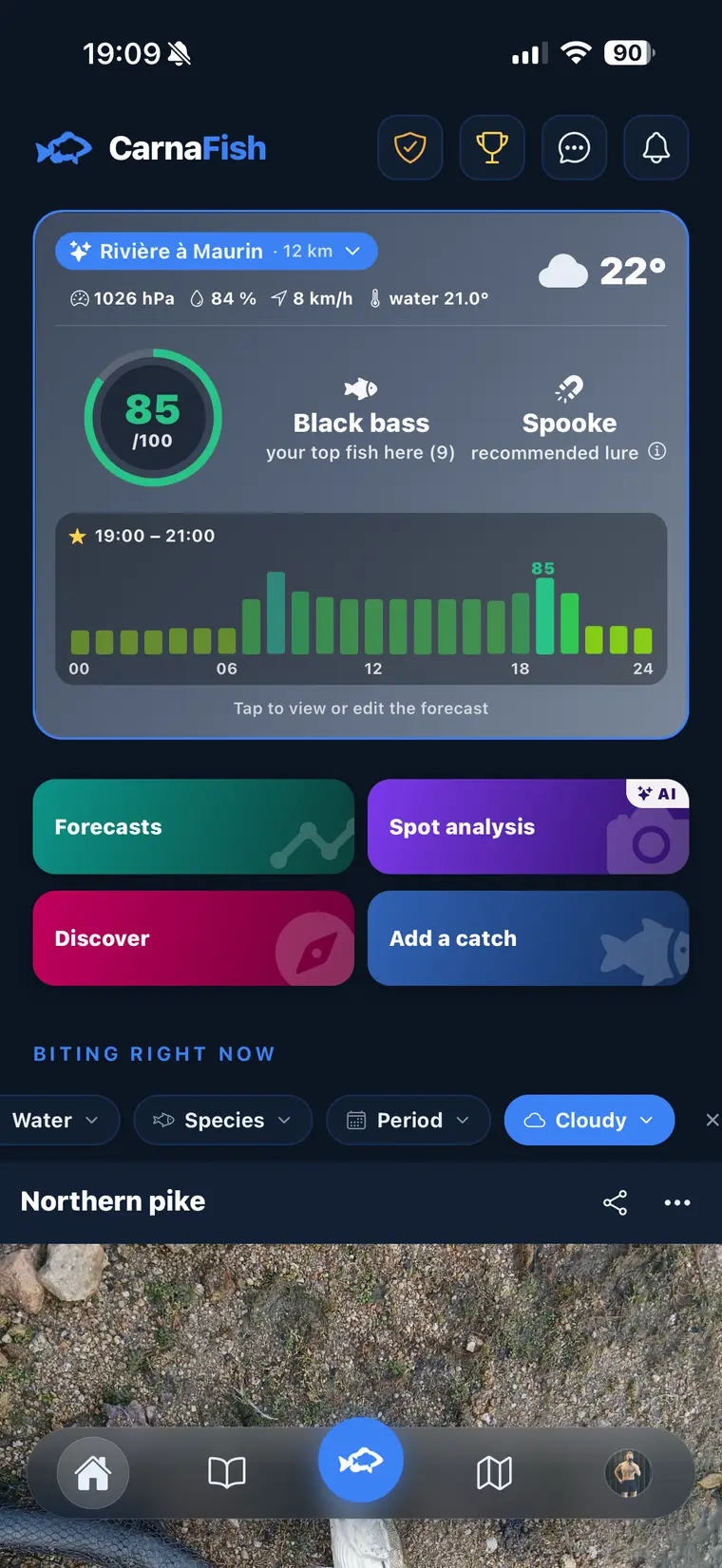
Not sure this lure fits YOUR spot today? CarnaFish tells you in 10 seconds, from a photo.
A seven-centimetre lure with no tail, no claws and no paddle: on the shelf the Ned Zone looks like a piece of plastic left behind in a mould. Dropped on the bottom with its small jighead, it does something no swimbait does: it stands up vertically, tail in the air, and starts quivering on its own as soon as the line moves a centimetre.
The Ned rig, explained in thirty seconds
The rig takes its name from Ned Kehde, a Kansas fishing writer who popularised this finesse approach out of the American Midwest. The principle is disarmingly simple: a short piece of plastic on a small collared jighead, sitting on the bottom, worked as little as humanly possible.
The reason it crossed the Atlantic so quickly is that it answers a situation everyone knows: the day nothing bites. Clear water, fish visible on the sonar but indifferent, heavy angling pressure. The Ned rig is not trying to provoke a reflex strike; it offers a tiny, motionless and entirely believable prey item within a metre of the fish.
Why the plastic has to float
That is the core of the Ned Zone, and X Zone states it plainly: the body is moulded from a soft floating plastic. Without that buoyancy a stick on a jighead lies flat on the bottom and does nothing at all.
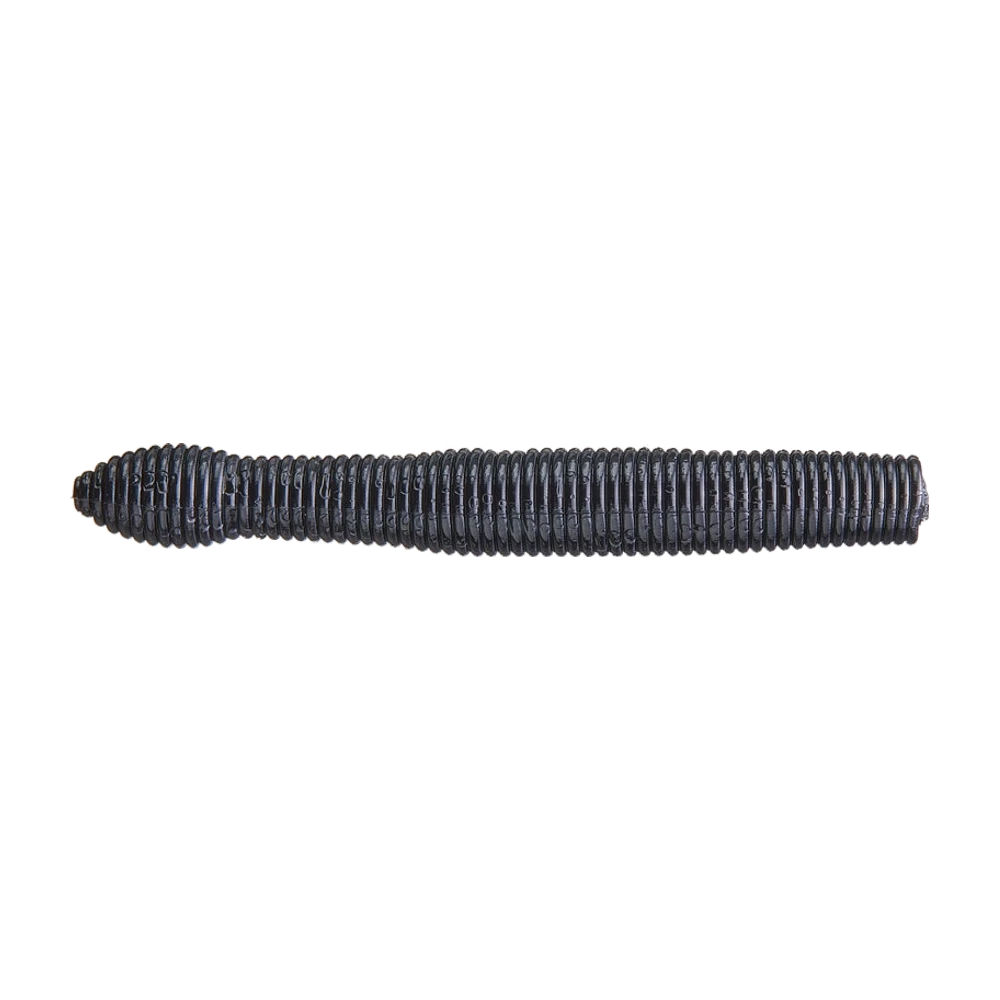
With it, the lure behaves differently. The jighead touches down and the body, lighter than water, rises to vertical. The small swollen tail visible at the end of the stick acts as a concentrated buoyancy point: it is what pulls the body upwards. So the lure stands up, motionless from the angler's point of view, but constantly travelled by micro-vibrations from the current and the tension in the line.
The body is ribbed from end to end, as the photo shows. Those rings do two things: they increase the surface in contact with the water, and therefore the amplitude of the quiver, and they hold onto attractant if you use any.
Check how high your Ned Zone stands before you start fishing: drop it in the water beside the boat or the bank with the jighead on the bottom. If the body does not come up clearly vertical, the head is too heavy for that bait. Drop one size — it changes everything.
The jighead, the only real adjustment
The weight
The useful range is narrow: 1.8-5 g / 1/16-3/16 oz, and most often 2.5-3.5 g. The universal beginner's mistake is to go heavier to feel the bottom or to cast further. A 7 g head crushes the buoyancy of the body, the lure lies down, and you end up with an ordinary rig that has lost its reason to exist.
Pick the lightest weight that keeps you in contact under the day's conditions. More wind or more current justifies going up; depth alone does so far less. A Ned rig reaches eight metres on 3.5 g — you simply have to be willing to wait.
The hook
Fine wire hook with a large upturned eye, typically a size 1 or 1/0. The thin wire is deliberate: with 20-25/100 fluorocarbon and a light rod, a thick hook will never set. The flip side is that dense weed and branches are out — the Ned rig is a clean bottom or rock rig.
Working it: almost nothing, then truly nothing
The Ned rig retrieve comes down to two moves. You drag the jighead slowly for a few dozen centimetres, rod tip low, almost motionless. Then you stop and let the body rise and quiver. Five, ten, fifteen seconds. You can add a shake on the spot, but nothing more.
The classic mistake
Hopping it on the rod as you would an ordinary jighead. A hopped Ned rig does exactly what a Ned rig must not do: it lifts off, lies down and only rises again once it has settled. Every second spent animating it is a second the lure is not working. The upside is that you can fish two rods at once from the bank, or take the time to read the spot.
To compare the main Ned profiles, the Zman TRD Ned Rig is the historic reference in elastic material, and the Missile Baits Ned Bomb offers a bulkier body. For the full logic of the rig, hooks and weights included, our Ned rig setup page covers everything.
Not sure what to tie on?
Photograph your spot: CarnaFish reads the scene, cross-checks the conditions and gives you the zone, the lure and the retrieve. Free on iOS and Android.
And for perch, in Europe
The Ned rig was designed for bass, but in Europe it made its name on another fish: perch. Same clear-water context, same wary fish on pressured spots, and a profile that matches exactly what a good perch hunts for near the bottom. Simply drop to 1.8-2.5 g heads and 18-20/100 fluorocarbon.
The rig does demand clean bottom, though. Over soft silt the head sinks in and the vertical stance is lost; over rock or gravel it is lethal.
Colours by water
- Clear water: Green Pumpkin, the default Ned rig colour, which reads as a small crawfish or a larva equally well.
- Stained water or heavy cloud: Black Blue, close to the sample photographed, which gives a sharp silhouette when light is short.
- Dark bottom, lightly coloured water: Coppertreuse, a copper base with a chartreuse tip that adds a point of visibility without spoiling the rig's discretion.
The Ned rig is precision fishing: you need to know where the hard bottom is, where the breakline runs, where the fish sits. That is exactly what CarnaFish helps with: one photo of the spot, and the AI suggests the zone and the presentation for the day's conditions. To go further on the species that benefits most from it on this side of the Atlantic, our guide to lure fishing for perch is a good companion to this page.
What to remember
- The floating plastic and the small swollen tail keep the body upright: without that, the Ned rig has no point.
- Stay between 1.8 and 5 g of jighead; beyond that the body lies down and the rig loses its behaviour.
- You do not animate it: you drag gently, you stop, and you wait for the lure to quiver by itself.
- A clean bottom or rock rig. The fine wire hook will not clear dense weed.
FAQ
Which Ned head weight should I use?
Between 1.8 and 5 g, with 2.5-3.5 g as a starting point. The criterion is not depth but wind and current: take the lightest weight that still lets you feel the bottom. Too heavy and the body stops standing up, which costs you the whole point.
Does the Ned rig work for perch?
Yes, it has become one of its most common uses in Europe. Drop to 1.8-2.5 g heads and thinner fluorocarbon, and target hard bottom or gravel breaklines.
How many baits per pack?
Eight pieces. That is a standard count for this type of stickbait, which takes damage quickly on the head's keeper barb: push the body back into place after each fish rather than replacing it.
Can I fish it in weed?
Not in dense weed. The Ned hook is exposed and fine-wired, so it catches. Keep this rig for rock, gravel or sand, and switch to a weedless Texas rig when there is vegetation.
Should I add attractant?
The description mentions neither salt nor a scent formula on this model, unlike other baits from the same brand. A scent gel therefore makes more sense here than elsewhere, and the ribbed body holds it well.
How fast should I retrieve it?
As slowly as you possibly can, and mostly by barely retrieving at all. A drag of twenty to thirty centimetres, then a ten second stop. The bite almost always comes during the stop, and it usually registers as nothing more than weight on the line.
The full bass lure guideSeason-by-season strategy: which family of lure, when, and why.Go from theory to fish
CarnaFish reads your spot from a photo and gives you the game plan: zone, lure, retrieve. Free on iOS and Android.