Lake Fork Worm: the ringed body that bleeds air bubbles
Rather not fish it blind? Photograph your spot — CarnaFish cross-checks the conditions and points you the right way.
A big worm isn't a bait you cast to see what happens. It's an end-of-day tool, for when the small stuff has produced three perch and you want to know whether a real fish is still on the spot. The Lake Fork Worm belongs to that category: a thick, deeply ringed body, a double ribbon tail, and enough mass to drop into the heart of cover without loading up on lead.
Two lengths, although the copy describes only one
That's the first thing to sort out, because it can have you ordering the wrong pack. Lake Fork's sales copy announces a worm that "measures 10 inches" and leans on that oversized profile. But the spec table just underneath lists two:
- 10 in, 25.4 cm — 8 baits per pack.
- 8 in, 20.3 cm — 10 baits per pack.
When prose and table contradict each other, the table is what counts: there really are two lengths, and the marketing sentence only describes the bigger one. The 8 and 10 beside each length are the number of baits per pack, not a weight or a reference — logically, the pack holds more of the small ones than of the large.
Lake Fork publishes no weight at all, which is genuinely missing when you want to match a rod rating: weigh one rather than trusting an unsourced estimate. On size, the 20.3 cm / 8 in is already a very big bait by European standards and covers most situations; the 25.4 cm / 10 in is a selective bait, fewer bites but almost exclusively fish worth the trouble.
The ringed body and the bubble trail
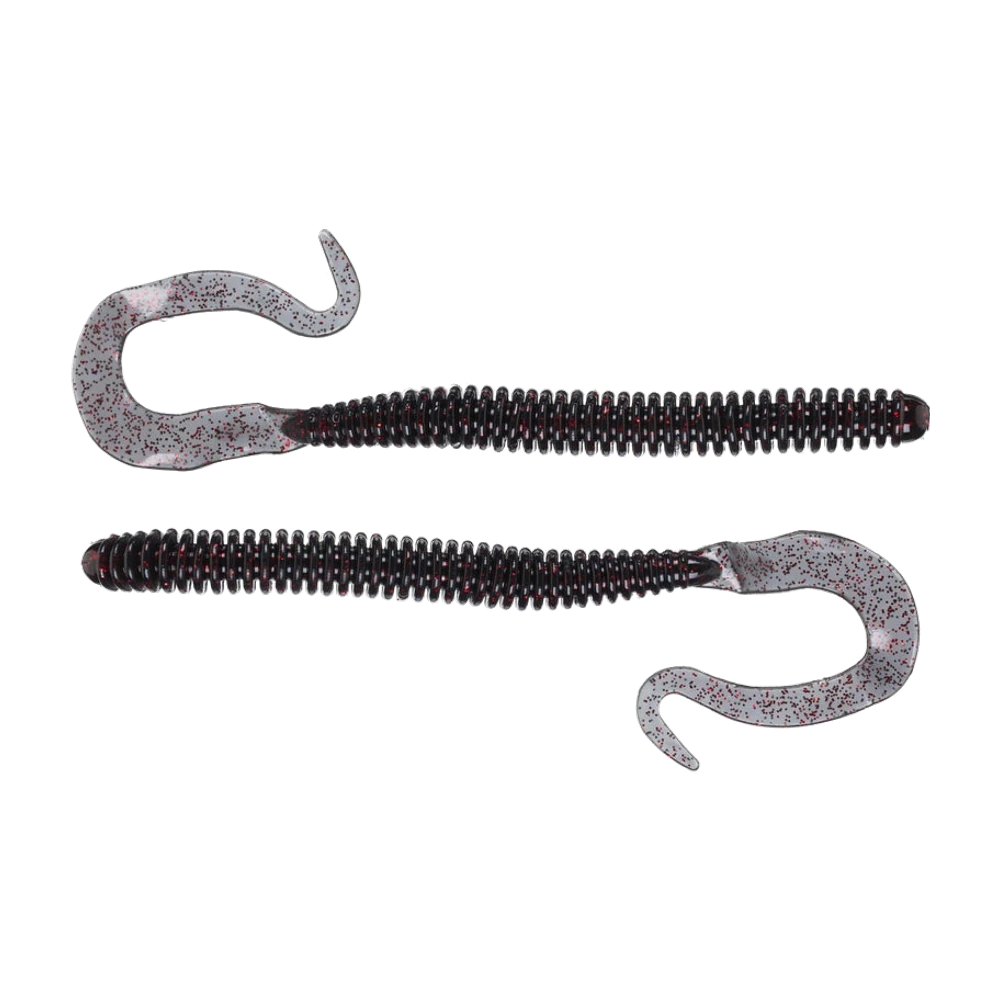
Lake Fork highlights a large-diameter ringed body that releases tiny air bubbles, described as a natural breathing action. The mechanism is simple: each groove between two rings traps a little air as the bait enters the water, then releases it gradually during the drop and the first pulls. You get a trail of micro-bubbles behind a slow-moving bait — exactly what a prey item rooting on the bottom produces.
The ribbing has a second function, less advertised but more useful day to day: it multiplies the edges that grip water. A smooth body slides, a ringed body brakes and transmits — on a short pull you feel where the bait is and how it sits.
Lake Fork adds that the bulkier profile helps conceal the hook. That matters: on a Texas rig, a big wide-gap hook disappears into the thickness of the body, where it would distort a thin worm and compromise the hookset.
Dip the worm and shake it once before the first cast. The rings hold dry air that otherwise makes it float off-kilter for the first thirty seconds — precisely when the bite comes on a tight target.
The double ribbon tail
The photo shows two wide flat ribbons splitting at the end of the body and coiling in opposite directions. Lake Fork claims this large double-curled tail delivers an enticing swimming action on the retrieve and on the fall.
It's that second half that deserves attention. A single ribbon tail spins well under tension but often falls back lifeless on the drop. Two ribbons work against each other: they create a mutual resistance that keeps them undulating during the fall, with no reel input at all. Same reasoning as on the big slow search worms like the Gambler 13 in Ribbon Tail Worm, but with two appendages instead of one. Direct consequence: never force the retrieve. Two or three seconds of pause after each pull is enough to let the ribbons work, and that's almost always when the fish takes.
Rigs and retrieve
Texas, the reference rig
A 7 to 14 g / 1/4 to 1/2 oz bullet weight depending on depth and cover density, wide-gap hook in through the nose, back out and tucked into the body. Lake Fork claims enough bulk to work through the heaviest cover, which is consistent with a body this thick: it doesn't fold back on itself against a branch. The Texas rig is the baseline, and the only one that truly lets you drop this worm into dead wood.
Carolina and jighead, to cover water
On a Carolina with a 60 to 100 cm / 24 to 40 in leader, the worm glides freely behind the weight and both ribbons work constantly. That's the rig for big flats and soft breaks, covered in our Carolina rig page. On a heavy jighead you gain contact and vertical precision, but lose most of the weedless character.
The classic mistake
Setting the hook too early. On a 25 cm / 10 in bait, a fish inhales the tail first: set then and you only grab plastic. Let the line go, drop the rod, then tighten and set hard once you feel the weight. Second mistake: adding lead to get down fast. A bait this bulky needs a slow fall for the ribbons to undulate; if you need 21 g / 3/4 oz to reach bottom, the spot is probably too deep for this worm.
Not sure what to tie on?
Photograph your spot: CarnaFish reads the scene, cross-checks the conditions and gives you the zone, the lure and the retrieve. Free on iOS and Android.
Garlic-scented, salt-impregnated plastic
Like all the brand's soft plastics, this worm is garlic scented and salt impregnated. Garlic plays on how long a fish holds on, salt on density and taste. Both push the same way: the fish keeps the bait a little longer, which buys the time for the delayed hookset described above.
Known trade-off with salt: it weakens the plastic. A salted worm tears faster at the hook entry than a neutral plastic, so shift the hole by a millimetre every time you re-rig. Lake Fork also states that its lures are made in the USA.
Colour by water clarity
- Stained water or low light: the red-flaked black of the photographed sample, with translucent tails that let a little light through. The most readable combination in poor visibility.
- Clear water: green pumpkin, the tone that blends into weed and that fish examine without getting suspicious.
- Very dark water or night fishing: a solid dark colour, chosen for silhouette clarity from below rather than for the hue.
On a bait this size, volume matters more than the exact shade. Change size before you change colour.
How it compares with other big worms
The Lake Fork Worm plays in the same yard as the Gary Yamamoto Ichi Worm, with one clear difference: a double tail instead of a single one, so more signal on the fall but also more drag under tension. If you want a subtler profile for finesse work, a Culprit Original Worm stays more versatile. The big worm isn't a search bait: you bring it out when you know there's a fish to go and get.
You still need to know where to look, and that's exactly what CarnaFish makes easier: a photo of the spot, and the app suggests a zone, a depth and a presentation suited to the day's conditions. To know when a bait this size earns its place, our season-by-season predator fishing guide puts each family on the calendar.
Key takeaways
- Two lengths in the table — 20.3 and 25.4 cm / 8 and 10 in — although Lake Fork's copy only describes the bigger one; the table is what counts.
- The 8 and 10 beside those lengths are baits per pack, not weights.
- The large-diameter ringed body releases tiny air bubbles and completely hides a big wide-gap hook.
- The double ribbon tail also works during the fall: long pauses aren't wasted time, they're the heart of the technique.
FAQ
Does the Lake Fork Worm come in several sizes?
Yes, two: 8 in (20.3 cm) and 10 in (25.4 cm). The sales copy only describes the 10 in version, but the spec table clearly lists two. When the two disagree, the table is the reference.
What do the 8 and 10 in the table mean?
They're pack quantities: 8 baits for the 10 in version, 10 baits for the 8 in version. They are not weights — an easy confusion when the table is printed as a run-on line.
How much does this worm weigh?
Lake Fork doesn't publish it. The maker gives only lengths and pack quantities. If you need the mass to pick a rod rating, weigh one rather than trusting an unsourced figure.
Why a ringed body rather than a smooth one?
Two reasons. The rings trap air and then release it as tiny bubbles, which Lake Fork describes as a natural breathing action. And they multiply the edges that grip water, braking the bait and telling you where it sits through the rod.
What bullet weight should I use on a Texas rig?
7 to 14 g / 1/4 to 1/2 oz in most cases, taking the lightest that still gets you down. Too heavy a weight flattens the fall, and the fall is when the double ribbon tail works best.
Should I set the hook straight away on a bite?
No, and it's the most frequent mistake on a bait this long. The fish inhales the tail first: let the line go, give a little slack, then tighten and set once you feel the fish's weight. An instant set usually brings back nothing but torn plastic.
The full bass lure guideSeason-by-season strategy: which family of lure, when, and why.Go from theory to fish
CarnaFish reads your spot from a photo and gives you the game plan: zone, lure, retrieve. Free on iOS and Android.