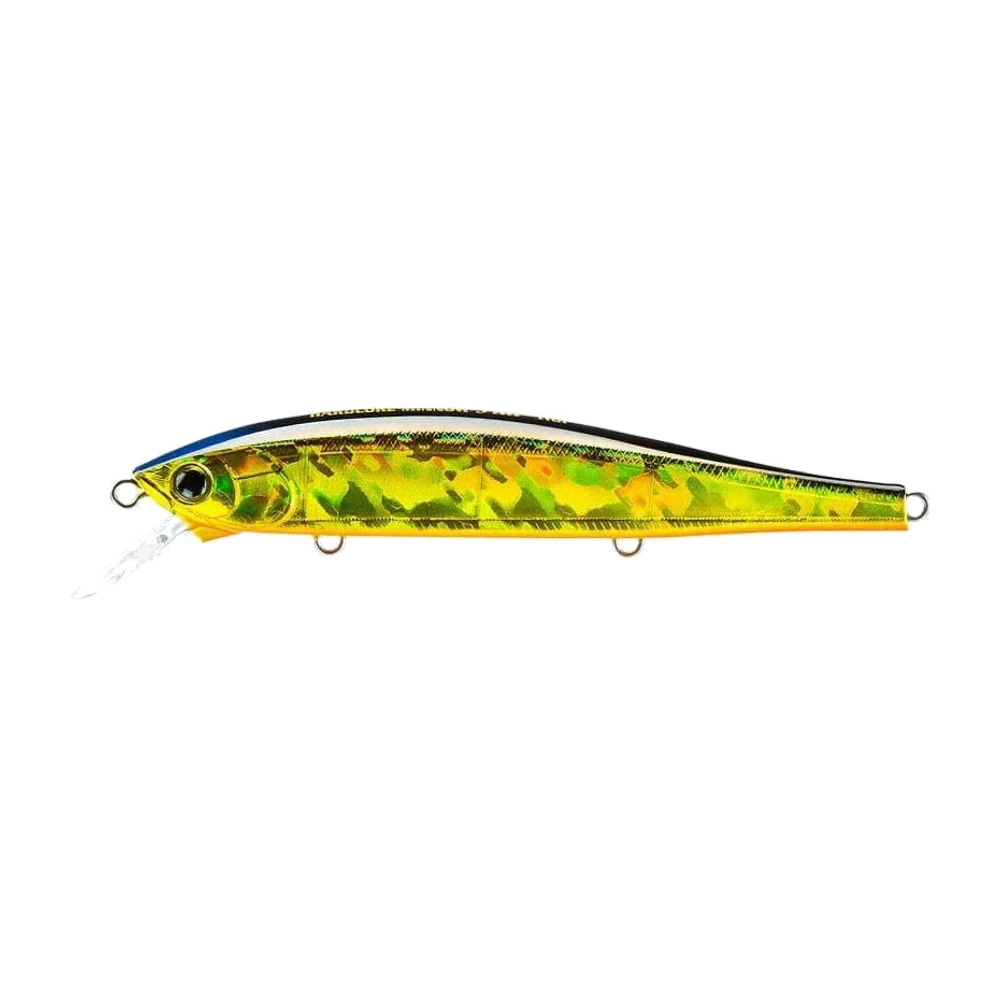
Yo-Zuri Hardcore Minnow: one lure for the canal and the harbour
Rather not fish it blind? Photograph your spot — CarnaFish cross-checks the conditions and points you the right way.
Some sessions you have no idea what you are going to find. A canal bank in late autumn, a harbour basin on a Sunday morning, a slow river after rain: you walk, you move spot every fifty metres, and you do not want to open the box each time. What you need is not the best lure for one situation, it is a lure that stays decent across five different ones.
The Hardcore Minnow fills exactly that role. It is spectacular nowhere, and that is precisely what makes it useful: it swims just as well on a slow straight retrieve for a pike on the margin as it does on short twitches for a bass sitting against a pontoon.
Two behaviours in one body
Most minnows are built around a single use: either a steady swimming action or a reaction to the twitch. Lures cut for one are usually mediocre at the other.
The Hardcore Minnow holds both thanks to a compromise in its balance:
- On a continuous retrieve, it produces a tight, steady roll with no wide wobble. That is a discreet action, easy to hold over long retrieves, and it works on a passive fish.
- On the twitch, it darts off line by 20 to 30 cm, no more, then comes back on its own. It is not the wide dart of a dedicated jerkbait, but it is enough to create a visible break in a metre of stained water.
- The internal mass-transfer system gives it honest range — 35 to 45 m depending on size — which matters when you are fishing from a high canal bank and want to reach the far margin.
The trade-off: it does not suspend properly. At rest it rises slowly depending on the model. That is not a flaw if you use it, as we will see.
Two retrieves depending on the fish
For pike along the margin, in a canal or slow river:
- Cast parallel to the far bank, a metre off the edge, not straight across.
- Retrieve slowly and steadily, rod tip at mid height, to hold the lure between 60 cm and 1 m.
- Make a dead stop every six to eight seconds. The lure rises a few centimetres: that is the main trigger on a pike that follows without committing.
- Start again immediately after the stop, with no violent jerk.
For bass in a harbour or sheltered basin:
- Cast against the structure — piling, hull, quay corner — and bring the lure away from it.
- Link two sharp, short twitches, wrist only, rod tip pointed at the water.
- Pause one to two seconds, no more: the lure rises, which creates an inverted staircase path.
- Repeat, slowing right down over the last five metres near the wall.
On the water: in a harbour basin, do not fish the middle. Bass run along vertical structure and often sit in the first fifty centimetres against the wall, in the shade. Stand at the end of the quay and cast along the wall, not out into open water: your lure then stays in the productive zone for the whole retrieve instead of crossing it in two seconds.
Choosing the size
| Size | Typical use | Target fish |
|---|---|---|
| 7 to 8 cm | Narrow canal margin, harbour basin | Bass of 35-50 cm, margin pike |
| 9 to 10 cm | Slow river, big canal, general searching | Average pike, decent bass |
| 11 to 12 cm | Wide water, hunting big fish, wind | Adult pike |
For pike, a 20 to 30 cm wire or titanium leader is essential, even on an 8 cm lure. Fluorocarbon in 0.50 mm is no substitute for wire: it holds sometimes, and "sometimes" means a lost lure and an injured fish.
Looking after a lure that sees brackish water
This model goes from fresh water to harbour water in the same week, and that is where lures die early. Salt attacks split rings and treble shafts long before it marks the paint.
The habit that doubles its life: after a saltwater session, rinse the lure in fresh water while shaking it, then let it dry hooks down, out of the box. A mass-transfer chamber that keeps a drop of salt water eventually seizes up, and the lure loses both its casting distance and its start-up without anything being visible from the outside.
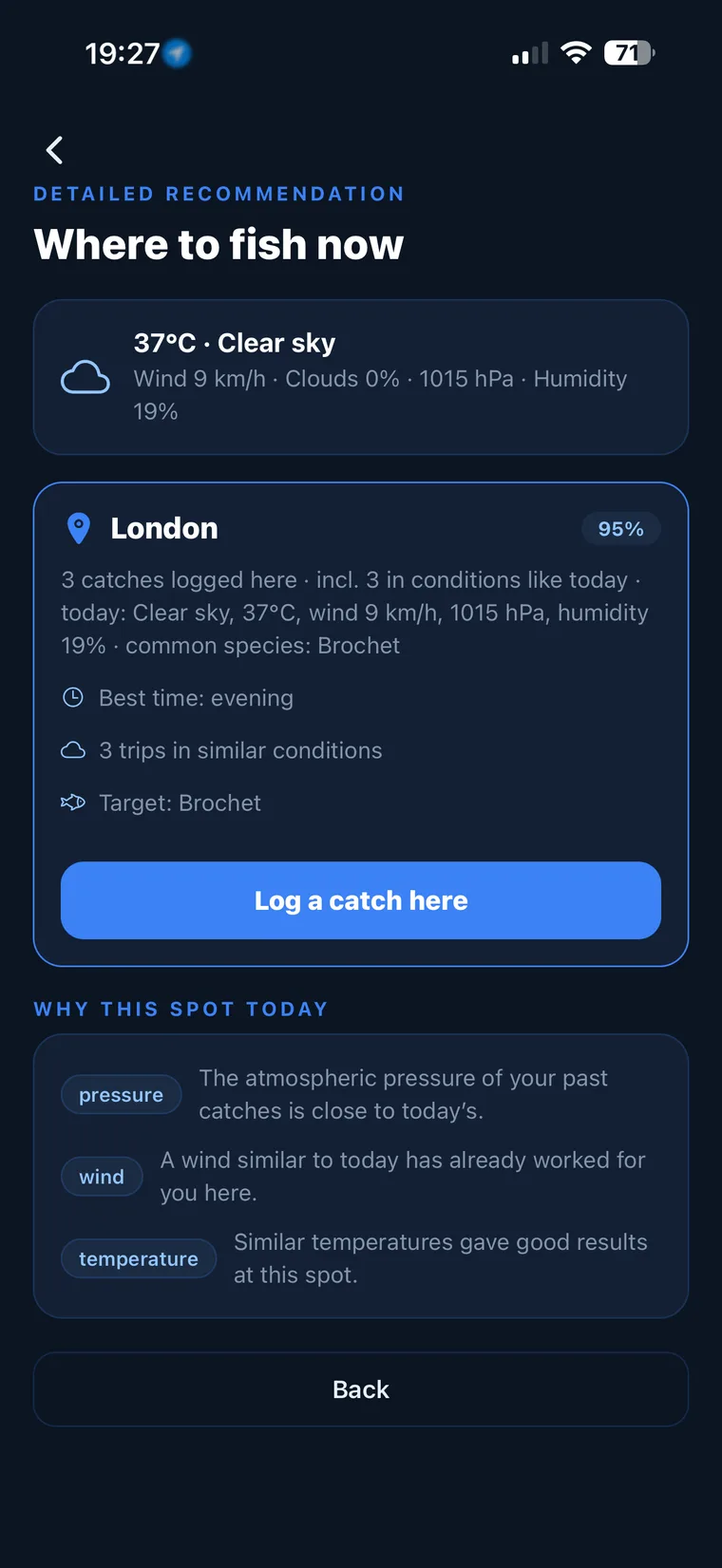
Not sure what to tie on?
Photograph your spot: CarnaFish reads the scene, cross-checks the conditions and gives you the zone, the lure and the retrieve. Free on iOS and Android.
Its limits, stated plainly
- It does not suspend. In very cold water, when you would want to hold the lure still for ten seconds, it rises and leaves its depth band. A suspending jerkbait does that better.
- It works high. Past 1.5 m it will not go down, whatever you do with line and rod.
- It cannot handle a sea state. Despite the family name, this model is built for sheltered water. As soon as there is chop, it blows out.
- It is too regular for very educated fish in clear, calm water.
Hardcore Minnow or Duel Heavy Minnow: same name, two jobs
This is the commonest confusion and it deserves clearing up: Yo-Zuri and Duel are two trade names of the same Japanese company, and the Hardcore range exists under both labels depending on the market. Hence models with near-identical names and very different roles.
The Duel Hardcore Heavy Minnow is a sinking, far denser model, cut for open sea: very long casts into the wind, dropping into the swell, working a rock face taking the weather. It is unusable in a shallow canal, where it hits bottom on the third turn of the handle.
The Hardcore Minnow is floating with slow buoyancy, lighter, tuned for a 0.6 to 1.5 m band. It is at home in sheltered, shallow water, and it drowns in the swell. The two do not replace each other; they cover opposite ends of the same catalogue.
If you want a pronounced dart and genuine stillness on the stop, the Yo-Zuri 3DB Jerkbait is the logical choice within the same brand. Our guide to choosing a pike lure places the all-round minnow among the other families. And if you are torn between straight retrieve and twitch when you reach your margin, CarnaFish analyses a photo of the spot and answers.
Key takeaways
- An all-rounder: fine on a slow straight retrieve and on short twitches, outstanding at neither.
- On canal pike, the dead stop every six to eight seconds is the trigger.
- In a harbour, cast along the wall rather than out, to stay in the productive zone.
- Wire or titanium leader is compulsory wherever there are pike, even in small sizes.
- Does not suspend, does not go below 1.5 m, cannot handle a sea state.
FAQ
Does the Yo-Zuri Hardcore Minnow suspend on the stop?
No, it rises slowly depending on the model. That is not a flaw if you use it: the gentle rise after a stop is exactly what triggers pike that follow without attacking.
What is the difference with the Duel Hardcore Heavy Minnow?
Yo-Zuri and Duel are two labels of the same company. The Heavy Minnow is sinking, far denser, designed for open sea and very long casts. The Hardcore Minnow is floating, lighter and meant for sheltered water between 0.6 and 1.5 m.
Do you need a wire leader for pike?
Yes, every time, even with an 8 cm model. Thick fluorocarbon is no substitute for wire or titanium: a cut-off means a lost lure and a fish swimming off with hooks in it.
What depth does it work at?
Between 0.6 and 1.5 m depending on size and rigging. It will not go deeper, even with fine line and a low rod: to search below that, you need a different lure family.
Is it suitable for bass in open sea?
Hardly. It is built for sheltered water — harbour basins, calm estuaries, protected channels. As soon as a sea gets up it blows out and loses its action; a dense sinking model suits far better.
What colour should you pick in a stained canal?
A dark or tiger back with a contrasting flank, or even a firetiger pattern. In low-visibility water, silhouette and contrast count far more than how realistic the pattern is.
The full sea bass lure guideSeason-by-season strategy: which family of lure, when, and why.Go from theory to fish
CarnaFish reads your spot from a photo and gives you the game plan: zone, lure, retrieve. Free on iOS and Android.