Yo-Zuri Crystal Minnow: the flash that cuts through churned water
Not sure this lure fits YOUR spot today? CarnaFish tells you in 10 seconds, from a photo.
A westerly morning on a shingle beach. The surface is churned, the water is carrying foam and suspended sand, and your minnow makes ten passes without anything happening. The reflex is to blame the fish: "they're not here". Often that's wrong. They are here, they just can't see your lure.
In broken, slightly coloured water, the swimming action stops being enough. A slim minnow's vibrations drown in those of the swell, and the silhouette gets lost in the chaos. What's left to work with is light: a brief, repeated signal that punches through where everything else fades out.
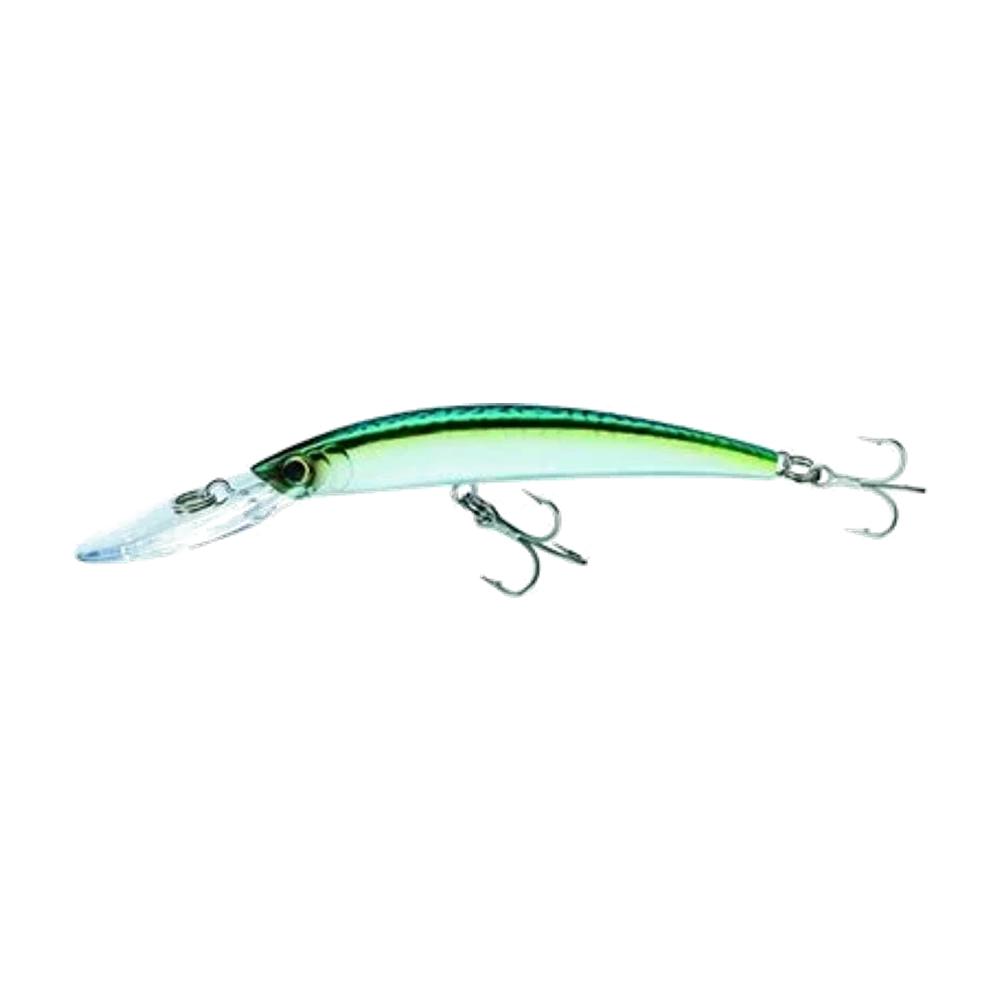
The Crystal Minnow is built around that. Its body isn't painted silver: it's made of surfaces that throw light back in several directions on every oscillation. It's a visibility lure before it's an imitation lure.
A body that works like a reflector, not like paint
Most minnows carry a metallic finish applied flat onto a smooth flank. The result is a single flash, which only appears when the flank lines up exactly between the sun and the fish. In flat, clear water that's enough. As soon as the light goes diffuse or the water gets stirred up, that flash becomes rare and random.
The Crystal Minnow plays a different game: the internal finish throws light back from several angles at once. Instead of one clean flash every two or three oscillations, you get an almost continuous run of micro-reflections, visible even when the lure isn't perfectly oriented.
Three practical consequences:
- The lure stays readable from the side and from below, which matters enormously for a bass sitting on the bottom looking up into the light.
- The signal survives the chop, because it doesn't depend on perfect alignment.
- It works in low light, at dawn or under an overcast sky, where plain chrome paint goes dull.
The other technical point is the action: a pronounced roll for a minnow this slim. The body tips from one flank to the other instead of settling for a lip wobble, and that's what feeds the reflector.
The retrieve: let the wave do half the work
In saltwater, the right move is not to fight the movement of the water but to complete it.
- Cast across the current or the drift, not straight out, so the lure crosses the water lane instead of swimming up it.
- Retrieve slowly for two or three seconds, long enough to feel the lip bite and the lure start to roll.
- Give a short twitch of the rod tip, ten to twenty centimetres. The lure darts then straightens up, and it's during that recovery that the flank is exposed longest.
- Leave a one-second micro-pause, reel stopped. The lure rises a few centimetres and takes a nose-up angle that multiplies the reflections.
- Pick the retrieve back up and repeat every three to five seconds all the way to your feet.
For pike in a lake, drop the twitches and go to a very slow straight retrieve, with a one to two second pause every five metres: in flat freshwater it's the steadiness of the roll that builds the signal, not the break.
On the water: on the coast, stop the reel completely when a wave passes over the lure. The push of water makes it roll on its own for a second or two, and that roll is more irregular — therefore more convincing — than anything you can produce with the rod. Plenty of bites come at exactly that moment, when the line is slack and you're not expecting it.
Choosing a size: the table that saves you buying five
The range covers a wide spectrum, and the choice depends on the depth of the zone more than on the size of the fish.
| Approximate size | Indicative weight | Running depth | Typical situation |
|---|---|---|---|
| 7 cm | 7 to 8 g | 0.3 to 0.6 m | Very shallow margins, perch and small bass, calm water |
| 9 cm | 10 to 12 g | 0.5 to 0.9 m | Beaches and estuaries, the most versatile size |
| 11 cm | 15 to 18 g | 0.7 to 1 m | Shore bass in wind, pike on lake margins |
| 13 cm | 20 to 25 g | 0.8 to 1.2 m | Long casts, formed swell, big bass and pike |
If you're only taking one, pick the middle 9 to 11 cm size: it casts properly in a crosswind and stays discreet enough late in the season.
Where it wins, and where it's beside the point
The Crystal Minnow is a lure for broken water and low light. Its window:
- The coast in a following or cross wind, when the surface is rippled and the water lightly coloured.
- Dawn and dusk, when the light is low but still strong enough for the reflector to work.
- Estuary mouths and tidal currents, where the lure has to cross a lane of dirty water.
- Lake margins early in the season for pike, on a slow straight retrieve over new weed growth.
Conversely, it's out of place in three cases. In very clear, flat water on pressured fish, its flash becomes a flaw: too much signal for a fish that has already refused ten lures. In genuinely dirty water, a strongly vibrating lure covers the ground better. And beyond 1.5 m, you're outside its range: this is a surface-layer lure.

Not sure what to tie on?
Photograph your spot: CarnaFish reads the scene, cross-checks the conditions and gives you the zone, the lure and the retrieve. Free on iOS and Android.
Rigging: what breaks and what to check
In saltwater, the weak point is never the body: it's the split rings and the trebles, which deform on a bass dragged over rocks. Check them after every physical session.
For line, 0.25 to 0.35 mm fluorocarbon is the right compromise in saltwater. For pike, you must move to a steel or titanium leader of 20 to 30 cm: a floating minnow gets grabbed across the body. A small round snap is acceptable and doesn't degrade the roll.
Crystal Minnow or long-casting minnow
Against a Rapala Max Rap Long Cast, the split is clear: the Max Rap reaches out thanks to its weight transfer, but swims a straighter line. The Crystal Minnow loses on distance and wins it back over the near thirty metres, when the fish are in the breaking waves and you need signal, not range.
Against a Duo Tide Minnow Slim, it's a question of profile: the Slim is finer and more accurate on wary bass in clear water, the Crystal Minnow louder and more forgiving in dirty water. If you want the same visual vocabulary with a sharper twitching style, the Yo-Zuri 3DB Jerkbait covers that slot.
Our guide to lure fishing for sea bass explains how to read a beach according to wind and tide. And if you're unsure which size to tie on when you arrive at churned-up water, CarnaFish reads a photo of the spot and answers for you.
Key takeaways
- This is a visibility lure: the finish throws light back from several angles rather than in a single flash.
- It excels in broken water and low light, exactly where a subtle minnow disappears.
- Cast across the current, short 10 to 20 cm twitches, one-second micro-pauses.
- Stop the reel as a wave passes: that passive roll triggers a lot of bites.
- Beside the point in flat, very clear water on educated fish, and beyond 1.5 m deep.
FAQ
How deep does the Crystal Minnow run?
Between 0.3 and 1.2 m depending on the size and the lip of the model. The small sizes stay just under the surface, the 11 and 13 cm get down towards a metre. It's a surface-layer lure: don't count on it to search beyond 1.5 m.
Is it a saltwater lure or a freshwater one?
Both, but not with the same retrieve. In saltwater you work it across the current with short twitches. In freshwater for pike, switch to a slow straight retrieve with simple pauses: the steady roll is enough to build the signal.
Do I need a wire leader?
For pike, yes, always: steel or titanium, 20 to 30 cm. For sea bass, 0.25 to 0.35 mm fluorocarbon is enough and stays more discreet — check it after every fish landed over rocks.
Why isn't my Crystal Minnow catching in clear water?
Because its strength turns into a handicap. In flat, clear water on fish that get fished for often, the sheer quantity of reflection can shut down the take. Switch to a slimmer, more matte minnow, or slow down and drop the twitches.
Can I fish it on a snap?
Yes. A small round snap doesn't restrict the roll and lets you change size quickly. Avoid heavy snaps, which weigh down the front and flatten the action on the smaller sizes.
What size for shore fishing for sea bass?
The 9 to 11 cm covers the vast majority of situations: it casts properly in a crosswind, runs between 0.5 and 1 m, and stays credible for bass of all sizes. The 13 cm mainly earns its place when you need to cast a long way or cut through formed swell.
The full sea bass lure guideSeason-by-season strategy: which family of lure, when, and why.Go from theory to fish
CarnaFish reads your spot from a photo and gives you the game plan: zone, lure, retrieve. Free on iOS and Android.