Yo-Zuri Hydro Pencil: the pencil that holds in estuary current
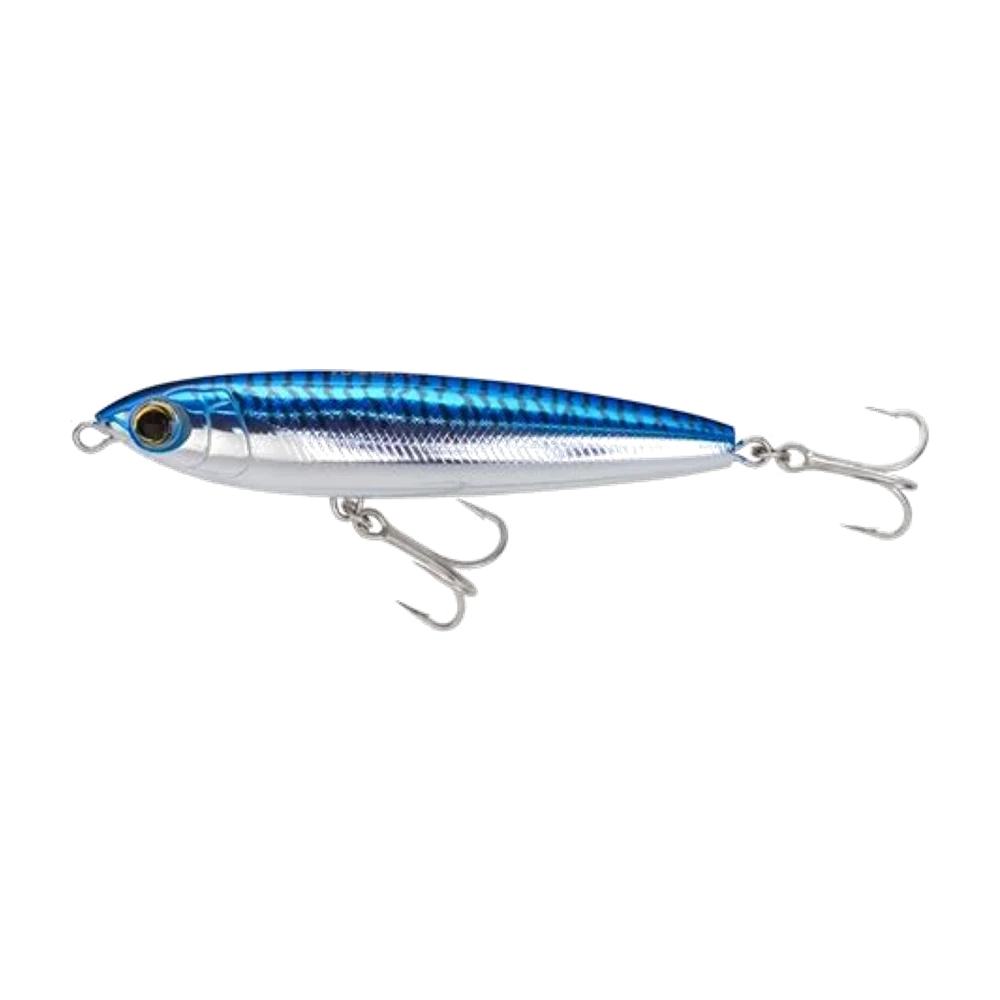
This lure shines under specific conditions. CarnaFish tells you in 10 seconds if today is one of them.
In an estuary, the surface lies. You see smooth water sliding past, you drop a floating pencil on it, and the current carries it off like a cork: it drifts, it turns broadside, and it never stays long enough in the seam that matters to be seen. Meanwhile the bass are ten centimetres lower, pinned in the layer where the current runs evenly, and they will not come up for a lure skating past.
The Hydro Pencil solves that by changing storey. It does not work on the water but in the surface film, a few centimetres down, which lets it stay keyed into the current instead of being pushed around by it.
A pencil that refuses to leave the water
Three things separate it from a classic surface stickbait.
Its buoyancy is close to neutral. At rest it does not stand up vertically like a tail-weighted pencil, and it does not lie flat like a calm-sea pencil. It stays roughly horizontal, very low, ready to go again on the first pull.
It displaces water instead of throwing it. No spray, no plop. On every pull you see a V-shaped wake and a travelling bulge. In a calm estuary at dusk, that discreet signal carries a very long way over smooth water — much further than you would think.
Its path is a continuous S, not a zigzag. Where a classic stickbait cuts sharp angles, this one draws curves. In practice the lure never stops completely, which keeps it from drifting off at the first surge of current.
The retrieve: pull long, never leave the current
This lure is not fished with the wrist but with the forearm.
- Cast upstream, at 30 or 40° up-current. Never downstream: a lure coming back with the current has no purchase at all.
- Let it drift for two seconds while you take up the slack, long enough for it to enter the seam.
- Give long, soft pulls, 40 to 60 cm of travel, rod horizontal, roughly one pull every two seconds.
- Let the current do half the work: between pulls you barely retrieve at all, you simply follow the drift while keeping light contact.
- Work the edge of the seam, where fast water rubs against slow. That is the line the bass sits on.
On the water: in an estuary, it is not the fast seam you should fish, it is its boundary. Find the line of foam or debris marking the split between current and dead water, and run your lure just on the slow side of that line. A bass spends zero energy behind the boundary and intercepts everything coming out of the current. Fish the middle of the seam and you are fishing empty water.
The time slot matters more than the tide
This lure has a window that is not the same as the others'.
| Time | How to fish it |
|---|---|
| Last hour of daylight | Regular pulls, translucent colours, wide searching |
| Full dark | Slower, more spaced-out pulls, dark opaque colours |
| First light | A brisker tempo, speeding up as day breaks |
| Broad daylight | Little effect, except under heavy cloud or in stained water |
On the tide: the first third of the ebb is generally the best moment in an estuary. The water starts dropping, the current organises itself, and everything spread across the mudflats gets pulled toward the channel. Two hours later, when the current gets too strong, the lure no longer holds and you need to drop a storey.
Colours and visibility at night
At night, colour works by contrast, not realism. A bass looking up sees a silhouette cut out against a sky slightly less black than the water.
- Dusk, clear water: translucent, pearl, a subtle back. The lure is still seen by its shape and its wake.
- Full dark: opaque and dark, black included. A clean silhouette beats a glitter finish that becomes invisible.
- Urban lighting (quay, bridge, street lamp): stay light and slightly reflective, and fish the shadow/light boundary rather than the lit area itself.
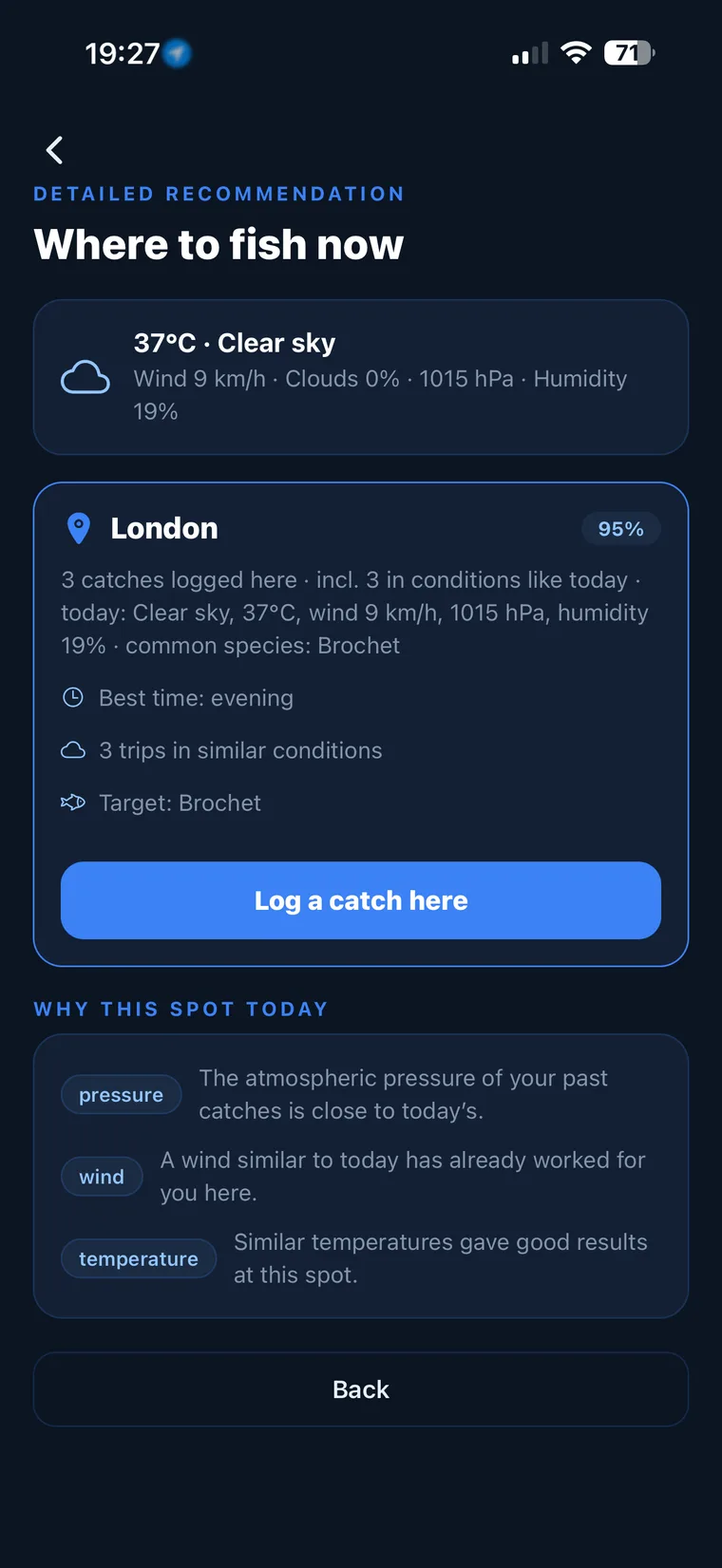
Not sure what to tie on?
Photograph your spot: CarnaFish reads the scene, cross-checks the conditions and gives you the zone, the lure and the retrieve. Free on iOS and Android.
Setting the hook in current
A detail that costs a lot of fish: in an estuary the bass almost always attacks across the current, and your line is rarely in line with the lure. A reflex hookset upward then only tightens an arc of line without moving the hooks.
The right answer is not to strike at all at first: speed the retrieve up by half a turn, let the rod load, and set sideways, downstream, once you feel the weight. On a surface lure worked slowly, that half-second of delay turns one missed bite in two into a hooked fish.
Where not to count on it
- A sea state and strong wind. Its near-neutral buoyancy and moderate travel make it unplayable as soon as there is real chop; you then need a heavier, more ballasted stickbait.
- Long range. It is not built to go past 50 m, which rules it out on offshore feeding fish.
- Very shallow water over weed, where its trebles snag straight away.
- Full sun on gin-clear water: it works too close to the surface to go unnoticed.
Hydro Pencil or open-sea stickbait
The Maria Chase SW is its design opposite: heavily rear-weighted, cut to hold in a sea state off a windswept point, fished fast and without pauses. Where it loses out is precisely in a calm estuary at dusk: it displaces too much water and its heavy glide looks brutal on a smooth surface.
Within Yo-Zuri, the most telling comparison is with the 3DB Popper: same surface family, radically different signal. The popper announces loudly and from a distance, which is useful on churned-up water or to gather scattered fish. The Hydro Pencil does the opposite — it slips discreetly through the seam, and it is that discretion that makes it effective on an estuary bass that has watched twenty lures go past in a week.
To plan your whole session around the tide, our guide to lure fishing for sea bass covers how the water layers follow one another on the ebb. And if you are unsure which side of the seam to attack when you reach the quay, CarnaFish analyses a photo of the spot and answers.
Key takeaways
- It works in the surface film, a few centimetres down, not on top of it.
- Long, soft forearm pulls, letting the current do half the work.
- You fish the boundary between fast seam and dead water, never the middle of the current.
- Best window: the last hour of daylight and the night, on the first third of the ebb.
- Unplayable in a sea state, at long range and in full sun on clear water.
FAQ
Is the Hydro Pencil a surface or subsurface lure?
Both, depending on speed. Retrieved slowly it stays in the surface film leaving a visible wake; speed up and it drops to around thirty centimetres. That adjustable range is what makes it useful in current.
How do you work it in estuary current?
Cast upstream at 30-40°, let it enter the seam, then give long 40 to 60 cm pulls roughly every two seconds while following the drift. You retrieve very little: the current does half the work.
Should you fish it at night?
That is its best window, along with the last hour of daylight. At night, slow the tempo, space the pulls out and switch to dark opaque colours that cut a clean silhouette seen from below.
What colour should you pick in water lit by a quay?
A light, slightly reflective finish — and above all the right placement: fish the boundary between the lit area and the shade rather than the cone of light itself. Bass hunt from the shadow into the light.
Is it suitable in rough seas?
No. Its near-neutral buoyancy and moderate travel make it blow out as soon as there is chop. In those conditions a heavier, rear-weighted stickbait holds its path far better.
What leader should you use?
Fluorocarbon of 0.30 to 0.40 mm, knotted straight to the split ring. A clip that is too heavy weighs the nose down and costs the lure its horizontal attitude at rest.
The full sea bass lure guideSeason-by-season strategy: which family of lure, when, and why.Go from theory to fish
CarnaFish reads your spot from a photo and gives you the game plan: zone, lure, retrieve. Free on iOS and Android.