Yum Crawbug: the hollow-bodied soft craw that scoots off the bottom
One lure, endless conditions. CarnaFish reads your spot from a photo so you are not just guessing.
On a rocky margin in late summer, bass stop looking up: they work the bottom, and what they are hunting down there has eight legs and two claws. Crawfish lures exist by the hundred, but most of them miss the detail that matters — it is not the resemblance at rest that triggers a strike, it is the behavior of a crawfish that has just realised it has been spotted. The Yum Crawbug is built around that moment.
A hollow body, and what it changes
The feature Yum states for this model is a hollow body, moulded with pronounced three-dimensional detail in a very soft compound. The three go together. The hollow volume makes the bait light for its size, the soft material lets the appendages move under minimal water pressure, and the detailing supplies the outline.
In practice a hollow, soft body responds to far smaller inputs than a solid bait of the same volume. A single twenty-centimetre drag along the bottom is enough to open and close the claws and set the legs working. That is exactly what you want when fish are sitting tight and a wide sweep only pushes them away.
There is also a less obvious consequence the maker does not mention: a hollow body can trap an air bubble when you thread it onto the hook. Rig it at the water's edge, let it sink where you can see it for a metre or so and watch how it behaves. If the tail rises instead of staying low, squeeze the body gently between two fingers under water to expel the air before the first real cast.
Two sizes, two jobs
Yum offers the Crawbug in two lengths, 2.5 in / 6.4 cm and 3.25 in / 8.3 cm, eight pieces per pack in both cases. The gap looks small on paper; it is obvious on the water.
The 6.4 cm is a finesse bait. On a light jighead or as a trailer on a small jig it goes everywhere and suits hard days, clear water and educated fish. It is also the size that interests perch wherever they share the bottom with crayfish, on riprap and dam margins.
The 8.3 cm is the classic Texas-rig format, the one you send into cover with a bullet weight and a wide-gap hook. It moves more water, shows up from further away and grades fish sizes slightly upwards. As a trailer on a 10-14 g jig it rounds out a package that needs volume without going full bulky.
A fleeing crawfish never runs forwards: it backs away in sharp flicks of the tail. If you want to be convincing, angle your drags so the bait hops towards you tail-first, then let it settle. This is not a cosmetic detail — it is the trigger, and plenty of anglers work a craw like a worm without ever noticing.
Working the Crawbug: three presentations
Football jighead
The most direct presentation. A 5-10 g football head threads the Crawbug along the body and keeps it in permanent contact with the substrate, claws up. You drag slowly, you feel the head bump every stone, and you pause for one or two seconds each time you clear an obstacle. Over hard bottom — rock, gravel, rubble — this is where the bait is at its best.
Texas rig with a bullet weight
Wide-gap hook, point buried in the back, 5-14 g bullet weight pegged or free. This rig is compulsory as soon as you fish flooded wood, branches or dense vegetation. The action then becomes vertical: lift, follow the fall, move on. A pegged weight transmits bottom feedback better, while a free weight lets the bait sink more slowly behind the lead.
Jig trailer
The use that needs the least adjustment. The Crawbug threads onto a skirted jig's keeper and adds two moving claws to a bait that has none. Pick the 6.4 cm on a compact jig, the 8.3 cm on a flipping jig. One thing to watch: the compound is very soft, so the grip on the keeper tires faster than with a dense plastic trailer. A drop of soft-plastic glue at the collar solves it for the day.
The classic mistake
Working it too hard and too fast. The Crawbug is built to respond to small inputs: the further you pull, the less its appendages move proportionally, because water pressure pins them against the body. Maximum output from legs and claws comes at a very slow, almost crawling pace. If you feel nothing is happening, slow down further before you reach for a heavier weight.
Not sure what to tie on?
Photograph your spot: CarnaFish reads the scene, cross-checks the conditions and gives you the zone, the lure and the retrieve. Free on iOS and Android.
Colors by water clarity and season
Yum does not name any colors in this model's description. So think in tone families, which is more useful than a trade name anyway:
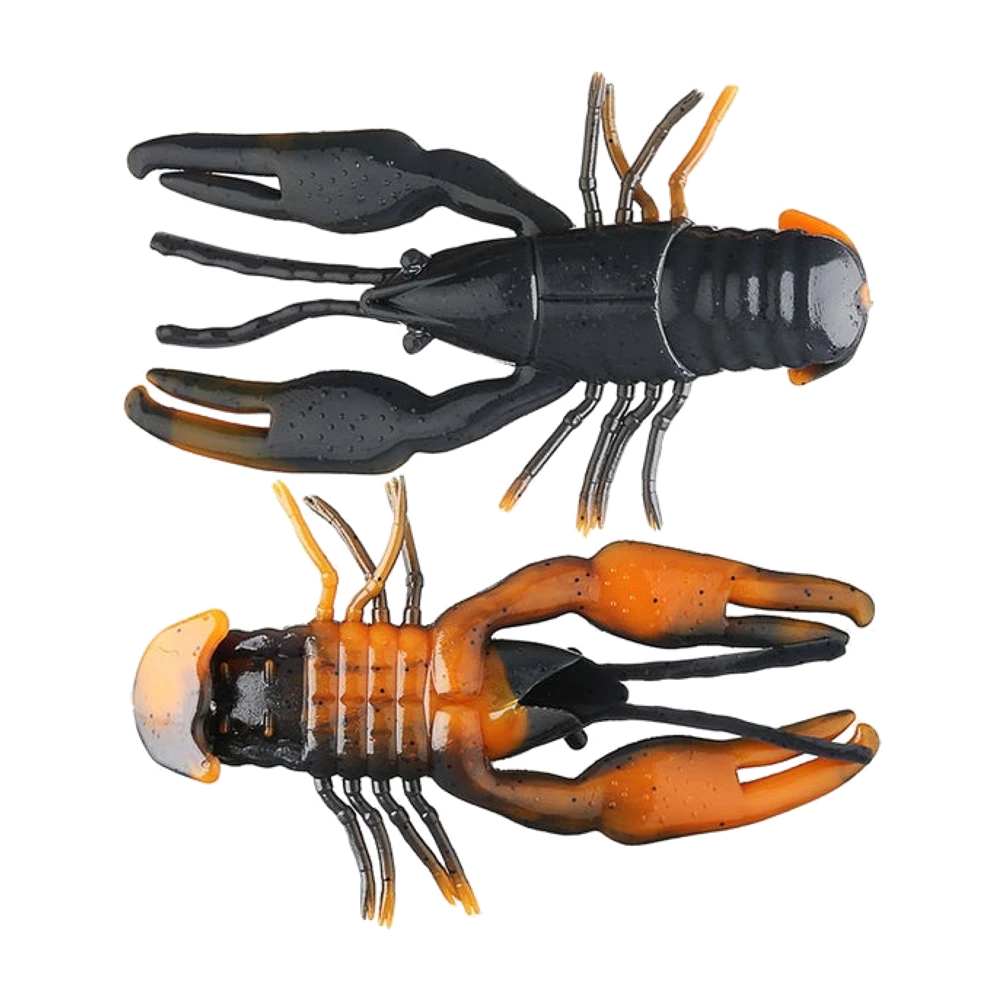
- Clear water over rock: browns and rusty oranges, like the lower bait in the photo. That is the real livery of an adult crayfish in most European waters.
- Stained water or dark bottom: near-black tones, like the upper bait. You are not after color here but after contrast in the silhouette seen from below.
- Spring, moulting and breeding period: dark bodies mixed with bright orange, with the claws clearly marked. Crayfish turn distinctly orange at that time of year and bass react strongly to it.
Keep in mind that on a crawfish the contrast between body and claws usually matters more than the overall tone. That contrast is what gives the fish a reference point to strike at.
Where to use it first
Hard bottom above all: riprap, scree, gravel, rock shelves, dam blocks, bridge pilings. Crayfish live where they can hide under a stone, and a craw bait over pure silt is an inconsistency that wary fish do pick up on. Reed edges over a hard substrate also work very well, especially early and late in the season.
Next to a Gary Yamamoto 3 Yama Craw, softer and more buoyant in the lower body, or a Keitech Crazy Flapper which relies on big flat, highly mobile claws, the Crawbug plays the realism and fine-appendage card. A Berkley PowerBait Chigger Craw remains the blunter choice for flipping. All three sit happily in the same box.
Reading the bottom is what decides whether a soft craw makes sense on a given spot, and that is exactly what CarnaFish settles quickly: a photo of the swim, and the AI suggests a zone, a depth and a presentation consistent with the day's conditions. To lay the groundwork, our guide to getting started with bass fishing covers the tackle and the classic holding spots.
Key takeaways
- Hollow body and very soft compound: claws and legs move on minimal input, so work it slowly and in short drags.
- Two sizes, 6.4 cm for finesse and for perch, 8.3 cm for Texas rigs and flipping, eight per pack either way.
- Three rigs cover everything: football head over hard bottom, Texas rig in flooded wood, jig trailer.
- Yum publishes neither a weight nor a density for this bait: test yours in a metre of visible water to learn its real attitude, all the more so with a hollow body.
FAQ
Does the Yum Crawbug sink or float?
The maker gives no density figure for this model, and the size table carries no column of that kind. Like any unweighted soft plastic, the rig decides how it falls; check your own in clear water before fishing, especially as a hollow body can trap an air bubble.
Which size should you start with?
The 8.3 cm if you mainly fish Texas rigs and jig trailers, the 6.4 cm for clear water, educated fish, or if perch interest you as much as bass. If in doubt, the 8.3 cm is the more versatile of the two.
What weight should you use?
5 to 10 g on a football head over hard bottom, 5 to 14 g as a Texas bullet weight depending on how thick the cover is and how much wind there is. Keep the lightest weight that still lets you feel the bottom: too heavy and the fall is crushed and you miss the bites on the drop.
How many pieces are in a pack?
Eight, in both sizes offered. That is a fair count for a bottom bait, but the compound being very soft, expect to get through more of them than with a dense plastic if you fish rock.
Can you catch perch on the Crawbug?
Yes, mainly in 6.4 cm on a light jighead, wherever perch share the bottom with crayfish populations — riprap, dam blocks, rocky margins. Stay on short movements and long pauses, perch inspect before they commit.
Why do the claws barely move?
Because the action is too wide or too fast: under water pressure the appendages fold against the body and stop working. Cut your drags down to fifteen or twenty centimetres and lengthen the pauses, and the bait comes straight back to life.
The full bass lure guideSeason-by-season strategy: which family of lure, when, and why.Go from theory to fish
CarnaFish reads your spot from a photo and gives you the game plan: zone, lure, retrieve. Free on iOS and Android.