Yum Hellgrammite 3: the soft larva that flails on a ned rig
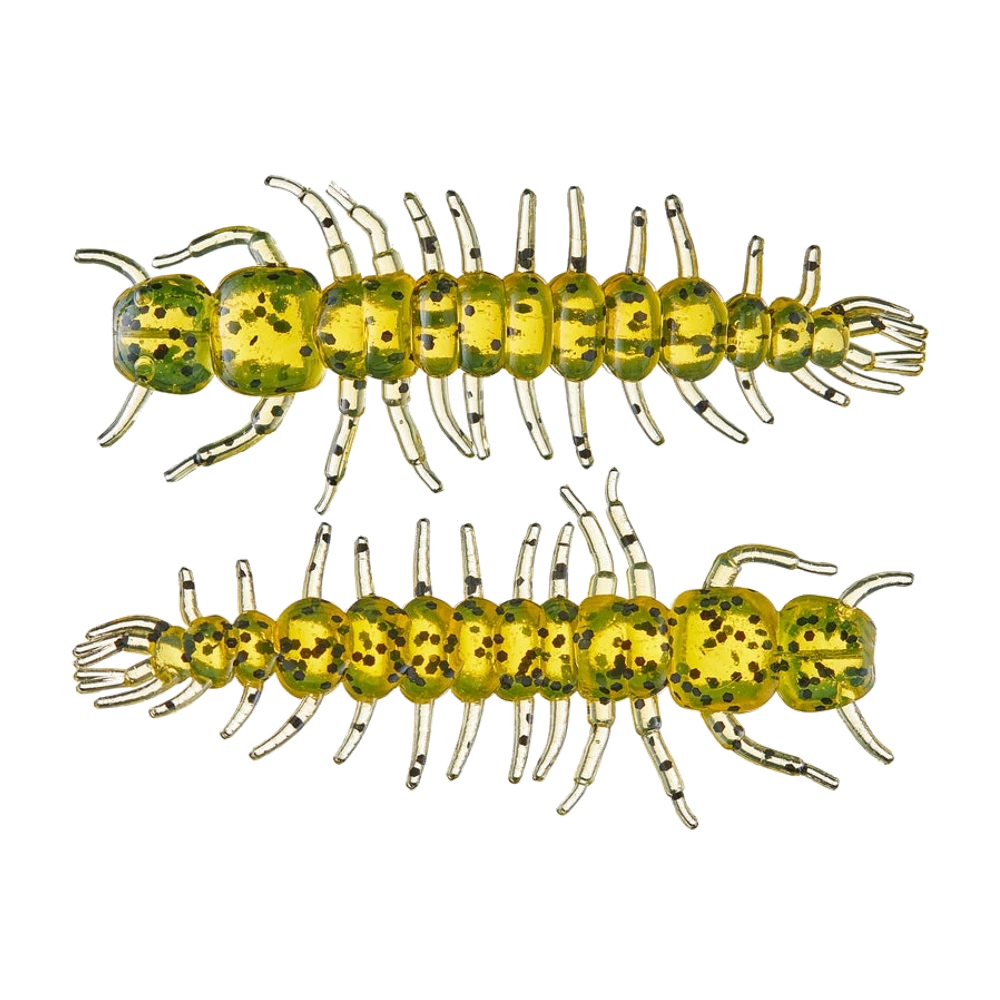
This lure shines under specific conditions. CarnaFish tells you in 10 seconds if today is one of them.
In a rocky-bottomed river, turn a stone over: what you find there — flat larvae, nymphs, small legged creatures — makes up the bulk of the diet of nearly every fish in the stretch. That is exactly what the Yum Hellgrammite sets out to reproduce, with a clear stance: not a shad, not a craw, but an aquatic insect with a segmented body and thread-thin appendages, cut out for slow fishing in contact with the bottom.
What the bait actually imitates
A hellgrammite is the aquatic larva of the dobsonfly, a large North American insect. Over there it is a major prey item for river bass and trout, to the point that local anglers use it as live bait.
In Europe that larva does not exist. Better to say it plainly: no European fish has ever seen a hellgrammite. But that matters far less than it sounds, because this bait does not work as a species-accurate imitation — it works as a generic outline of a big aquatic larva. Our rivers are full of them: stonefly larvae, cased-less caddis, dragonfly nymphs, and they all share the same layout — a long segmented body, legs along the flanks, appendages at the rear. Yum acknowledges as much in its own copy, noting that the model also matches nymphs and small crawfish.
On the bait itself, three features do the work. A body in pronounced segments, which breaks up the light and gives that jointed look no smooth body reproduces. Fine legs set along both flanks, long enough to stand well clear of the body. And a tail split into fine strands that carries the movement backwards. Together they produce what the maker calls a flailing action: unlike a paddle tail that beats regularly, here every appendage moves on its own account.
The test worth doing once, at the water's edge: set the rigged bait on the bottom where you can see it, in half a metre of water, and pull the line one centimetre. You will see every leg take off at once in a different direction. One centimetre. That is the scale this bait is built to work at, and it is ten times finer than what an angler who has never looked actually does.
The ned rig, and why it is the right one
Yum designs this model around its own weedless ned head, and the choice makes sense. A ned rig means a small soft plastic on a light round jighead, set up so the bait stands vertically when it rests on the bottom. Applied to a larva the result is instantly credible: the bait stands up on its head, legs in the air, exactly like a larva clinging to a stone.
On weight, stay light. Two to three grams is enough in a metre of still water or along a margin. Four to five becomes necessary in marked current or to hold bottom beyond three metres. Go heavier and you lose the point: the head becomes too heavy for the bait's volume, the body lies down and the legs stop working.
The weedless version, with the point protected, earns its place in the second use Yum states: cluttered shorelines, grass and wood laydowns. That is exactly where a conventional open-hook ned rig becomes unusable.
If you are new to this rig
The ned rig needs light tackle: a 3-14 g spinning rod, fine braid and an 18-22 hundredths fluorocarbon leader. The bite usually registers as a simple heaviness, not a sharp knock. Our page on the ned rig walks through the setup step by step if you want the basics.
Where and how to fish it
In rivers, its home ground
Yum presents it as a bait for river and creek anglers, and that holds up. The method is simple: cast upstream or across, let the bait settle on the bottom, and follow its drift keeping just enough contact to feel the stones. You barely animate it at all — the current does that. The targets are the eddies behind a boulder, the holes at the tail of a riffle and deep shaded margins.
Along cluttered shorelines
The second stated use: low grass and fallen trees. Here you cast as tight to the cover as you can, let it sink, and work it in small ten to twenty centimetre pulls broken by three to five second pauses. The bite almost always comes during the pause.
The classic mistake
Treating it like a worm and working it in long pulls. The appendages fold against the body as soon as speed picks up, and all that is left is a small piece of lifeless plastic. If you feel this bait is doing nothing, the first thing to try is not a colour change but dividing your stroke length by three.

Not sure what to tie on?
Photograph your spot: CarnaFish reads the scene, cross-checks the conditions and gives you the zone, the lure and the retrieve. Free on iOS and Android.
Colors by water clarity
Yum advertises a wide colour range without naming any of it in this description. Think in families:
- Clear water: translucent greens with flake, as in the photo. A live larva is rarely opaque, and transparency combined with flake reproduces well the way light passes through an insect body.
- Rocky bottom, moderately clear water: natural browns, which disappear against the substrate and force the fish to key on movement rather than colour.
- Stained water or dark overhung stretches: solid dark tones. On a larva, a clean silhouette matters more than the detail of the finish.
A niche bait that still earns a slot
The Hellgrammite is not a versatile lure and does not try to be. Next to a Zman TRD Ned Rig, the category benchmark with its buoyant compound, or a 6th Sense Ned Fry Worm with its more neutral profile, it brings one specific thing: a very large number of moving appendages on a very small volume. That is exactly what you want when a fish is parked, inactive, and you need to put something alive under its nose without ever moving it away.
It also interests perch in Europe, on the same rocky lies and with the same crawling pace — a style of fishing that demands patience but delivers when faster lures have stopped producing.
What remains is knowing whether a spot suits this slow approach or calls for covering water instead. That is what CarnaFish settles quickly: a photo of the swim, and the AI suggests a zone, a depth and a presentation suited to the conditions of the moment. If rivers are your ground, our guide to river trout fishing complements the approach through reading current.
Key takeaways
- A 7.6 cm / 3 in imitation of a large aquatic larva, segmented body and thread-thin appendages, designed around the weedless ned rig.
- The larva it copies does not exist in Europe, but the general outline matches our big river nymphs: the bait works through the overall layout, not the species.
- Work it by the centimetre, not by the pull: the faster you go, the less the appendages move.
- Yum publishes neither weight nor density for this model: the sink rate depends entirely on the jighead you choose.
FAQ
What exactly is a hellgrammite?
It is the aquatic larva of the dobsonfly, a large North American insect. It lives under river stones and is a major prey item there for bass and trout. It is not present in Europe, but our big river nymphs present a very similar outline.
Does the bait still work in Europe?
Yes, because to the fish it does not imitate one precise species but a type of prey: long segmented body, legs along the flanks, appendages at the rear. Our stonefly larvae and dragonfly nymphs share exactly that layout, and river fish know them very well.
What ned head weight should you choose?
2 to 3 g in still water or along a shallow margin, 4 to 5 g in marked current or beyond three metres. Above five grams the body lies flat on the bottom and the appendages stop working, which cancels the point of the bait.
Does the Hellgrammite float like a TRD?
The maker gives no density figure for this model, and there is no size and weight table. So do not assume it stands up like a buoyant Zman TRD Ned Rig: check how yours behaves in half a metre of visible water before you fish it.
Can you really catch trout on it?
Yum lists trout among the target species, which is consistent with a larva imitation fished on the bottom in rivers. Do check local rules though: on some beats soft plastics are restricted or banned outright.
How many pieces per pack?
Retailers list it in packs of eight. The maker's description does not state it directly, so check the packaging before ordering, especially if you are comparing prices between shops.
The full bass lure guideSeason-by-season strategy: which family of lure, when, and why.Go from theory to fish
CarnaFish reads your spot from a photo and gives you the game plan: zone, lure, retrieve. Free on iOS and Android.