Z-Man Sling Bladez Double Willow: the head that refuses to roll
One lure, endless conditions. CarnaFish reads your spot from a photo so you are not just guessing.
Every angler has watched a spinnerbait lie down on its side the moment the retrieve speeds up: the blade stalls, the lure corkscrews back to the boat and the follow you could just make out behind it stops dead. The culprit is almost never the blade — it is the head. The Z-Man Sling Bladez, designed by Luke Clausen, attacks that exact point with a grooved underbelly, and it is about the only spinnerbait on the market that leads with that detail rather than with its blades.
StabilTrack: a keel under the belly
Z-Man calls the head geometry StabilTrack. The idea is simple: a lengthwise groove under the lead body, working like a boat's keel. As the lure picks up speed, the side forces that make it roll press against that ridge instead of tipping the lure over, and the maker claims rolling is eliminated at any retrieve speed.
What that means on the water is very concrete. A spinnerbait that no longer rolls is first of all a spinnerbait you can burn without choking it — so a fast search bait along an edge, at the speed that triggers reaction strikes. It is also a lure whose attitude never changes: the skirt stays level, the hook point stays up, and your hooking percentage does not collapse the moment a fish eats it from the side. Finally, it is a lure you can wake just under the surface without it flopping flat.
Luke Clausen belongs to the very small group of anglers who have won both the Bassmaster Classic and the Forrest Wood Cup. That guarantees nothing about a lead head, but it explains the brief: a tournament lure where nothing is allowed to go out of tune by the twentieth cast of the day.
Twin willow blades: flash, not thump
The double willow choice is not neutral. A willow leaf spins close to the arm, moves little water and mostly throws reflection; a Colorado takes the water head on and produces thump. Running two willows means accepting a lure that trades on the visual rather than on pressure waves.
In practice the Sling Bladez Double Willow wants reasonably clear water, light and a committed retrieve. In milky water under a low sky, a Colorado model will beat it. But the moment fish are feeding by sight on a bait ball, the double willow does exactly its job: plenty of flash, little resistance, a lure that rises quickly and does not punish your wrist.
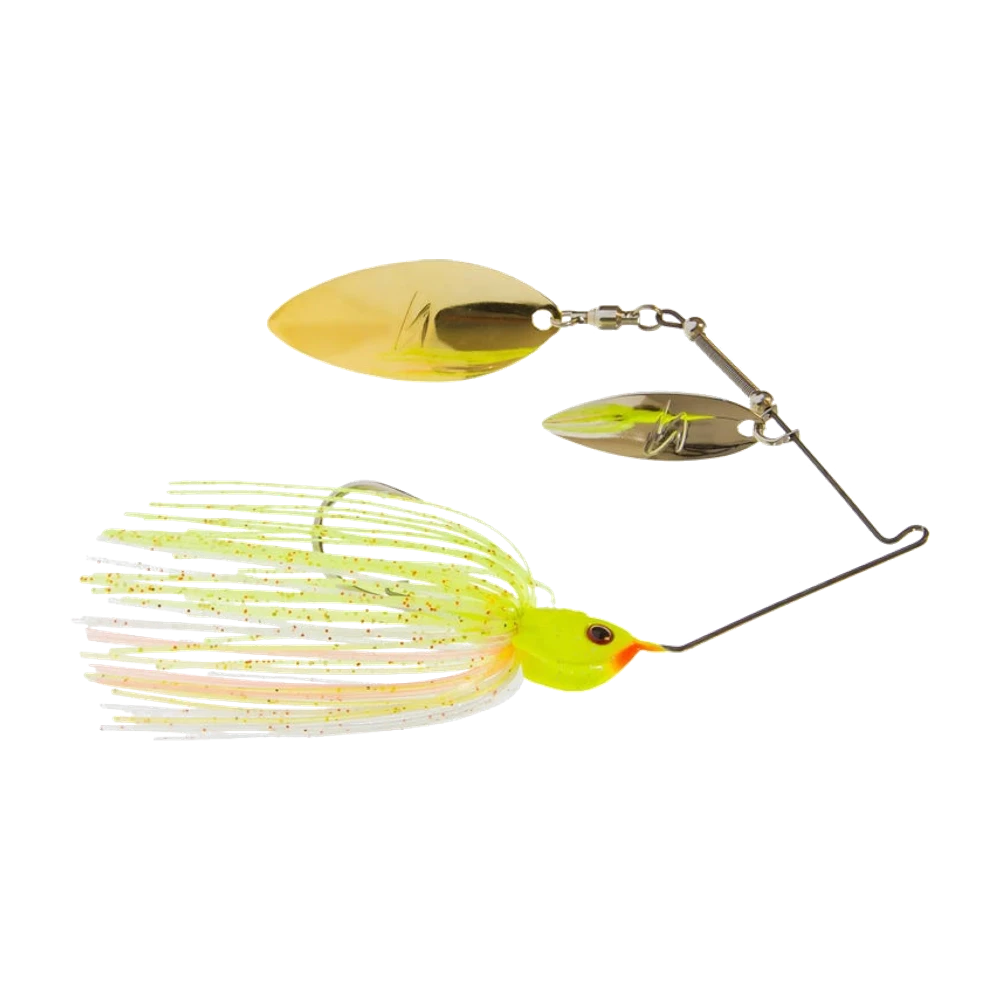
The product copy states that both blades are electroplated with a highly reflective finish. On the sample photographed, the two are different metals: a small nickel willow near the head and a large gold willow at the end of the arm. That silver-and-gold contrast is a classic in shifting light, because the two metals return different wavelengths.
Tuning the arm, the step nobody takes
A new spinnerbait is rarely perfectly aligned, and one that has taken a few hits is not aligned at all. Lay the lure flat on your palm and sight down it from the front: line tie, head and hook should sit in the same vertical plane. If the upper arm is off, bend it back gently by hand. The 17-7 wire the maker quotes is a spring steel — it holds, but it does not like repeated back-and-forth. Set it once, properly.
A 5/0 hook and what follows from it
The copy lists a VMC O'Shaughnessy hook in 5/0. That is a hook size, not a fraction of an ounce: 5/0 is a heavy wire with a wide gape, leaving room for a soft trailer without the point resting against it. Combined with the wire keeper that locks the trailer in place, you get a setup that does not slide on the cast.
A gape that wide calls for a firm hookset and the gear to match: medium-heavy rod, strong braid or fluorocarbon. It is the exact opposite of a finesse jig like the Dirty Jigs Luke Clausen Finesse Jig, signed by the same angler but designed for the other end of the spectrum.
That 5/0 is also what makes this lure relevant for pike in Europe, provided you add a bite-resistant leader. The steel arm shields part of the rig, but a pike eating it sideways will cut mono in front of the line tie without any trouble.
Where and when to use it
A double willow spinnerbait is an edge lure and an upper-water-column lure. Three situations where it takes over: a reed line or laydown bank you parallel at a constant speed half a metre off the cover; a grass flat where you run it over the tops with the blades just under the surface; and a wind-blown drop where you let it sink a few seconds before reeling it up the slope.
The classic mistake
Reeling too slowly "to make the blades turn". That is Colorado thinking. Willow blades spin up almost instantly and accept high speeds; a slow retrieve turns them lazily, with no flash and no vibration, and gives the fish all the time it needs to inspect the lure. If you want to fish slowly along an edge, change family and go to a bladed jig, for instance a Z-Man ChatterBait Jack Hammer, which keeps a strong signal at a crawl.
Not sure what to tie on?
Photograph your spot: CarnaFish reads the scene, cross-checks the conditions and gives you the zone, the lure and the retrieve. Free on iOS and Android.
Colors by water clarity
The product copy names no color at all. The sample photographed carries a chartreuse head with a red gill mark and a painted eye, and a silicone skirt mixing white and chartreuse strands with copper flake. That finish sets the grid:
- Stained or green water: chartreuse and white exactly as shown, with the gold blade returning warm light in water that filters out blue.
- Clear, bright water: white and silver with two nickel blades, to stay in the baitfish register without overplaying it.
- Very dark water or late evening: black skirt with a dark or copper blade, where silhouette matters more than reflection.
What the product copy leaves out
And it hurts: no weight, no length, no blade size is given. On a spinnerbait, weight is the first selection criterion, since it sets running depth at a given speed. Without that number, nothing better than a usage range can honestly be stated — read the packaging in the shop. For a numbers-based approach to weights and blades, the Booyah Covert Spinnerbait page lays out the weight-to-depth logic, which transfers directly here.
Always carry two identical Sling Bladez. A spinnerbait rarely dies of wear — it dies of an arm bent on a stump — and swapping in an identical one mid-flurry beats spending ten minutes straightening wire.
Picking the right spinnerbait family mostly comes down to reading the spot: clarity, vegetation, depth of the break. That is exactly what CarnaFish does from a single photo of the spot, suggesting a zone and a presentation type that fit the day's conditions. For the rest of the pike box, our guide on which lure for pike puts the spinnerbait back among the other families.
Key takeaways
- The real novelty is the grooved StabilTrack head, which stops the lure rolling over when you speed up.
- Double willow means lots of flash and little vibration: clear water, light, committed retrieve.
- Wide-gape 5/0 hook and a wire trailer keeper: medium-heavy gear and a firm hookset are mandatory.
- No weight published by the manufacturer — check the packaging before you buy.
FAQ
How fast should I retrieve this spinnerbait?
Medium to fast. Willow blades start turning from the first crank and take speed without stalling, and speed is precisely what triggers the reaction bite along an edge. Crawling it turns it into a lure it was never designed to be.
Can I fish it for pike?
Yes, the 5/0 hook and the steel wire build suit it, provided you add a bite-resistant leader. The upper arm does not protect the connection in front of the line tie, which stays the weak point on a sideways strike.
Should I add a soft trailer?
Not compulsory, but usually worth it: a swimbait or a twin tail slows the lure slightly, widens the silhouette and adds lift. The wire keeper on the arm exists for exactly that and stops the trailer sliding on the cast.
Double willow or Colorado?
Double willow for flash, speed and clear water; Colorado for vibration, slow speeds and dirty water. In milky water under a low sky, a Colorado will outfish this model, which bets on the visual first.
Which weight should I choose?
The manufacturer does not publish its weights, so go by the packaging. The logic is standard: lighter to fish high and slow, heavier to get down a wind-blown break or hold a line in current.
Why doesn't my spinnerbait run straight?
In almost every case the arm is out of alignment. Sight down the lure from the front: line tie, head and hook must sit in the same plane. Bend the wire back by hand once, cleanly — spring steel does not like repeated corrections.
The full bass lure guideSeason-by-season strategy: which family of lure, when, and why.Go from theory to fish
CarnaFish reads your spot from a photo and gives you the game plan: zone, lure, retrieve. Free on iOS and Android.