Zoom Uni Toad Swimbait: one paddle instead of two legs
Rather not fish it blind? Photograph your spot — CarnaFish cross-checks the conditions and points you the right way.
A lily pad mat at dawn, glass-flat water, and not one place to land a hard bait without snagging it in the first metre. That is the soft toad's exclusive ground: a flat body you reel in without ever stopping, which crosses the vegetation leaving a wake behind it, and which a bass comes up to take in a sheet of spray. The Uni Toad is the quietest member of that family, and that is precisely why it is worth a look.
A toad is not a hollow frog
The confusion is common on the shelf and it costs fish. A hollow-body frog is a soft plastic shell with two double hooks laid against it: it floats at rest, you walk it on the spot, and it collapses on the hookset to free the points. A toad like the Uni Toad is a solid body on a single hook, and it does not float on its own: retrieve speed and the paddle's lift are what keep it on the surface.
The consequence for how you fish is immediate. With a hollow frog like the SPRO Bronzeye Frog you can sit still for ten seconds over a hole in the cover. With a toad, the moment you stop, the lure drops. These are not two versions of the same tool, they are two kinds of fishing: the frog works on the spot, the toad covers ground. Over a big mat the two complement each other perfectly on two ready rods.
One paddle instead of two legs
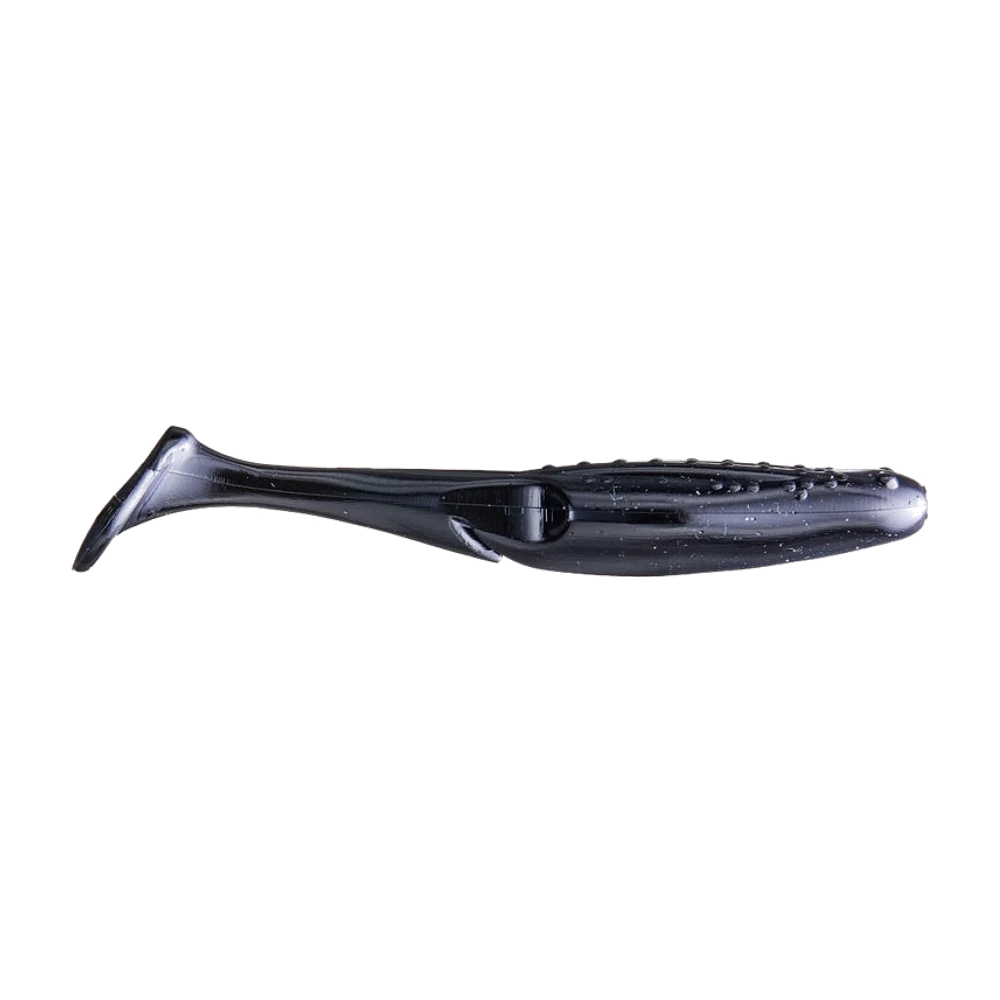
That is the only difference Zoom states against the original model: the same body as the Zoom Horny Toad, but a single paddle tail at the back in place of the two Ultra-Vibe legs. In the photo, the flat body, the little nubs lined up along the back and the belly slit are indeed the Horny Toad's; only the tail changes.
That change is not cosmetic. Two legs beating in alternation produce a chopped-up splashing, an almost constant surface noise — that is the Horny Toad's signature. A single wider paddle produces something else: less airborne noise, but a fuller kick and a stronger pressure wave below the surface. Zoom talks about a strong kicking motion that bass crush on top; the practical takeaway is that the Uni Toad suits calm days, flat water and fish that refuse anything too noisy, while the Horny Toad stays the logical pick in a chop or in stained water.
One rigging consequence follows. A single paddle applies torque to one side as the lure starts moving: rigged off-axis, it takes on a roll and ends up on its flank after a few metres. Check the alignment by eye before you start casting seriously.
The belly slit, and why it is there
Zoom mentions a slit under the belly intended to improve hook penetration. That is the historic weakness of the solid toad: on the hookset the point has to travel through the full thickness of the body before reaching the fish's mouth, and in slightly thick plastic it does not always make it. The slit creates a zone of lower resistance exactly where the point is buried.
Rigging it, step by step
A wide-gap Texas hook sized to the body, or a screw-lock holder if you want to stop wrecking the nose on every cast. Enter at the tip of the nose, exit a centimetre back, turn the hook over, then bury the point in the back so it just sits under the skin, square with the belly slit. A back held too tight pins the lure and blocks the hookset; too slack and the body bunches and ruins the swim. The right setting is when the lure is perfectly straight without being stretched.
One speed, held from start to finish
Working the Uni Toad comes down to a single sentence: cast, rod at 45 degrees, reel steadily and never stop. The right rhythm is the one that just brings the paddle's wake to the surface — not fast enough for the lure to skip, not slow enough for it to sink. Over dense grass, raise the rod to lift the lure over the top; in open water between two mats, drop it to make the lure work three or four centimetres down.
The rule that makes all the difference: when the fish explodes, do not strike. Keep turning the handle until you feel the weight in the blank, then sweep sideways. A reflex hookset on a toad pulls the lure out of a still-open mouth nine times out of ten, and it is the most widespread mistake on this family of lures.
Not sure what to tie on?
Photograph your spot: CarnaFish reads the scene, cross-checks the conditions and gives you the zone, the lure and the retrieve. Free on iOS and Android.
As a buzzbait trailer
Zoom puts forward a second use: rigging the Uni Toad behind a buzzbait in place of the silicone skirt. The arguments given are better casting and a bigger target, and they hold up — a skirt brakes in the air, a solid body does not, and a 10 cm toad visually doubles the size of the package. In practice a Booyah Buzz dressed this way casts further in a crosswind and can be reeled a little slower without sinking, because the toad's paddle adds lift.
An honest note: no weight is published for this bait, and the dealer's table stops at the 4 in size and the pack count of five pieces. That five is a number of lures, not a weight. No buoyancy class is given either, which is consistent with a lure whose ability to stay up depends entirely on speed.
Colours, light and bottom
No colour is named in the description, only a house range. The sample photographed is deep black with fine silver flake spread over the whole body — an observation from a product photo.
- Backlight, dawn, dark water: exactly that flaked black. Seen from below against the sky, a topwater lure is only a silhouette, and black is what cuts it out best.
- Clear grass, full sun: the natural greens, which blend into the vegetation and reassure a fish sitting under the mat.
- Stained water: white, which stays findable at short range when visibility drops below a metre.
What not to expect from it
This is not a pike lure, even though it crosses the same weedbeds: a solid soft body does not survive a toothy strike, and you would need a leader that would spoil the presentation anyway. It is not a cold-water lure either — below 15 °C bass rarely come up to feed on top, and the time spent insisting costs more than it returns. Finally, the body tears around the nose after a few fish: that is normal on a Texas-rigged soft plastic, and it is why the pack holds five.
Knowing which edge of a mat is worth a pass and which is not is the real question, and that is exactly what CarnaFish makes easier: a photo of the spot, and the AI suggests the zone, the depth and the kind of presentation that suit the day's conditions. For the basics on tackle and bass swims, our beginner's guide to bass fishing covers the ground.
What to remember
- Solid body, not hollow: it does not float at rest, speed keeps it on top. One pause and it sinks.
- A single paddle replaces the Horny Toad's two legs: less surface noise, a fuller kick underwater.
- The belly slit is there for the hookset, not the swim: point buried square with it and the hook-up rate climbs noticeably.
- When the fish blows up, keep reeling until you feel weight before you strike.
FAQ
How is it different from the Zoom Horny Toad?
The body is identical; only the tail changes. The Horny Toad has two Ultra-Vibe legs producing a chopped splashing, the Uni Toad has a single paddle that makes less surface noise but moves more water underneath. One for a chop, the other for flat water.
Does the lure float on its own?
No, and that is the very principle of a solid-bodied toad: only retrieve speed and the paddle's lift keep it up. The moment you stop, it sinks — which can actually be used on purpose to trigger a bite at the edge of a hole in the cover.
Which hook should I use?
A wide-gap Texas hook proportioned to the body, or a screw-lock holder to preserve the nose. Bury the point in the back, aligned with the belly slit: that is what Zoom designed it for, so the hook can drive through on the strike.
Why am I missing so many fish?
Because you are striking too early. On a toad the take is spectacular but the mouth is not always closed. Keep reeling until you feel firm resistance in the rod, then sweep sideways, never upwards.
Can it be rigged behind a buzzbait?
Yes, Zoom recommends it in place of the silicone skirt. The stated gain is better casting and a bigger silhouette, which is easy to verify: the buzzbait carries further and tolerates a slightly slower retrieve.
How much does a Uni Toad weigh?
The manufacturer does not say. The table stops at the 4 in size and the five pieces per pack, and no buoyancy class is given either.
The full bass lure guideSeason-by-season strategy: which family of lure, when, and why.Go from theory to fish
CarnaFish reads your spot from a photo and gives you the game plan: zone, lure, retrieve. Free on iOS and Android.