6th Sense Axle Swinging Hybrid Jig: the jig that drops the weedguard
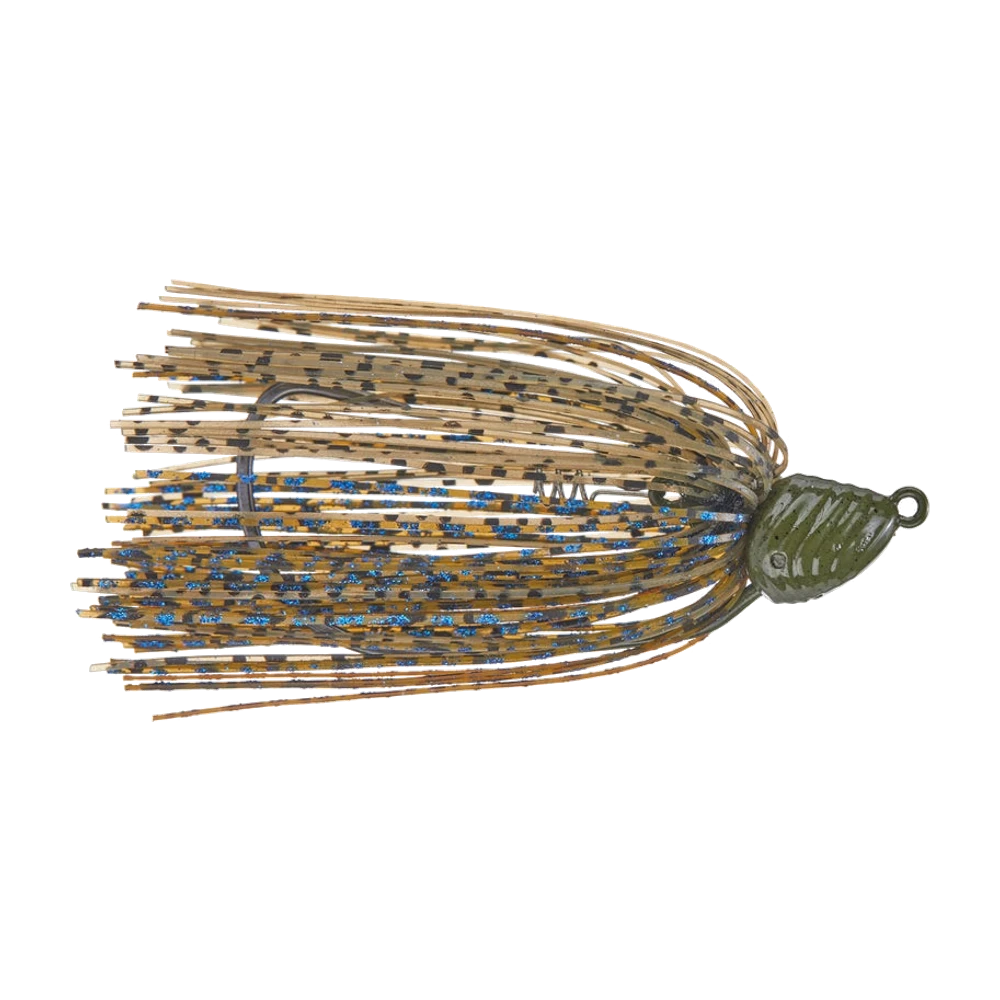
This lure shines under specific conditions. CarnaFish tells you in 10 seconds if today is one of them.
You pitch a jig under a flooded branch, the line jumps, you swing — and up comes a piece of wood with the weedguard mashed flat against the hook point. Every jig angler knows that sequence. The weedguard protects the hook from cover, but it also protects it from the fish, and we had all quietly accepted that as the price of fishing a jig. The 6th Sense Axle Swinging Hybrid Jig starts from the opposite premise: delete the guard, and make the bait snagless some other way. The maker says it took over three years of testing to get there.
The real problem with a weedguard
On a standard jig the weedguard is a bundle of fibres set behind the eye and angled toward the point. It does two things at once: it deflects grass and twigs away from the hook, and it fills the hook gap. The denser it is, the less you snag and the more fish you miss; the more you thin it with pliers, the better you hook up and the more jigs you leave in the wood. Every angler has a recipe — cut it on a bias, pull out a third of the fibres, fan them out — and none of them is satisfying, because they move the compromise around instead of solving it. The Axle isn't looking for the right guard setting: it has no guard at all. The head carries nothing but a wide-gap hook, fully articulating, and a screw-lock keeper.
An articulating hook instead of one moulded into the head
On almost every jig on the market the hook is poured into the lead or tungsten: head and hook form one rigid block. Here the hook sits free on the head and pivots. Two very concrete consequences.
The first is how it clears cover. A rigid block hits a branch and levers against it: either it slips past or it wedges, and the head geometry decides. An articulating hook lets the whole thing fold on contact, pivot around the obstacle and swing back in line behind it. You feel it in the rod: instead of the hard stop of a conventional jig, you get a soft resistance that releases.
The second is the hookset. The shank is an R-bend — that R-shaped kink just behind the eye — and 6th Sense states that it pushes upward when a fish bites. In other words, the fish's pull and yours rotate the hook the right way, point toward the roof of the mouth, before penetration even begins. On a jig set fifteen metres / 50 ft away, deep inside a bush, where you lose half your sweep to angles and stretch, that free half-turn matters.
Tex-posing is what actually makes it weedless
This is the part people misread: the Axle is not snagless by construction. It is snagless because you bury the point in the trailer. So the trailer isn't a bulk accessory the way it is on a skirted jig with a guard — it is a component of the system.
Rigging takes three moves: screw the trailer's nose onto the keeper, keeping it straight on the axis; bring the point back toward the trailer's back; then push it through the plastic and tuck it back in just under the skin, so it sits flush without breaking through. It is standard Texas-rig tex-posing, applied to a jig.
Two possible mistakes, and they are mirror images. Point left exposed: you now have an open-hook jig that snags like one. Point buried three millimetres into the body: the fish has to drive through plastic before it touches steel, and on a bass that is just mouthing the bait, you miss.
Check the point with a thumbnail before the first cast, and again after every fish and every time you pull the jig free of a branch. It should catch your nail without breaking out of the plastic. That is the only adjustment this jig has, and it goes out of adjustment every time you haul on it.
A hybrid head, and what that really means
6th Sense describes the head as a cross between a structure jig, a grass jig and a football jig. It's a versatility claim, and it is honest as long as you read it both ways.
One way: you can fish a rock slide, a grass edge and a brush pile with the same jig, without re-rigging in between. On a mixed spot — which is the rule rather than the exception — that keeps you from writing off a zone because the jig on your line is the wrong one.
The other way: a hybrid head is never the best tool on any one piece of terrain. Over open rock a Strike King Tungsten Football Jig still talks more through the rod tip and sits flatter between two stones, and a Molix Supernova Jig has its own logic on structure. The Axle isn't here to beat them on their own ground; it's here to avoid being the wrong tool on a spot you haven't read yet.
The hand-tied skirt isn't just a finishing touch either. Hand tying leaves the strands freer at the base than a production collar does, so the skirt opens and closes more when the jig stops moving. That is exactly what works for you during the three-second pause when the bass makes up its mind.
How to fish it
Not on a straight retrieve. This jig is built to be pitched short, into cover, and worked on the spot. The basic cycle: pitch under the branch, let it drop on a semi-tight line while you count seconds, pause three to five seconds with the skirt open, then a slow 30 cm / 12 in drag with the rod tip, then another pause. Two or three cycles per target, then move on. A bush is fished in four pitches, not twenty.
The articulation has a downside worth knowing: on a long cast with slack line, the hook and trailer can swing around the head and tangle in the leader. Keep your distances short and guide the fall with the rod tip.
As for trailers, the screw-lock keeper wants a firm, ribbed body that holds the screw without tearing on the first fish. A 6th Sense Bodega Creature Bait ticks both boxes and adds broad appendages that slow the fall. A Strike King Rage Craw does the opposite: more kick during the drag, a straighter fall, less life at rest.
Not sure what to tie on?
Photograph your spot: CarnaFish reads the scene, cross-checks the conditions and gives you the zone, the lure and the retrieve. Free on iOS and Android.
What 6th Sense doesn't spell out
This needs saying plainly, because it drives the buying decision. The maker publishes no readable weight chart for this jig: reading the description, you can't tell whether you're buying the equivalent of a 10 g or a 21 g head. And on a jig, weight decides everything — fall speed, usable depth, bottom feel. Hook size isn't stated either, nor the skirt material beyond the fact that it is hand-tied, and the colour list isn't confirmed. Street price runs around $7.99 apiece. Check the weight on the retailer's own listing before you order.
Colour by water clarity
The exact 6th Sense catalogue names aren't confirmed for this model. So think in hue families — the ones that structure every bass jig range — rather than in specific references.
- Clear water, hard bottom, bright light: the green pumpkin family, with or without flake, the default tone for a crawfish-imitating jig.
- Stained water, low light, end of day: the black and blue family, which works on silhouette rather than on colour you actually perceive.
- Spring, bass keyed on crawfish: the red-brown craw family, in step with crawfish colouring as the water warms.
The Axle Swinging Hybrid Jig replaces neither a specialised football jig nor the guarded jig you've been trimming to your own taste for ten years: it answers one precise question, how to fish genuinely thick cover without giving up hook penetration. But no jig makes up for misreading a spot, and knowing whether that particular bush is worth four pitches or none is most of the result. That's exactly what CarnaFish does — a photo of the spot, and the app suggests the zone, the depth and the kind of presentation that fit the day's conditions. For tackle and spot-reading fundamentals, our beginner's guide to bass fishing sets the scene.
Key takeaways
- No weedguard: the point tex-posed in the trailer is what makes the rig snagless, so the trailer is part of the system, not decoration.
- The fully articulating hook pivots over cover, and the R-bend shank rotates upward on the bite to improve penetration.
- Hybrid structure-grass-football head: versatile on a mixed spot, never the best option on specialised terrain.
- The maker publishes no clear weight chart — check the weight with the retailer before ordering.
FAQ
Why doesn't this jig have a weedguard?
Because the point is protected another way: you bury the hook in the soft trailer, Texas-rig style. The payoff is a completely free hook gap for penetration, since there are no longer any fibres between the point and the fish's mouth.
Can you fish it without a trailer?
Not usefully. With no trailer the point stays in the open and you end up with an exposed-hook jig that snags on everything. On this model the trailer isn't cosmetic — it's the part that makes the rig weedless.
What weight should I pick?
There's no precise answer: 6th Sense doesn't clearly detail the weights available for this jig. Apply the general rule — the lightest head that keeps you in constant contact — and check the stated weight on the retailer's listing.
Does the articulating hook change the hookset?
Yes, and for the better. The R-bend shank pushes upward as soon as the fish clamps down, which orients the point before penetration. Keep the line tight and set with a side sweep rather than a sharp upward snap, as with any jig fished at distance.
Is it a good jig for deep rock?
That isn't its home ground. The hybrid head is a compromise: over open hard bottom a true football head like the one on the Strike King Tungsten Football Jig sits flatter between stones and sends more feel up the rod tip.
Does it work for pike or perch?
It's a bass jig, designed for thick cover. Nothing stops a pike from eating a jig, but the rig includes no bite-resistant leader and the big single hook is sized for a bass's mouth. For pike, other families of lures are a far better fit.
The full bass lure guideSeason-by-season strategy: which family of lure, when, and why.Go from theory to fish
CarnaFish reads your spot from a photo and gives you the game plan: zone, lure, retrieve. Free on iOS and Android.