6th Sense Congo Craw: the craw whose fall rate you set yourself
This lure shines under specific conditions. CarnaFish tells you in 10 seconds if today is one of them.
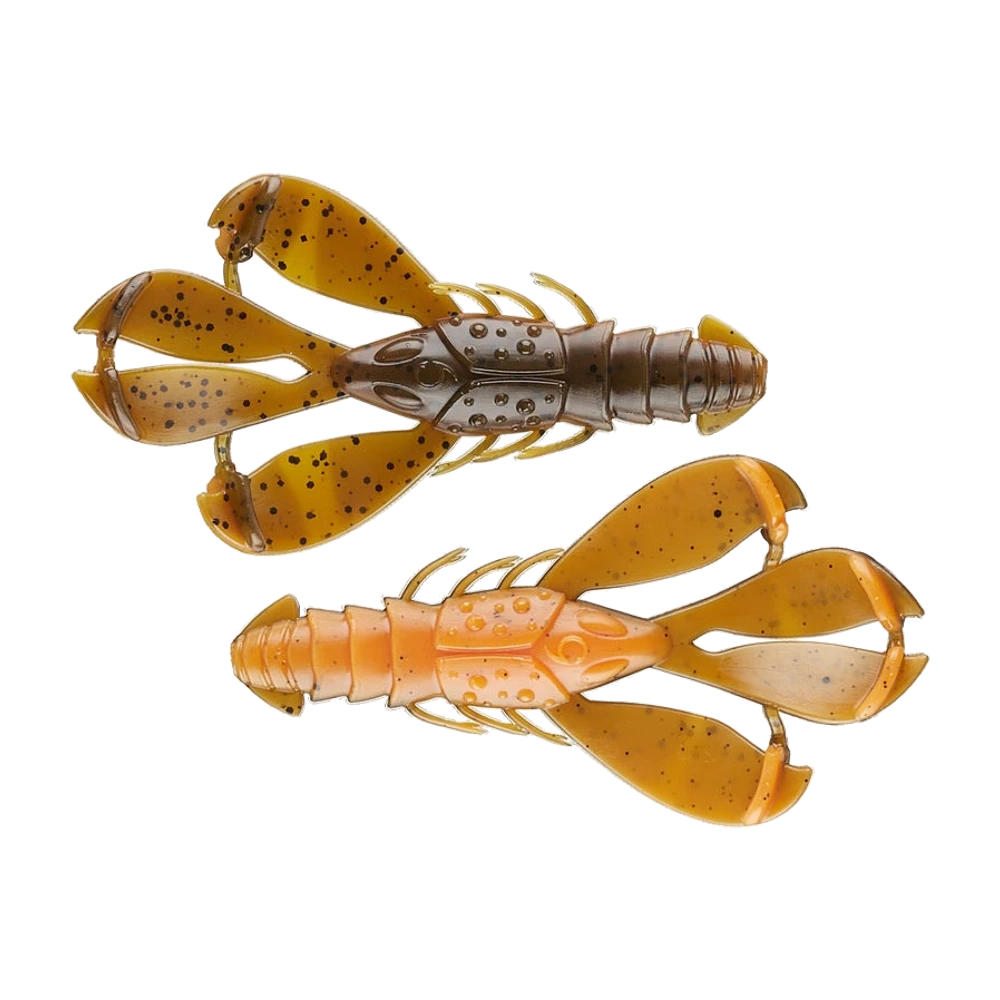
A soft plastic craw is rarely a question of realism. A bass does not count legs: what it detects is a volume moving in jerks near the bottom, with appendages pushing water. The 6th Sense Congo Craw starts there and asks a simple question that rarely gets answered: what if the angler decided how much water gets moved and how fast the bait fell, right there on the bank, with his fingers?
Four appendages, two of which you pull off whenever you like
The Congo Craw comes out of the bag with four appendages. Each is moulded with deliberately thickened edges at the tip of the claw, which increases the surface offering resistance and produces a wide movement as soon as the bait moves or sinks.
Left intact, the bait displaces a lot of water and sinks slowly. That is the configuration for stained water, active fish, and every situation where you want the bait noticed during the drop — typically a pitch under a dock where you want the descent to last.
Remove the two outer appendages and the behaviour changes completely: less surface, so a noticeably more discreet action and a clearly faster fall. That is the clear-water configuration, the high-pressure configuration, the one for fish that have seen everything. It is also the deep-water configuration, when you want to reach eight metres without waiting thirty seconds on every cast.
Do not assume the full version is right by default. Run the test on one spot: three casts intact, three casts stripped down. On pressured fish it is very often the two-appendage version that triggers a bite, and almost nobody takes the time to check.
The hook slot, a detail that counts in flipping
A moulded slot along the back of the bait takes the shank of the hook. It looks incidental, but in a flipping presentation — the bait you drop vertically into a hole in the weed, a brush pile or under a stump — that slot does three things.
It keeps the bait perfectly aligned, which is the condition for it not to spin and twist the line. It lets the point sit flush without protruding, so the rig stays genuinely snag-resistant. And it reduces the thickness of plastic the point has to drive through on the hookset, which matters enormously when you are setting the hook through two branches with heavy braid.
Use a wide gap hook matched to the body volume, and a tungsten bullet rather than lead: at equal weight tungsten is more compact, gets through vegetation better and tells you more about the bottom.
Three ways to fish it
Flipping and pitching into cover
The core use. A short flat cast, the bait entering the water silently right against an obstacle, free fall to the bottom, two or three small lifts, then you cast somewhere else. Ten to fifteen seconds per target, no more. You are not trying to convince a distant fish, you are putting the bait on the head of the one already there.
Slow dragging on the bottom
Over rock or an open flat, the Congo Craw drags slowly on a Texas rig, rod low, scraping the substrate. The appendages fold and open to the rhythm of the irregularities, exactly like a crayfish moving from stone to stone. It is slow fishing but very productive on fish sitting deep in summer and autumn.
Jig trailer
That is the other half of its working life. Rigged behind a skirted jig it adds volume, water resistance and a complete craw silhouette. On a Strike King Tungsten Football Jig dragged over hard bottom, a four-appendage trailer slows the fall and widens the movement of the skirt. And here again, if you find the whole thing sinks too slowly, you pull off two appendages.
The classic mistake: over-working it in flipping
The reflex is to pull, cast again, pull again, because you are afraid of doing nothing. In reality a soft craw in a flipping presentation almost always gets eaten during the initial fall or the first pause on the bottom. If you shake the bait the moment it arrives, you miss it. Let it settle, wait three seconds with the line just taut, and watch the line rather than the rod: in this kind of fishing the bite is often seen before it is felt.
Not sure what to tie on?
Photograph your spot: CarnaFish reads the scene, cross-checks the conditions and gives you the zone, the lure and the retrieve. Free on iOS and Android.
Colour by water and season
- Clear water: green pumpkin, sometimes with flake. A natural crayfish is brown-green, and that tone stays credible over every bottom type.
- Stained water or low light: black and blue. High contrast, a silhouette that stays readable, and historically the reference colour for heavy cover fishing.
- Spring, rocky bottom: a red or orange craw tone. Early in the season crayfish are the staple of a bass's diet over hard bottom, and reddened claws are a signal the fish recognises instantly.
What to keep it next to
The Congo Craw sits in the same family as a Strike King Rage Craw, whose wide claws create a very pronounced flapping on the slightest movement, and a Zoom Brush Hog, longer and more versatile, which plays the volume card more than the imitation one. Its difference lies elsewhere: it is the only one of the three whose behaviour you alter mid-session without changing bait. For heavier, deeper bottom work, the same bait rigged as a trailer behind a Strike King Tungsten Football Jig covers a complementary register.
Effective flipping starts with knowing which obstacle deserves ten seconds and which deserves none. That is exactly what CarnaFish makes easier — a photo of the spot, and the app suggests the zone, the depth and the kind of presentation that suit the day. To build tackle and spot fundamentals, our beginner's guide to bass fishing is a good place to start.
Key takeaways
- The two outer appendages come off: intact for a slow, expressive fall, stripped for a fast and discreet one.
- The integrated hook slot keeps the bait straight and makes setting the hook through cover easier.
- Three coherent uses: flipping into cover, slow bottom dragging, jig trailer.
- The bite almost always comes on the initial fall or the first pause. Do not work it too early.
FAQ
Do I really need to remove the outer appendages?
Not systematically, but it is the bait's most useful adjustment. Keep it intact in stained water or on active fish, and strip it down in clear water, on pressured fish, or when you want to reach the bottom faster. Test both on the same spot before deciding.
What hook and weight for the Texas rig?
A wide gap hook sized for the body volume, seated in the slot along the back, with a 5 to 14 g tungsten bullet depending on depth and cover density. Tungsten beats lead because it is more compact at equal weight.
Does the Congo Craw work as a jig trailer?
Yes, it is one of its two main uses. Rigged behind a skirted jig it adds volume and slows the fall. If the combination sinks too slowly, pull off the two outer appendages rather than changing jig.
How long should I fish each obstacle?
Flipping, ten to fifteen seconds is enough: if the fish is there and committed, it eats during the fall or just after the bait settles. Covering thirty targets quickly beats working three thoroughly.
How many baits per pack?
Six per pack in the 3.8 inch size. That is a reasonable count for cover fishing, where one bait usually survives several fish as long as the tail and claws stay intact.
Does it suit predators other than bass?
The description and the design point this bait clearly at bass. In Europe a soft craw on a light Texas rig can interest perch over rocky bottom, but a 9.7 cm volume is still sized for a bass's mouth.
The full bass lure guideSeason-by-season strategy: which family of lure, when, and why.Go from theory to fish
CarnaFish reads your spot from a photo and gives you the game plan: zone, lure, retrieve. Free on iOS and Android.