6th Sense Bodega Creature Bait: the craw bass hold on to
Before tying this one on, it helps to know if the spot actually calls for it. CarnaFish reads the scene from a photo.
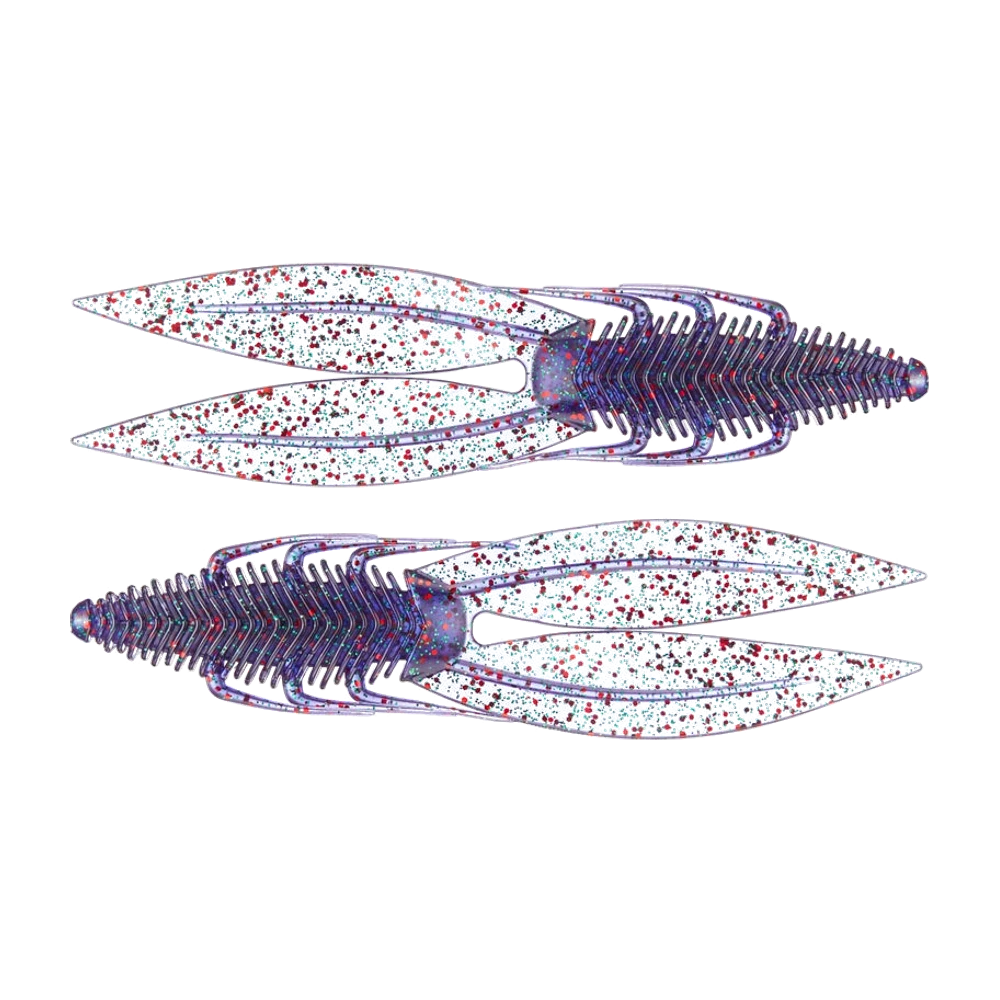
There is a precise moment, fishing a reed edge or a laydown, when you feel the fish take the bait without really eating it. It pinches it, holds for a second, then lets go before you have time to set the hook. That is exactly the problem a creature bait like 6th Sense's Bodega is built to solve: a lump of plastic covered in textures and appendages, designed to keep a curious bass holding on long enough.
A ribbed body and two tiers of appendages
The body is ribbed, grooved along its whole length. Those grooves work first as a mechanical grip: the hook settles into a groove and stops sliding along the plastic cast after cast. A mundane detail, but on a bait you pitch into branches twenty times, a body that creeps up the shank on every pitch means twenty resets and that many missed bites. 6th Sense also lists several different textures on this body, meant to make the fish hold on longer — a claim that is hard to verify objectively, but consistent with the rest of the design.
Behind the body come two large flat appendages. They produce the visible signal: on the fall they brake the bait and make it glide instead of drop, with a wide waving motion. They work with no input from you at all, purely on water resistance, and that is why the fall is the most important phase of the whole presentation.
Then come the thin legs, far more discreet. They do not glide, they vibrate: a fast kick, a quivering that carries on even when the bait is sitting on the bottom and you are doing nothing. That is the close-range signal, the one that matters on a fish that has already come to look and is hesitating twenty centimetres away.
What 6th Sense does not publish
Let us be blunt: the exact dimensions of the Bodega are not given. No stated length, no pack count, no weight, no detail on the plastisol or on any salt or attractant. All we know is that it is a mid-size creature bait, bulky enough to make a credible jig trailer and compact enough to flip cleanly. Check the real length on the packet before you buy hooks: an undersized hook on a creature bait means lost fish.
On price, a pack sits around 6 to 7 US dollars. You sometimes see much higher figures, which most likely correspond to multi-pack lots, but that is not confirmed.
Three uses, three rigs
Flipping and pitching
This is the main job. Texas rig on a wide gap hook, bullet weight pegged with a stopper, and you drop the bait at the foot of each piece of cover rather than casting long. The pegged weight brings the whole rig down as one and penetrates cover better, the bait following immediately with its appendages open. Stay light as long as the vegetation allows: the heavier the weight, the faster the fall and the less time the big appendages have to glide. On a shallow open margin, 5 to 7 g / 3/16 to 1/4 oz is often enough; in a thick mat you need 14 g / 1/2 oz or more to punch through, and you then give up part of the gliding effect. It is a trade-off to accept, not a dead end.
Carolina rig
The Carolina rig changes the nature of the fishing. The sliding weight hits the bottom first, then the bait sinks on its own, slowly, at the end of its leader. For a bait whose whole point is the fall, that is ideal: you get a long free drop after every pull, out on a big flat where a Texas rig would force you to fish faster. Pull along the bottom, slowly, then wait.
Jig trailer
The Bodega's size makes it a natural jig trailer, and that is probably where it adds the most. A bare jig drops in a straight line; with this creature bait behind it, the fall slows, the silhouette widens and the profile becomes plainly crawfish. Over a rocky bottom where crawfish are the dominant prey, that is exactly what the fish is waiting for.
Where and when it comes into its own
The Bodega is a cover and hard-bottom bait, not an open-water bait. It gives its best from spring to autumn, when crawfish are active and bass are holding tight to something: a laydown, a lily pad edge, a riprap bank, a dock piling. In cold water it loses much of its point, because the appendages need movement and a winter fish does not work the bait enough to make them talk.
The real adjustment on this bait is the weight, not the colour. Always start with the lightest sinker that lets you reach bottom and get through cover. The moment you go heavier just for casting comfort, you remove the second and a half of glide that triggers the bite, and nothing tells you so.
The classic mistake
Fishing the Bodega like a swimbait, on the retrieve. A creature bait almost never gets eaten while it is moving forward: it gets eaten while it is dropping, in the first three seconds after it lands. So keep the line semi-tight and watch it on every fall, because the bite is often seen before it is felt — line moving off to the side, or stopping too early on the way down. And set hard: you have to drive through the plastic before you reach the jaw.
Not sure what to tie on?
Photograph your spot: CarnaFish reads the scene, cross-checks the conditions and gives you the zone, the lure and the retrieve. Free on iOS and Android.
Colours by water clarity
6th Sense does not publish a colour list for this model, so we reason by colour families rather than with confirmed catalogue names.
- Clear water and vegetation: the green pumpkin family, natural greens and browns, which does not surprise a wary fish.
- Rocky bottom, active crawfish: the red-brown craw family, the one that matches the prey actually present in spring.
- Stained water or low light: the black and blue family, which plays on silhouette rather than on a colour the fish really sees.
Check the exact match on the packet, as naming varies from one 6th Sense range to another.
Alongside the other creature baits
Against a Zoom Brush Hog, the Bodega leans more on two stacked levels of movement, the glide of the big appendages and the quiver of the thin legs, where the Brush Hog relies mainly on a long profile and claws that kick hard. Against a Reaction Innovations Sweet Beaver, far more compact and streamlined for punching a mat, the Bodega is the bait for moderate cover and hard bottom, not for pure punching. The three cover different cover densities.
The right creature bait is worth nothing if you read the spot wrong, and that is exactly what CarnaFish is for: a photo of the bank, and the AI suggests the zone, the depth and the type of presentation that suit the day's conditions. For the basics on tackle and typical bass lies, our beginner's guide to bass fishing starts from scratch.
Key takeaways
- The ribbed body locks the hook in place, which saves you from resetting the bait over and over in the branches.
- Two levels of movement: the big flat appendages that glide on the fall, the thin legs that quiver even at rest.
- Three uses the manufacturer intends: flipping and pitching on a Texas rig, Carolina on big flats, jig trailer over rock.
- Length, weight and colours are not published by 6th Sense, so check the packet before you buy hooks.
FAQ
How long is the Bodega Creature Bait?
6th Sense does not publish exact dimensions for this model. It is a mid-size creature bait, bulky enough to serve as a jig trailer. Check the length printed on the packet before choosing your hooks.
What hook should I rig it on?
A wide gap hook sized to the body diameter, in practice 3/0 to 4/0 for a creature bait of this build. Since the length is not published, adjust once you have the bait in hand rather than ordering blind.
When does the bite come on this bait?
Almost always during the fall, in the first three seconds after it lands, before the bait even reaches the bottom. That is why you keep the line semi-tight and watch it on every drop.
Does the Bodega really work as a jig trailer?
It is one of the uses the manufacturer intends, and probably one of the most interesting. It slows the jig's fall, widens the silhouette and pushes the overall profile towards a crawfish, which counts for a lot over rock in spring.
What bullet weight should I use on a Texas rig?
The lightest that lets you reach bottom and get through cover. Between 5 and 7 g / 3/16 to 1/4 oz on a shallow margin, considerably more in dense vegetation, bearing in mind that every extra gram shortens the glide phase.
Is it any good for pike or perch?
It is a bait designed for bass and rigged accordingly. A pike can certainly take a Texas-rigged creature bait along a margin, but it is not the most rational technique for that fish, and a wire leader then becomes necessary. For perch, the bulk is simply too much.
The full bass lure guideSeason-by-season strategy: which family of lure, when, and why.Go from theory to fish
CarnaFish reads your spot from a photo and gives you the game plan: zone, lure, retrieve. Free on iOS and Android.