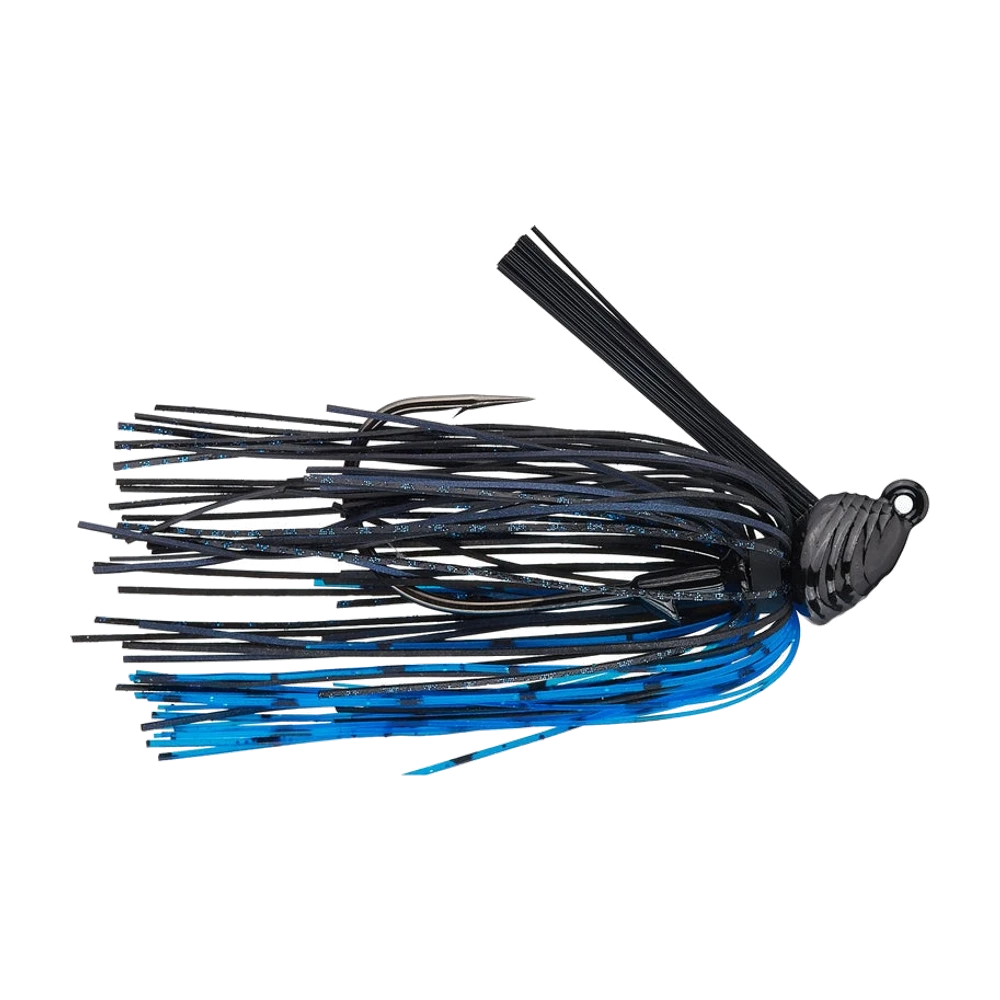
6th Sense Divine Hybrid Jig: one casting jig for every cover type
One lure, endless conditions. CarnaFish reads your spot from a photo so you are not just guessing.
You pull up on a reservoir where the first bank is a row of docks, the second a grass mat, and the evening spot a rocky ledge in six metres of water. Three cover types, three different jigs in the classic American logic — and three rig changes over the day. The 6th Sense Divine Hybrid Jig is an attempt to answer that: one head, shaped so it isn't bad in any of the three.
A head that refuses to pick a side
To understand what this jig does, you need to know what the three families behind it do. A structure jig has a slim, elongated head that slips between branches and climbs an obstacle without wedging. A grass jig has an arrowhead nose that splits vegetation and lets it slide up the line. A football jig has a wide head flattened on the sides, which tips and stumbles over rock while keeping the hook pointing up.
Each of those shapes is best on its own ground and mediocre on the other two. The Divine Hybrid head borrows from all three: a nose tapered enough to get through wood, shoulders wide enough to stay stable on hard bottom, and a flat base that stops it lying over at random. Let's be clear: over pure rock a true football jig like the Strike King Tungsten Football Jig remains more precise. The point of the hybrid isn't to be better everywhere, it's to let you fish three cover types back to back without touching your rig.
The fiber weedguard comes fitted tight from the factory. That's a good setting for wood and grass, slightly firm for very slow work on hard bottom. If you feel you're missing soft bites, pull two or three fibers out of the side of the bundle — never trim it shorter, which just makes it useless.
Weight is the only real decision
6th Sense doesn't publish a single weight chart for this jig, which is just as well: the right weight depends on the cover, not on the lure. The rule that works is to take the lightest jig that still lets you feel bottom.
Shallow, in 50 cm to 1.5 m around a dock post or a fallen tree, a light jig falls slowly and stays inside the fish's window of vision much longer. The bite very often comes during that fall, before the first bottom contact. Conversely, dragging a ledge in five or six metres with a crosswind, a light jig costs you contact: you no longer know whether you're on rock, sand or silt, and jig fishing without reading bottom is pointless.
How to work it on each spot
In wood and under docks
Cast flat and as close as possible to the post or the branch, then let it fall on a semi-tight line — tight enough to see the bite, slack enough that the jig drops straight. Once on bottom, two small 20 cm lifts of the rod tip, a two-second pause, then reel in and cast somewhere else. A jig isn't walked around; it's placed in specific spots. On a dock you can make ten casts around the same post and get bit on the tenth.
Dragging a ledge
Rod at nine o'clock, pull slowly through a metre while keeping contact, give the line back, wait. The aim is to feel the substrate change. The moment the jig goes from sand onto rock is almost always the moment a bass is sitting there. It's slow fishing, boring to the point of unfair, and by far the most productive on big fish in summer and late autumn.
Skipping
The flat base of the head lets you skip the jig under a low dock or low branches. Low side-arm cast, loose wrist: two or three skips are enough to reach cover you couldn't touch any other way. It's one of the few skills that genuinely separates a jig angler from someone who merely owns a jig.
Count the seconds on the fall. On the same spot, if the jig hits bottom at six seconds and then at four on the next cast, you've just found a hump or a submerged obstacle nobody else noticed. A jig is as much a bottom-reading tool as it is a lure.
The trailer does half the work
The barbed keeper on the shank holds a soft plastic in place even after several bites, and the choice of that trailer completely changes how the jig behaves. A thick-clawed craw like the Strike King Rage Craw adds water resistance that slows the fall and shakes the bait on the slightest pull — ideal shallow and in slightly stained water. A slimmer creature bait like the Zoom Brush Hog drops faster and penetrates dense vegetation better.
The classic mistake
Setting the hook too early. The hook on this jig is heavy wire, which is deliberate so you can haul a fish out of cover, but a heavy-wire hook demands real hookset power. On a bite during the fall, you often just feel the line stop, and the reflex is to pull straight away. Let the fish load up for half a second, drop the rod, then set hard upward or to the side. Setting on a slack line with a heavy-wire hook is the surest way to lose the fish.
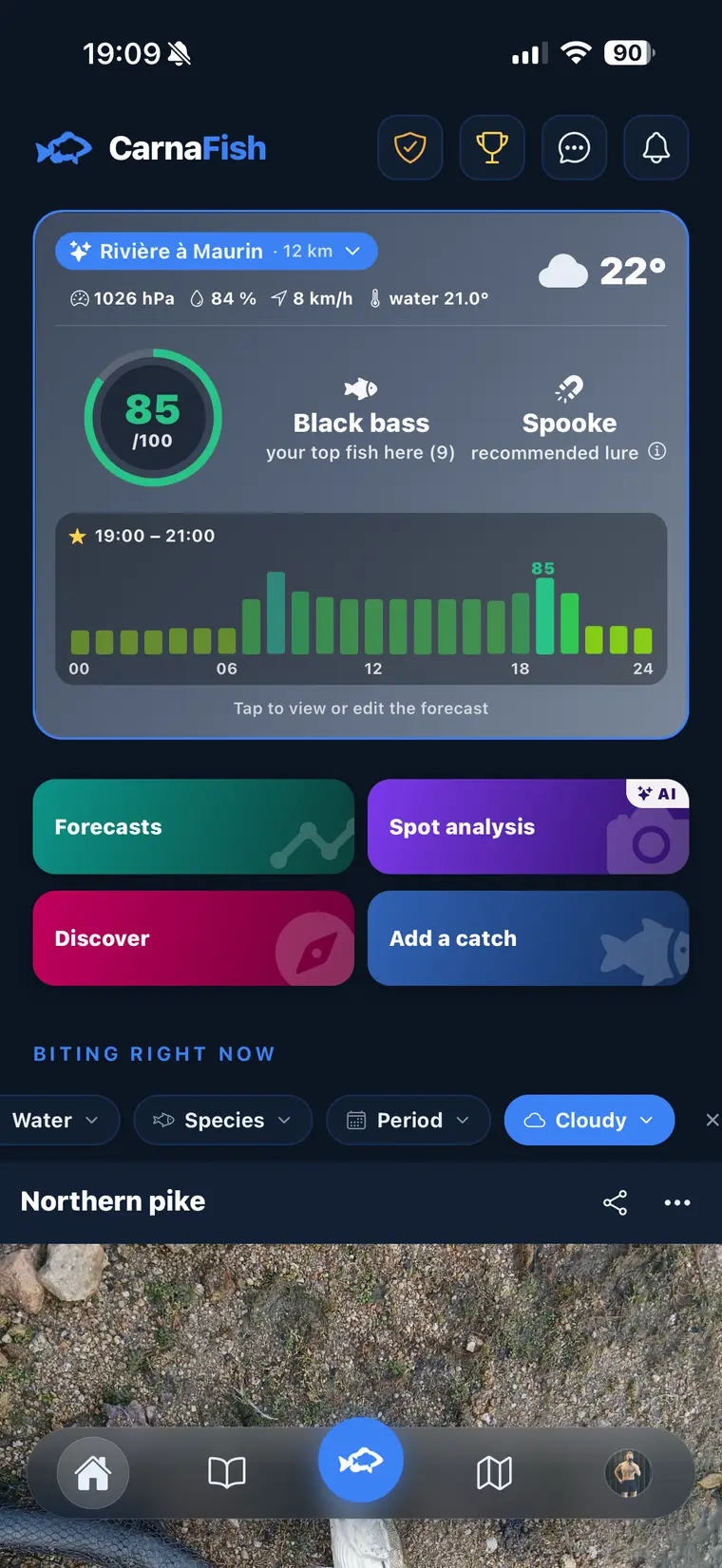
Not sure what to tie on?
Photograph your spot: CarnaFish reads the scene, cross-checks the conditions and gives you the zone, the lure and the retrieve. Free on iOS and Android.
Colors by water and bottom
- Clear water, mixed bottom: green pumpkin, the do-everything tone that reads as a crayfish or a small bottom fish equally well.
- Rocky bottom, spring: brown-orange craw. When bass are rooting through rock, that's the most believable silhouette.
- Stained water or low light: black and blue. Clean contrast that stands out without looking artificial, the classic dirty-water jig color.
Where it fits in an already crowded box
The Divine Hybrid Jig isn't a search lure: it complements the lures that cover water. You locate fast with a crankbait or a spinnerbait, then come back and place this jig precisely on the piece of cover that showed a sign. Against the 6th Sense Divine Swim Jig the roles are reversed: the swim jig is swum, the hybrid is dragged and placed. They don't do the same job, and owning both makes sense.
One jig placed in the right spot beats ten thrown at random, which is exactly what CarnaFish is there to spare you: photograph the water and the AI suggests the zone, the depth and the presentation type that fit today's conditions. To learn how to spot those obstacles and breaks with the naked eye, our guide to reading a fishing spot walks through the method.
The short version
- A head halfway between structure, grass and football jig: good everywhere, specialist at nothing.
- The right weight is the lightest that still lets you feel bottom, not the one that sinks fastest.
- The trailer on the barbed keeper changes fall speed and bulk — treat it as a real adjustment.
- Heavy-wire hook: set hard, and let the fish load up first.
FAQ
What weight Divine Hybrid Jig should I pick?
The lightest that still lets you feel bottom. Shallow and in no wind, a light size falls slowly and draws more bites; on a deep ledge or in a crosswind you have to go heavier to keep contact.
Does this jig come through grass?
Yes, thanks to the tapered nose and the factory fiber weedguard. In very dense vegetation, though, a true arrowhead grass jig stays more efficient.
Can you skip it?
Yes, it's one of its strengths: the flat base of the head makes the jig skip across the surface, so you can slide it under a low dock or low branches.
Which trailer should I use?
A thick-clawed craw to slow the fall and add bulk shallow, a slimmer creature bait to drop fast and get through vegetation. The barbed keeper holds both without slipping.
Should I trim the weedguard?
Never shorten it, it loses its function. If it feels too firm for slow work on hard bottom, simply pull two or three fibers out of the side of the bundle.
How is it different from a straight football jig?
A football jig is more stable and more precise over pure rock, but it hangs up more in wood and vegetation. The hybrid gives up a little precision on rock and gains the ability to fish all three cover types without changing lures.
The full bass lure guideSeason-by-season strategy: which family of lure, when, and why.Go from theory to fish
CarnaFish reads your spot from a photo and gives you the game plan: zone, lure, retrieve. Free on iOS and Android.