Zoom Lizard: the silhouette that triggers a territorial response
Rather not fish it blind? Photograph your spot — CarnaFish cross-checks the conditions and points you the right way.
In spring, on the shallow flats, you come across bass that are not feeding. They are sitting over a light-coloured patch, they chase nothing, they ignore your crankbait and your jerkbait. You can spend an hour offering them prey: they are not hunting, they are guarding something.
That is exactly the Lizard's window. This bait does not work because it looks like food, it works because it looks like an intruder. Salamanders and newts eat bass eggs; a fish on guard does not debate with that silhouette, it drives it off. Understanding that difference changes the way you fish it completely.
A silhouette, not a prey imitation
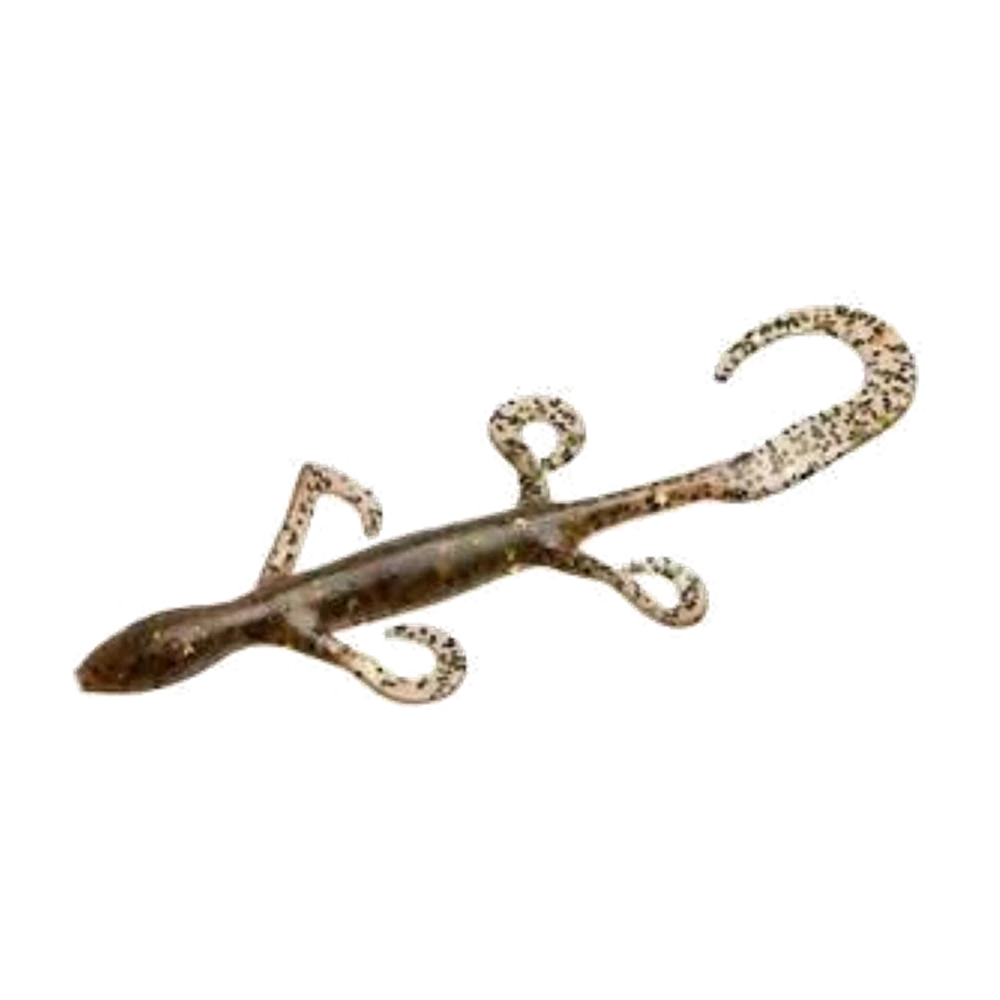
Lay the bait flat: four wide, flat legs, a long body, a fine curly tail. Nothing streamlined, nothing that looks like a fish.
What that shape produces:
- Constant undulation at almost zero speed. The four legs are cut from thin rubber and start working as soon as the bait moves two centimetres. That is what lets you drag it at a ridiculous speed while keeping it alive.
- A wide silhouette seen from above. A bass sitting over the bait sees a spread-out shape, not a slim outline. That is the view from which a guarding fish spots an egg predator.
- Natural braking on the drop. The legs act as a parachute: the bait planes instead of falling, which lengthens the fall phase behind a Carolina weight.
Second technical point, the material: Zoom's plastic is deliberately soft and salted. It tears faster than a hard plastic, and that is the accepted trade-off for such a fine undulation and a longer hold time in the fish's mouth.
Rigging: where the Carolina wins
The Lizard is fished on two classic rigs, already covered elsewhere on the site. The Carolina rig is the benchmark for this bait, and the Texas rig takes over as soon as things get cluttered. No point re-explaining them here — what matters is knowing which one to pick.
| Situation | Rig | Weight | Why |
|---|---|---|---|
| Open sand or gravel flat, 2 to 6 m | Carolina | 10 to 20 g | the long leader lets the bait plane behind the weight |
| Clean spawning margin, 0.5 to 2 m | Short Carolina, 40 cm leader | 5 to 10 g | precise control over a small area |
| Sparse weed, stumps | Weighted Texas | 5 to 10 g | goes everywhere, direct hookset |
| Visible fish that refuses | Weightless Texas | none | very slow fall, ultra discreet |
The Carolina leader is the real adjustment. Forty centimetres to fish precisely over a small area, one metre to one metre twenty to let the bait plane a long time behind the weight on a big flat. The longer it is, the more marked the gliding phase — and the harder the hookset becomes at range.
The retrieve: drag, feel the bottom, stop
- Cast past the area and let everything sink until it touches down, line semi-tight.
- Drag the weight sideways, sweeping the rod from 9 to 11 o'clock, very slowly. You should read the bottom: sand, gravel, weed, rock. The weight is your sounder.
- Take up the slack with the reel as you come back to 9 o'clock. Never pull with the reel: you would lose all the feel for the bottom.
- Pause three to eight seconds at the end of each sweep. The bait keeps sinking and waving behind the stationary weight.
- Repeat along the length of the flat, shifting two metres each cast to grid it out.
The bite is soft. Most often you feel weight being added, or the line easing off to one side during the pause. Set the hook sideways, sweeping long and winding as you go: with a metre of leader, a vertical hookset transmits almost nothing to the hook.
On the water: when you are dragging a Carolina and you feel the weight go from hard bottom to soft bottom, stop and fish that transition for five minutes. This is not a preference, it is a rule: in spring, guarding bass sit almost systematically on the break between two bottom types, not in the middle of the area. Most anglers cross that line without noticing it.
Not sure what to tie on?
Photograph your spot: CarnaFish reads the scene, cross-checks the conditions and gives you the zone, the lure and the retrieve. Free on iOS and Android.
Season and spots: a narrow window, but a very profitable one
The Lizard is first and foremost a spring bait, from pre-spawn to post-spawn, on water between 12 and 20 °C. Its spots: sand or gravel flats sheltered from the wind, north-facing coves that warm up first, margins of 0.5 to 3 m with a light bottom, and the bottom-type transitions right alongside.
It keeps catching in summer and autumn on big deep flats, on a long Carolina, but it loses its specific edge: at that time of year, a clawed creature or a worm does just as well, if not better.
It is clearly unsuited in three cases. In dense vegetation, where the four legs collect everything. For covering water fast: this is slow fishing by nature, you will not cover ground per hour. And in midwinter, when bass are deep and motionless — a nearly static finesse rig fits far better.
Lizard or clawed creature
Against a Zoom Brush Hog, the difference is a difference in the message sent. The Brush Hog plays the undefined creature with big flapping appendages: it triggers aggression and works all year, especially Texas-rigged in cover. The Lizard plays a precise silhouette, that of an egg predator, and its returns explode over a short period — the spawn — then go back to average.
Translated into a decision: if you carry only one creature bait, take the Brush Hog. If you are fishing spring over identified spawning areas, the Lizard will do clearly better. Against a Gary Yamamoto Flappin Hog, the contrast is about density and terrain: the Flappin Hog is more compact and heavier, built to drop fast into thick cover, whereas the Lizard wants to glide over open ground.
Our beginner's guide to bass fishing covers the phases of the season and their matching spots. And if you are unsure how to identify a spawning area when you reach the bank, CarnaFish analyses a photo of the spot and answers.
Key takeaways
- The Lizard provokes a territorial response in spring, not a feeding one.
- Four fine legs that wave at almost zero speed and parachute the descent.
- Carolina rig over open ground, weighted Texas as soon as it gets cluttered.
- Fish the transitions between two bottom types, not the middle of the flat.
- Outside spring, a clawed creature generally does just as well.
FAQ
Why does the Lizard work so well in spring?
Because the salamander is an egg predator. A bass guarding a nest attacks that silhouette to drive it off, not to eat it, which draws reactions from fish that refuse every conventional prey item.
Should I fish it Carolina or Texas?
Carolina over open sand or gravel bottoms, where the long leader lets the bait plane. Weighted Texas as soon as there is weed, stumps or wood, where a weedless rig becomes essential.
What leader length on a Carolina?
Around 40 cm to fish precisely over a small area, and 1 m to 1.20 m to maximise the gliding phase on a big flat. The longer the leader, the more you have to set the hook with a long sideways sweep while winding.
What colour should I choose?
Green pumpkin or watermelon in clear water, where natural tones go down best, and junebug or black as soon as the water colours up. Over the light bottom of a spawning area, a dark contrast is often more visible than a translucent tone.
Does the Lizard work outside spring?
It still catches in summer and autumn on big flats, on a long Carolina, but it no longer has any particular edge. A clawed creature or a worm covers those periods just as well.
Which size, 15 or 20 cm?
The 15 cm covers most situations and suits bass of all sizes. The 20 cm magnum is justified on big waters known to hold large fish, when you deliberately accept fewer bites.
The full bass lure guideSeason-by-season strategy: which family of lure, when, and why.Go from theory to fish
CarnaFish reads your spot from a photo and gives you the game plan: zone, lure, retrieve. Free on iOS and Android.