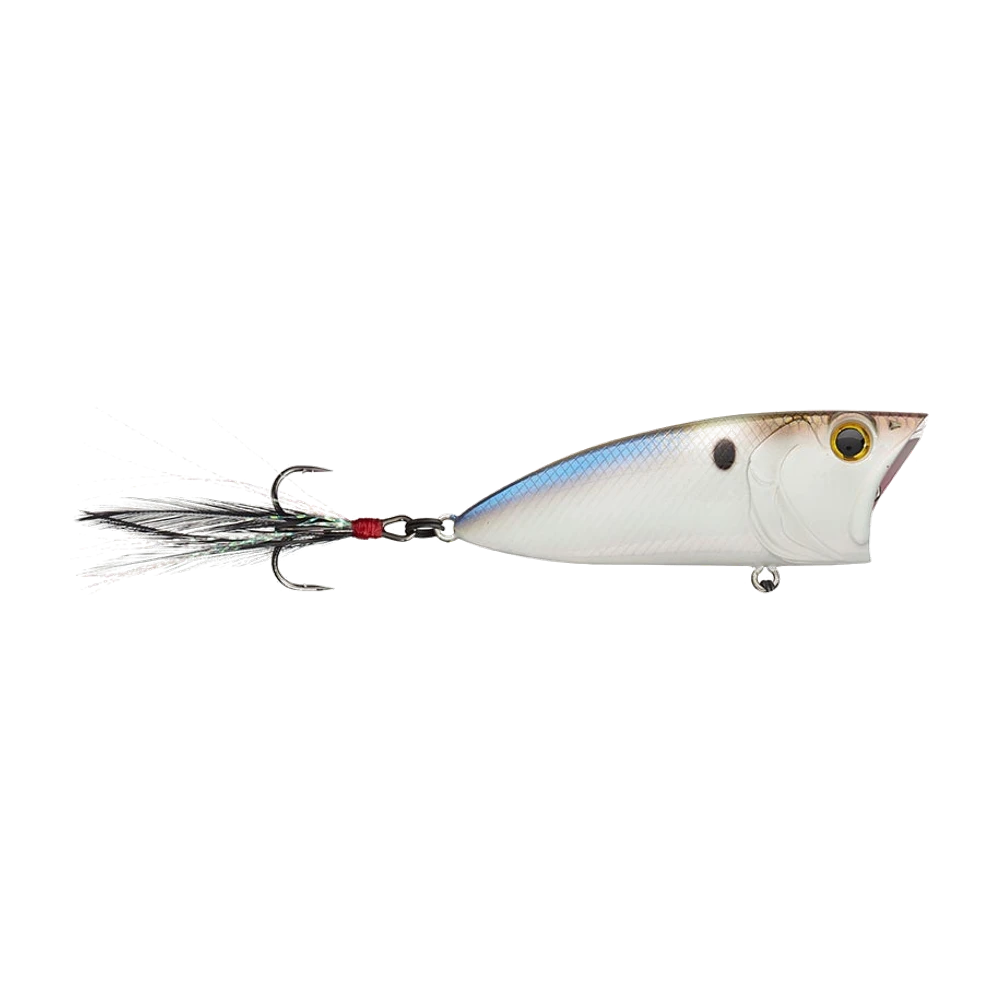
6th Sense Splash Back: the popper that walks like a stickbait
One lure, endless conditions. CarnaFish reads your spot from a photo so you are not just guessing.
Late August, a backwater without a breath of wind, and bass blowing up on anything that moves — for two casts. On the third, nothing. The colour didn't change in between; the amount of noise you dumped over three square metres of grass did. The Splash Back was designed with no internal rattle at all, and that's the first thing to understand before you judge it on the peg.
A popper with no internal noise
Most poppers carry one or more balls in a chamber to add a click on every rod stroke. The Splash Back is listed as non-rattling. Everything it produces comes from the outside: the "bloop" of a mouth filling and emptying, and the spray it throws. Nothing else.
On paper that looks like a missing feature. In practice it's a different tool. Clear water in midsummer, a pond that sees traffic every weekend, a bank already worked over by two boats before you — that metallic click becomes an alarm rather than a dinner bell. A Rebel Pop-R or a Strike King KVD Splash stay more effective when the water is stained or rippled and you need to carry sound a long way. The Splash Back takes over once the fish have already heard everything else in the box.
The V-shaped keel is what really sets it apart
The Splash Back's body isn't a plain cylinder with a cupped face. It's built on a keel shape with flat sides, and that has two concrete consequences.
First, the lure cuts water instead of shoving it. A sideways rod stroke isn't absorbed by resistance, it turns into a clean lateral move. That's what makes walking the dog possible on a lure that otherwise has a popper's mouth, whereas most chuggers simply refuse to pivot.
Second, and more subtly: at rest, the flat sides and V-shaped section keep the body rocking from side to side on its own, with no tension on the line at all. A standard popper settles and waits. That leftover rocking throws intermittent flashes off the flanks that look an awful lot like a stunned baitfish that can no longer hold itself upright on the surface.
Three retrieves in one lure
The hard chug
A very open mouth means a large volume of water displaced. Rod tip down, one short snap of the wrist, and the lure spits forward and leaves an air bubble behind. Two or three strokes, then three to five seconds of pause. This is the search retrieve, the one that announces you to twenty metres of grass edge.
The walk
Slightly slack line, a series of small even strokes on the same tempo, rod tip low. The lure zigzags with almost no splash. This covers more ground than chugging for the same effort, and it bothers an already-pressured fish far less.
The mix
The version that catches most fish on a precise target: two chugs to pull attention, then five or six walking steps to bring the lure in front of the fish, then the long stop. You move from a sound signal to a visual one without changing lures, which is exactly what the keel allows.
Don't swap the feather-dressed rear treble for a bare one just to gain hook points. The feather brakes the tail at rest and keeps the side-to-side rock alive; without it the body settles much faster and you lose the most productive phase of the presentation. If you want to upgrade the hardware, change the front treble instead.
Where, when, and which of the two sizes
The Splash Back's natural window is water above 18 °C / 64 °F, the first hour and the last two of daylight, and a surface that is flat or barely rippled. Grass edges, sunken timber, overhanging branches, island drop-offs — anything that gives the fish a ceiling and a clear hunting lane in front.
The Splash Back 70, 7 cm / 2.75 in for 10.5 g / 3/8 oz, is the size to pick when the forage is small and the fishing pressure is high. It casts respectably for its size thanks to its density, but it stays sensitive to a crosswind.
The Splash Back 90, 9 cm / 3.5 in for roughly 21 g / 3/4 oz, changes jobs. It carries a long way, it stays readable on a chopped surface, and it falls into a profile summer pike take without hesitation along shallow grass. On that size a 50 to 60/100 fluorocarbon leader is not overkill: a surface strike from a pike lands on the line as much as on the lure.
The classic mistake
Setting the hook on what you see. A surface strike is visible before it's felt, and the instinct is to lift immediately — which rips the lure out of the fish's mouth nine times out of ten. Wait until you have the weight in the rod, then set sideways, without much travel. On a lure carrying two trebles, a violent set unhooks more fish than it hooks.
Second mistake, quieter: working it too much. Long pauses feel wrong because it feels like doing nothing. Yet those three to five seconds are when the leftover rocking does its job, and that's very often when the blow-up comes.
Not sure what to tie on?
Photograph your spot: CarnaFish reads the scene, cross-checks the conditions and gives you the zone, the lure and the retrieve. Free on iOS and Android.
Colour by water clarity
- Clear water, low sun: a natural scaled shad or roach pattern, dark back and reflective flanks. From below the silhouette matters more than the hue, but those flanks earn their keep during the rocking phase.
- Overcast, flat light: bone. Clean contrast against a grey ceiling, without the flash that can cool off a wary fish.
- Stained water or late evening: dark back with a bright belly, chartreuse or orange. Here you're playing on the cut of the silhouette rather than on realism.
The manufacturer lists hand-painted finishes with 3D eyes, 3D gill plates and textured scales; colour names shift from one run to the next, which is why it pays to think in tone families rather than exact references.
One popper among other topwater tools
The Splash Back doesn't make other surface lures redundant, it fills a precise slot: the silent popper that can walk. Against a Heddon Zara Spook it walks less cleanly and less consistently, but it can chug; against a Rapala Skitter Pop it's quieter and easier to zigzag, but it carries its noise less well on rough water. Holding both logics in the box beats hunting for one do-everything lure.
Knowing which topwater to pick is one thing; knowing where to put it is another. That's exactly what CarnaFish is for: a photo of the spot, and the app suggests the zone, the depth and the kind of presentation that fit the day's conditions. For tackle fundamentals and reading bass structure, our beginner's guide to bass fishing is a good place to start.
Key takeaways
- No internal rattle: the Splash Back only makes the sound of its own mouth, an advantage in clear water and on pressured fish.
- The V keel and flat sides let it chug and then walk without a lure change.
- At rest the body keeps rocking on its own — long pauses are part of the retrieve, not dead time.
- The 70 for fine forage and heavy pressure, the 90 for distance, wind and summer pike.
FAQ
Does the Splash Back rattle?
Only the sound of its mouth. The manufacturer states it is non-rattling, so there's no internal click: everything comes from the "bloop" and the spray thrown on each rod stroke.
Can you really walk a popper?
On this one, yes, and that's its main point. The flat sides and keel-shaped body let it pivot sideways instead of resisting, with a slightly slack line and even rod strokes.
Which size, the 70 or the 90?
The 70, 7 cm / 2.75 in for 10.5 g / 3/8 oz, when the forage is small or the water very clear. The 90, 9 cm / 3.5 in for about 21 g / 3/4 oz, to cast far, stay visible on rippled water, or target pike along the bank.
Do I need a wire leader?
Not for bass alone, 30 to 35/100 fluorocarbon is enough. If you're fishing a spot that holds pike, move up to 50-60/100 at minimum, or a thin wire leader on the 90.
Why do I miss so many surface strikes?
Almost always a hook set triggered too early by the sight of the splash. Let the fish load the lure, wait until you feel the weight in the rod, then set sideways without excessive travel.
Is the feather treble actually useful?
Yes. It brakes the tail at rest and sustains the side-to-side rock that triggers a lot of blow-ups. Swapping it for a bare treble settles the body too fast and removes that phase entirely.
The full bass lure guideSeason-by-season strategy: which family of lure, when, and why.Go from theory to fish
CarnaFish reads your spot from a photo and gives you the game plan: zone, lure, retrieve. Free on iOS and Android.