6th Sense Trace 5: the jointed swimbait offered in three densities
Rather not fish it blind? Photograph your spot — CarnaFish cross-checks the conditions and points you the right way.
A jointed swimbait sold in three densities is not a catalogue argument: it is three different baits sharing one silhouette. The same Trace 5 worked over a weed flat in thirty centimetres of water and walked down a four-metre drop-off is not fished the same way, and does not belong in the same box. Understanding what each version changes is the only thing you need to settle before buying one.
Four segments for an S-shaped wave
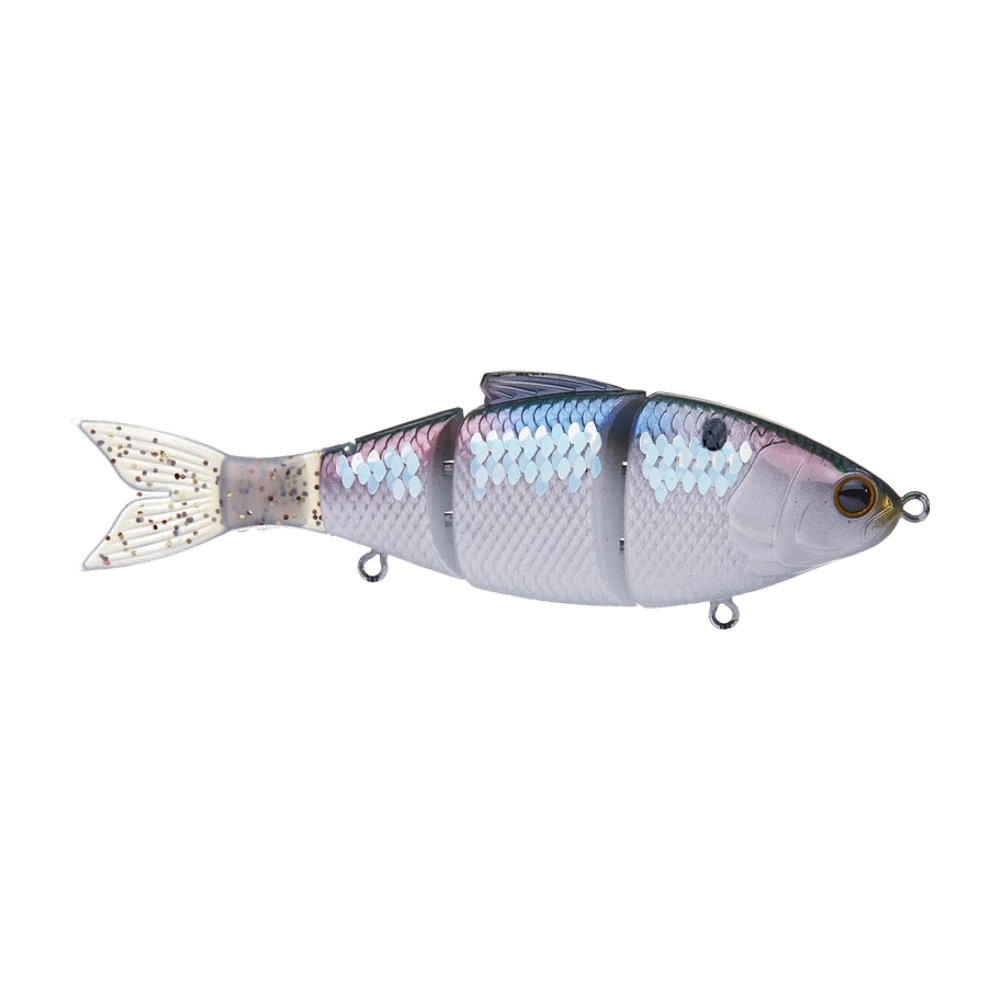
The Trace 5 measures 12.7 cm / 5 in and carries over the four-piece body of its bigger sibling, of which it is the compact version. That architecture is what produces the S-shaped swim: each joint offsets the movement of the next segment slightly, and the wave travels from head to tail rather than pivoting the whole body as one block. The visual result is very different from a one-piece swimbait, which rolls on itself, and from a two-piece, which breaks sharply in the middle.
The price of that construction is that it demands a clean retrieve. A jointed bait fished badly — too fast, or with rod snaps — loses its wave sequence and starts shimmying with no amplitude. On a 6th Sense Option Swimbait you can afford abrupt changes; on the Trace, steadiness does all the work.
The back end is a forked soft tail, held by a screw-lock hidden in the last segment. It swaps out without tools when a pike's teeth tear it, which solves the main weakness of swimbaits with a soft appendage: normally a shredded tail means a bait for the bin.
Keep a spare tail in the box from your first day out. That is not a theoretical precaution: on pike water it is usually the second or third bite that takes the tail, and you do not want to retire a bait because it is missing three centimetres of plastic.
The three densities, and what they actually change
The manufacturer gives a different weight for each version, and it is the most useful figure on the whole spec sheet:
- Floating, 0.8 oz / 22.7 g: stays on top at rest. This is the version for weed, lily pad edges and very shallow water, where you want to pause without snagging.
- Slow sink, 0.95 oz / 26.9 g: drops gently, typically 20 to 40 cm per second. The most versatile option, the one that lets you count down to pick your layer before you start reeling.
- Fast sink, 1.1 oz / 31.2 g: reaches the bottom quickly, for drop-offs, deep sunken timber and windy days when you lose contact.
If you only buy one, buy the slow sink. It is the only version that lets you fish all three depths by varying the countdown, at the cost of a little efficiency at either extreme.
The classic rigging mistake
Tying straight to the nose ring with a tight knot. On a jointed bait that restrains the head, which is the very segment that initiates the wave — and the whole S sequence collapses. Use a decent-sized snap or a loop knot. The reasoning is the same as on a lipped crankbait, except the effect is even more visible here because three segments depend on the first.
Where and when to use it
The Trace 5 is a slow-presentation bait for identified spots, not a tool for covering three hundred metres of bank. Its 12.7 cm size puts it in an interesting bracket: big enough to select good bass, compact enough not to spook fish on pressured water, unlike swimbaits of 20 cm and more.
In Europe pike are just as serious a target for this size, especially in slow-sink on autumn margins. Fit a wire or titanium leader then: a 27 g jointed bait leaving with a pike means a lost lure and a fish carrying two trebles. For a wider profile and an even slower cadence on the same water, a 13 Fishing BAMF Shad Swimbait takes over, while a 6th Sense Masterclass Panorama Swimbait covers the situations that call for still more volume.
The factory hooks quoted by 6th Sense are two size #2 black nickel trebles. In the product photo the bait is shown bare: only the belly split rings and the nose ring are visible, which does at least let you study the articulation.
Not sure what to tie on?
Photograph your spot: CarnaFish reads the scene, cross-checks the conditions and gives you the zone, the lure and the retrieve. Free on iOS and Android.
Colours by water clarity
- Clear water: Pearl Shad, the pearl finish in the photo, whose pale blue and pink highlights pass for a small roach or a juvenile shad in good light.
- Lightly stained water: Green Gizzard or an olive back, which keeps a readable silhouette without flashing excessively.
- Low light, dawn and dusk: a black back, chosen for the contrast of the silhouette seen from below rather than for the colour itself.
Knowing which density to pick depends first on the depth of the spot and where the fish are holding in the column — which CarnaFish helps you settle from a single photo of the spot, suggesting a zone, a depth and a lure family suited to the moment. If you are after pike with this size, our guide to choosing a pike lure places jointed swimbaits among the other families.
What to remember
- A four-segment body producing a progressive S-shaped wave, provided you reel steadily with no rod action.
- Three genuinely different densities: 0.8 oz floating, 0.95 oz slow sink, 1.1 oz fast sink. The slow sink is the most versatile.
- The soft tail is replaced via a hidden screw-lock: keep a spare, it usually goes before the rest of the bait.
- A 12.7 cm size selective enough for good fish without being intimidating on pressured water.
FAQ
Which version of the Trace 5 should I start with?
The slow sink, at 0.95 oz / 26.9 g. It lets you choose your layer by counting the seconds of descent before you start reeling, so one bait covers the surface as well as the first two or three metres.
What is the difference between the three densities?
Only the weight, and therefore the sink rate: 0.8 oz floating, 0.95 oz slow sink, 1.1 oz fast sink. The body, the 12.7 cm / 5 in length and the stated hooks are identical.
Can the soft tail really be replaced?
Yes, it is held by a screw-lock hidden in the last segment and changes by hand. That is a real advantage on a bait at this price, especially if you fish water holding pike, where soft tails do not last long.
Do I need a wire leader with this swimbait?
In Europe, yes, as soon as you fish water containing pike. Heavy fluorocarbon is enough on a strictly bass spot, but it will not protect against a side-on strike at a 12.7 cm bait.
Should it be worked with the rod?
Better not. The four segments build their S-shaped wave from steady traction; snaps break the sequence and the bait starts shimmying with no amplitude. Vary reel speed and add short pauses instead.
What rod casts a 27 g lure?
A medium-heavy casting rod with a rating covering roughly 15 to 40 g, matched with 20 to 30 lb braid. A rod that is too light handles the cast of a jointed bait poorly, since it catches the wind and tumbles more than a one-piece lure.
The full bass lure guideSeason-by-season strategy: which family of lure, when, and why.Go from theory to fish
CarnaFish reads your spot from a photo and gives you the game plan: zone, lure, retrieve. Free on iOS and Android.