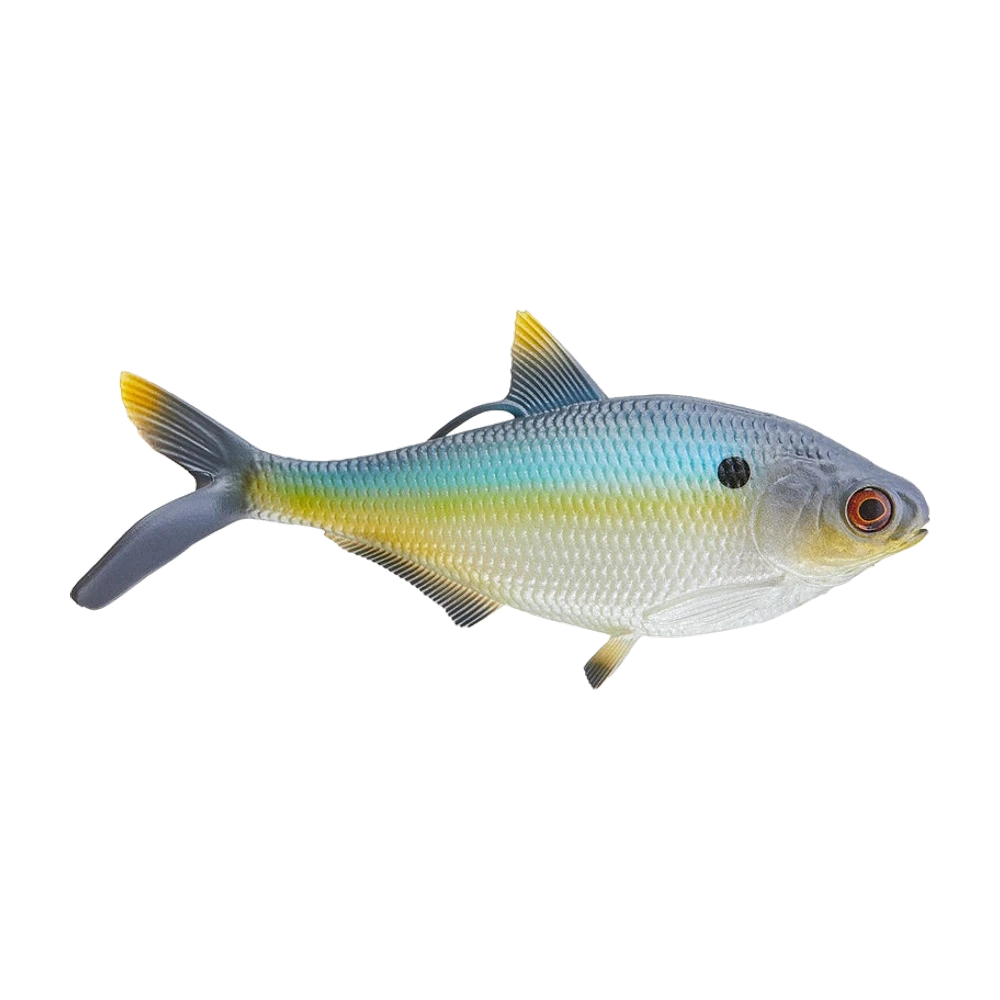
13 Fishing BAMF Shad Swimbait: the big weedless shad built for a screw lock
Not sure this lure fits YOUR spot today? CarnaFish tells you in 10 seconds, from a photo.
There comes a point in the season when you stop looking for bites and start looking for one fish. The weed is high, the banks are undercut and shaded, and the little shad that worked so well in June only brings up twelve-inch fish. That's BAMF Shad territory: a big, bulky soft bait rigged weedless on a screw lock hook, one you can throw into the dark holes in the vegetation without spending the afternoon unsnagging.
A bulky profile, and what that costs you
Released under the joint 13 Fishing and Coalition Bait Co. label, the BAMF Shad belongs to the family of large paddle tail soft swimbaits. The intent is plain: offer one big protein-packed meal instead of chasing numbers. The body is thick and deep-sided, with detail work that goes a long way — 3D eyes, pronounced scales, sculpted fins. That isn't decoration: on a fish that has watched hundreds of lures swim past this season, in clear water and on an inspection follow, it is often what separates a fish that trails the bait from a fish that eats it.
Worth saying straight away, because this is the detail that gets people the wrong size: the brand advertises several sizes and several colours, but publishes no spec chart — no official length per reference, no stated weight. Check the size printed on the pack before you order. On a big bait, an inch either way changes which rod you need to pick up.
The consequence of that bulk is the same as for any big soft bait: far fewer bites. If you want numbers, a mid-size profile like the Keitech Fat Swing Impact 4.8 will out-produce it over a day. The BAMF earns its place when you accept three hours without a bite for one contact that counts.
What the boot tail actually does
The boot tail — an angled paddle on the end of a narrow wrist, shaped like a boot heel — works like a shovel that grabs water on every half stroke and feeds the impulse back into the rear of the body. The bait swims rolling slightly on its own axis, with a slow, wide thump that pushes water and that you feel clearly in the blank even at 40 m / 45 yd.
It is the volume of the tail that creates the swim, not retrieve speed. A slow, steady retrieve has the bait working at full amplitude; speeding up doesn't widen the thump, it just lifts the bait in the water column and stiffens the swim. The right setting is the slowest speed that keeps the tail turning over.
Before the first cast, always run the bait two metres / six feet in front of your own eyes. If the tail isn't kicking cleanly and the body is spinning, the screw isn't seated square in the nose. At 40 m, a spinning soft bait doesn't register in the rod: you can fish a full hour behind a bait turning like a spoon without ever knowing.
Weedless rigging is the whole point
The body is moulded with a proprietary hook slot, a channel cut into the back that takes the shank and the point. The bait is designed to be rigged weedless on a screw lock style hook: a wide gap hook with a screw keeper you thread into the nose, point brought back into the slot. Rigged that way it becomes close to unsnaggable in cover.
Hook and weighting
Pick a hook whose gap clears the thickness of the back by a wide margin. This is the classic mistake on a bulky soft bait — too little gap and the point has no room to drive out through the plastic on the hookset. Bare hook for a high, gliding swim over submerged weed; belly-weighted hook to work down along an undercut bank. Total rig weight isn't published and can't be: it depends on the body size and the screw lock head you pick.
The nose anchors
On any big soft bait rigged on a screw, the nose dies first — the keeper works in the plastic on every cast and eventually tears it open. The BAMF has innovative nose anchors, moulded reinforcements that spread the load around the screw and hold the body in place both during rigging and against a fish shaking its head. It is a genuine durability gain, not a miracle: after a few good fish the nose will still give up. A drop of superglue on the screw thread stretches a body's life noticeably.
The classic error
Burying the point deep in the back to "make sure it won't snag." Thick plastic already absorbs a lot on the hookset; add three more millimetres of it and the point never breaks through. Keep the point flush, laid in the slot rather than pushed under, and set the hook by sweeping and reeling rather than snapping the rod up.
Not sure what to tie on?
Photograph your spot: CarnaFish reads the scene, cross-checks the conditions and gives you the zone, the lure and the retrieve. Free on iOS and Android.
Where and when to pick it up
This is not a search bait. The BAMF is fished on known spots: dark holes in the middle of a weed bed, pad edges, banks undercut below the vegetation, flooded timber, dock pilings. Anywhere a good fish sets up and a treble-hooked bait couldn't go. Late spring through autumn for bass.
Pike take it too, on two conditions: a thick fluorocarbon leader at the very least, titanium if the spot gives up pike regularly, because a sideways hit on a bait this size puts teeth right at the knot; and a firm hookset, since a single hook in a bony jaw needs real pressure. Out in open water, away from cover, a Westin Monster Teez still makes more sense.
Two honest limits. Price per bait, on top of the screw lock hooks. And the tackle: a medium-heavy to heavy rod, strong braid and a reel that takes heavy casting — with gear that's too light you won't cast properly and you won't set the hook. To stay lighter on the same spots, a Savage Gear Cannibal Shad does the job without changing your setup; for a big swimbait that arrives already weighted, the Megabass Magdraft needs less preparation.
Colour by water clarity
- Clear water: a natural silver baitfish tone. This is where the 3D eyes and the scales genuinely earn their keep, because the fish has time to look before it commits.
- Lightly stained water: a green or green pumpkin back with gold flanks, the compromise that keeps a believable silhouette while staying visible at arm's length.
- Muddy water or low light: a dark, high-contrast finish, black or black with blue flake, with a clean belly. In coloured water it is the silhouette that reads, not the colour.
The range is offered in multiple colours but with no stable public naming, and the names shift from one batch and one retailer to the next. Don't try to chase the exact shade you saw in an American video. Think in silhouette and contrast instead.
A big soft bait never makes up for picking the wrong spot, and at this size you have no margin for a misread, because you won't make twenty casts an hour. That's exactly what CarnaFish makes easier: a photo of the spot, and the app suggests the zone, the depth and the kind of presentation that suits the day. And if you plan to swim this one along pike banks, our complete pike lure guide puts the big weedless soft bait back among the other families worth knowing.
Key takeaways
- Big volume and heavy detail work: fewer bites over a day, but a clearly higher average size.
- The boot tail creates the swim at slow speed — no need to speed up to switch the bait on.
- Weedless rigging on a screw lock hook is its real territory, with the point flush and never buried in the back.
- Exact dimensions aren't published by the brand, so check the size at the point of purchase rather than trusting a photo.
FAQ
Which size of BAMF Shad should I pick?
There's no precise answer to give: the brand advertises several sizes without publishing a chart of lengths and weights. Read the size printed on the pack, and start with the smallest in the range if the bait is new to you.
What hook should I rig it on?
A screw lock style hook with a wide gap, big enough that the point clears the thickness of the back comfortably. Bare for a high swim over weed, belly-weighted to hold a lower part of the column.
What are the nose anchors for?
They are moulded reinforcements in the nose that spread the load around the screw keeper. They stop the plastic opening up during rigging and through a fight, which is the usual weak point of big soft baits rigged on a screw.
Can you really fish it in dense vegetation?
Yes, that is what it was drawn for: the slot in the back takes the hook point and the bait becomes close to unsnaggable in grass or flooded wood. In genuinely matted pads, a hollow-body frog is still cleaner to retrieve.
Does the BAMF Shad work for pike?
It works well on pike holding to the bank, provided you run a thick fluorocarbon or titanium leader and set the hook firmly by reeling. Away from cover, a big soft bait like the Westin Monster Teez suits better.
Do I need a specific setup to cast it?
Yes. A medium-heavy to heavy rod, strong braid and a reel that absorbs heavy casting, with total weight depending on the size and the screw lock head. Too light a setup costs you distance, accuracy and hooksetting power.
The full bass lure guideSeason-by-season strategy: which family of lure, when, and why.Go from theory to fish
CarnaFish reads your spot from a photo and gives you the game plan: zone, lure, retrieve. Free on iOS and Android.