Megabass Big Gabot: the catamaran-mouthed frog that walks on the spot
Before tying this one on, it helps to know if the spot actually calls for it. CarnaFish reads the scene from a photo.
A frog that slews sideways at the moment of the strike is one bite lost in two. The fish explodes under the bait, the hollow body rolls onto its flank, the points of the double hook end up facing up instead of searching for the roof of the mouth, and you reel back a crumpled frog with a sour grin. The Megabass Big Gabot takes that problem head on, and its answer runs through the mouth.
A mouth designed like a catamaran hull
Megabass describes the Big Gabot's mouth as a catamaran design, that is, a twin hull. The point is not only to spit water the way a popper would: that geometry stabilises the body and reduces roll during the blow-up, which directly improves the ratio between strikes and fish actually hooked.
That is a different approach from most frogs on the market, which work mainly on body shape and plastic softness. Here the maker starts from the precise moment everything is decided — the instant the fish inhales — and designs the front of the bait so the frog stays flat. On paper it looks like nothing. On the water it is the difference between a day of five bites and two fish, and a day of five bites and four fish.
The same design gives the Big Gabot its second quality: it pivots on the spot. Instead of travelling forward with every rod stroke, it can turn around its own axis and set off the other way, which lets you keep the presentation alive inside a one-square-metre hole in the weed.
Walking the dog, and the skirt that keeps it even
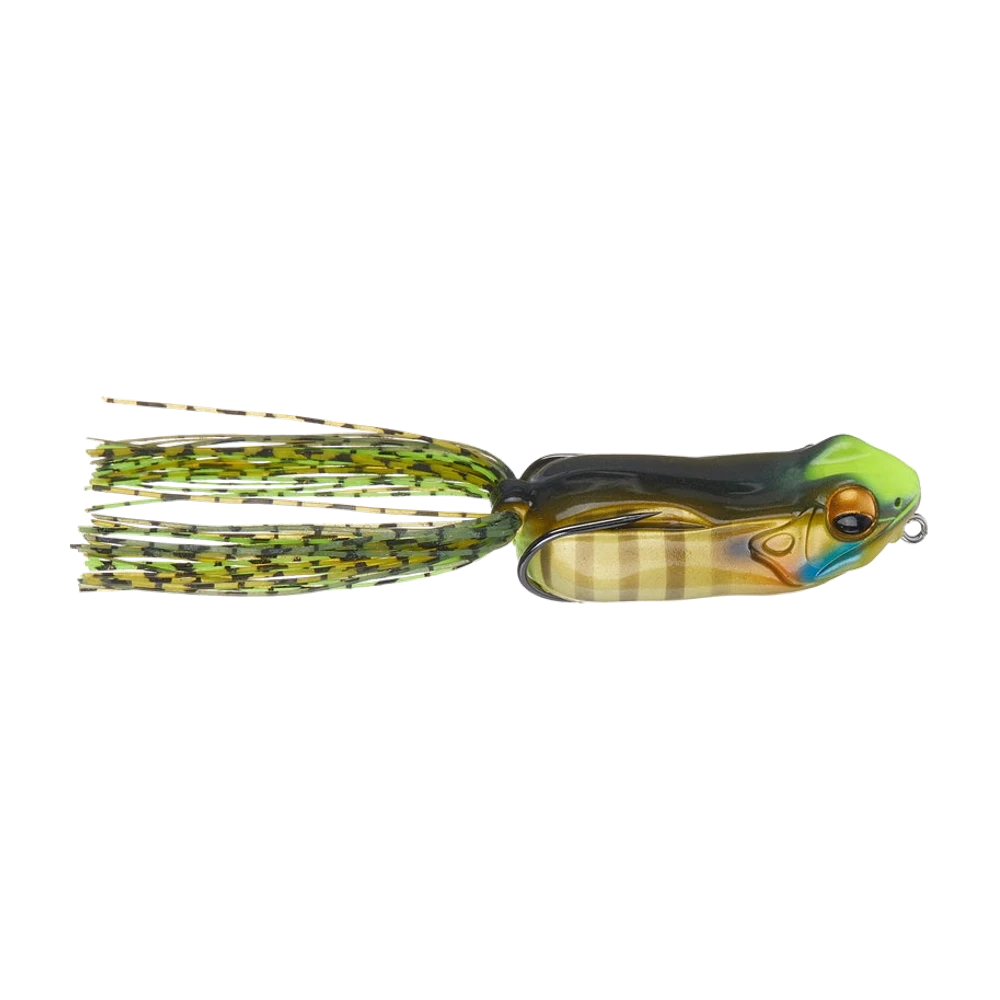
The Big Gabot walks. The maker talks about a textbook walk-the-dog motion and credits the evenness of the movement to the two skirt tails mounted at the rear, visible in the photo: they brake the body symmetrically and stop the frog lurching off to one side.
In practice the stroke is the same as on a topwater stickbait: rod tip down, short crisp taps, half a turn of the handle between taps to take up slack. The difference is in the rhythm. On a Megabass Dog-X in open water you can chain the strokes without thinking. On a frog sitting among lily pads, every two or three second pause counts as much as the movement: it is often at rest, while the skirt strands keep quivering on their own, that the fish makes up its mind.
Put the longest pause of your retrieve just after clearing the edge of a mat, not in the middle. The fish holding under that edge has watched the frog come out of thick cover and now has nothing but open water in front of it: that is when it comes up.
A body balanced between holding shape and collapsing
The body material is a compromise Megabass states openly: stiff enough to hold its shape and its buoyancy, soft enough to collapse under the pressure of the jaws and free the hook points. That is the whole crux of a hollow body frog, and it is where models differ. A frog that is too stiff never compresses, the fish ejects it before the strike lands; a frog that is too soft deforms after ten fish and starts taking on water.
The hook follows the same logic. Megabass states a hook bend, angle and wire diameter designed specifically for this bait, aimed at hook-up rate and holding power in heavy cover. In the photo you can see the two points laid flat against the back, very close to the body: that is what lets the bait slide over leaves without catching.
The mistake that costs the most fish
Striking at the sound. A surface explosion triggers a reflex, and nine times out of ten that reflex is too early: the fish has not yet closed on the hollow body, and you pull the frog away. The correct sequence takes discipline — you see the blow-up, you do not move, you wait until you feel the weight in the rod, and only then you set hard and long, using the fish's own weight as resistance.
The second reflex to unlearn is reeling too fast after the hook set. A bass hooked in a mat has to be dragged out on rod and braid, reeling steadily without snatching and without ever giving line back.
Not sure what to tie on?
Photograph your spot: CarnaFish reads the scene, cross-checks the conditions and gives you the zone, the lure and the retrieve. Free on iOS and Android.
Where a 7.6 cm frog belongs
At 21.3 g for 7.6 cm, the Big Gabot is a good-sized frog, not a finesse model. That format earns its place in three situations: thick mats where a small bait simply vanishes, waters holding big fish where you accept filtering your catch, and windy days when a light frog becomes impossible to place accurately.
In Europe, the weed beds and lily pads of ponds and backwaters are this lure's natural ground, and pike respond to it as readily as bass — with the reservation that their more sideways strike ends in a severed frog far more often. On a water known for pike, budget for lures accordingly. For a finer approach or less dense cover, a SPRO Bronzeye Frog or a Deps Slither K offer different swimming profiles.
Colours by light and cover
Megabass does not publish a colour list in this description, but the logic of a frog is simple and comes down to three cases.
- Clear water and light cover: the pattern shown here, dark olive back and chartreuse head with cream flanks barred in brown. A plausible imitation seen from below as well as from the side.
- Full sun over a thick mat: favour a pale belly, white or cream. A fish sitting underneath sees only a silhouette against the sky, and a pale belly stands out better on a bright one.
- Brown water or overcast sky: a genuinely dark tone, black or deep brown, which gives the cleanest silhouette when light is poor.
Picking the right mats and the right edges before you cast is half the job in topwater fishing. That is exactly what CarnaFish makes easier: a photo of the spot, and the AI suggests the zone, the type of cover to aim at and the lure family that fits the day. For the basics of bass fishing in weed, our guide to getting started on bass sets out the spots to look for.
What to remember
- 7.6 cm for 21.3 g, classed as floating by the maker: a good-sized frog, not a finesse model.
- The catamaran mouth exists first of all to limit roll during the strike, which lifts the hook-up rate.
- The two rear skirt bundles even out the walk and keep working while the bait sits still.
- Set on weight, never on sound: that single rule changes more than anything else in frog fishing.
FAQ
What exactly are the Big Gabot's size and weight?
The maker lists a single version, 3 in or 7.6 cm, at 3/4 oz or 21.3 g, in the floating class. That is a relatively large format among hollow body frogs.
What does the catamaran mouth actually do?
Two things according to Megabass: it spits water like a popper mouth, but above all it stabilises the body and reduces roll during the strike, which raises the number of bites converted. It also lets the bait pivot on the spot.
How do you walk the frog properly?
Rod tip down, short crisp taps, half a turn of the handle between taps to pick up slack. The two rear skirt bundles brake the body symmetrically and stop the bait from skewing off line.
When should you set the hook on a surface strike?
When you feel the weight in the rod, not when you see the explosion. The hollow body first has to collapse inside the fish's mouth to free the hook points. Striking at the sound pulls the frog away before the fish has closed on it.
What tackle does heavy cover call for?
A fast-action heavy rod, long enough to set the hook at distance, and thick braid, typically in the 30 to 40 lb range. In a mat you have to drag the fish out, never giving line back.
Does the Big Gabot work for pike?
Yes, hollow body frogs work well on pike sitting under lily pads. Their more sideways strike does cut hollow bodies open far more often than a bass does: on a known pike spot, treat the lure as a consumable.
The full bass lure guideSeason-by-season strategy: which family of lure, when, and why.Go from theory to fish
CarnaFish reads your spot from a photo and gives you the game plan: zone, lure, retrieve. Free on iOS and Android.