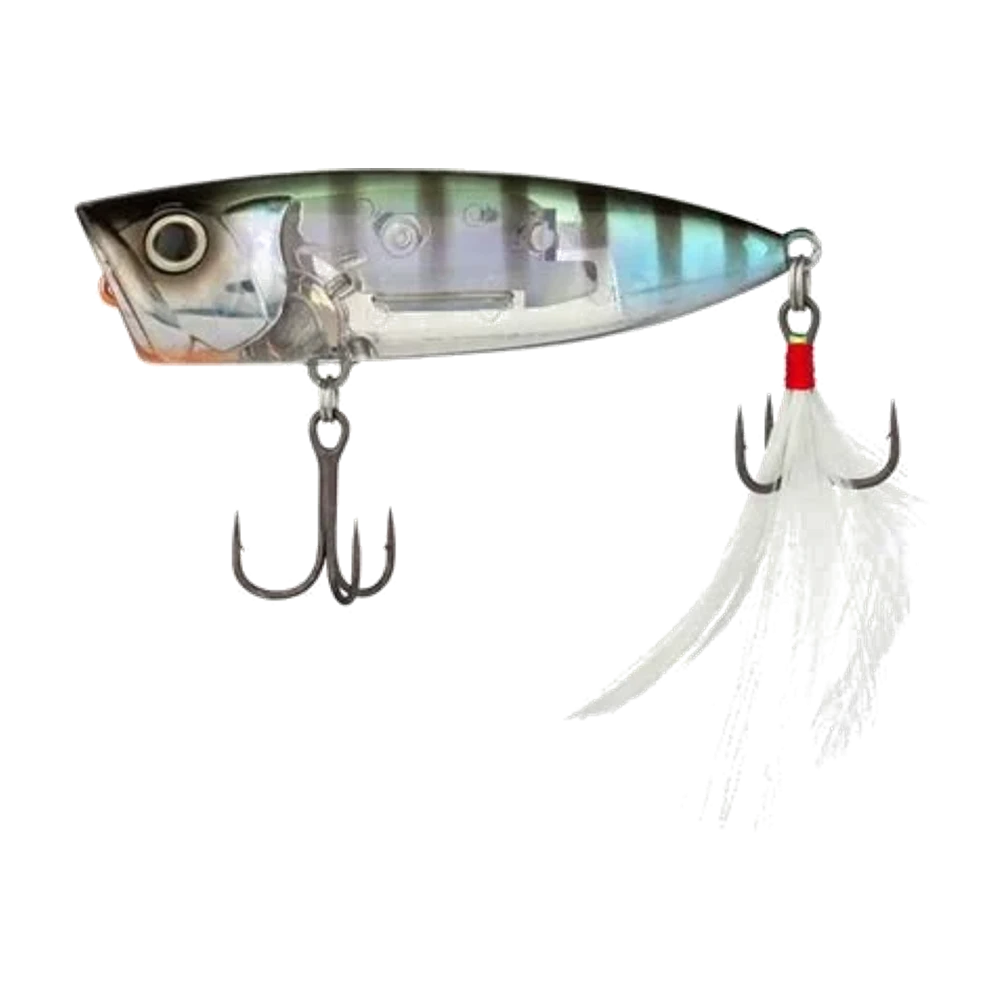
Shimano World Pop: the shoreline popper that handles chop
Rather not fish it blind? Photograph your spot — CarnaFish cross-checks the conditions and points you the right way.
A freshwater popper transplanted into the sea does not work. It is not a question of strength — though the hardware matters — it is a question of physics. From a rock, you often have to land the lure at fifty or sixty metres, with a quartering tailwind and a sea that is never perfectly flat. A short, light popper does two things in those conditions: it spins in flight and it gets lost in the chop.
The World Pop was designed for this context. The key point is not the cup, it is the internal weight transfer system: a heavy ball that slides to the rear on the cast to stabilise the trajectory, then returns forward on splashdown to restore the fishing attitude. In practice, you gain distance and you stop reeling back a lure tangled in its own leader.
Everything else follows from that: a popper you can put down a long way off is a popper you can actually use to fish a bay from the shore.
What a saltwater popper has to do differently
Three requirements separate a saltwater popper from a freshwater one, and they are all present here.
Fly straight. The weight transfer moves the centre of gravity rearward during the flight: the lure goes out like an arrow instead of tumbling. That is the only way to reach useful distance with an object this short and this light.
Stay readable in chop. The cup is sized to throw high and sound deep. On a sea rippled by wind, a timid spray blends into the wavelets. You need a signal that rises above the background, which is exactly the opposite of the logic of a freshwater popper on a small pond.
Hold its line on a fast retrieve. Plenty of poppers veer off, jump out of the water or lie over when you speed up. This one is built to take the fast cadence sea bass fishing demands, where you often link three to five pops per sequence with no long pause.
On the smaller freshwater sizes, those same qualities pay off on big bass lakes, where the wind picks up in the afternoon and light poppers become unusable.
The retrieve: set the rhythm by the sea
- Read the state of the surface before you cast. Flat sea, you will fish slow. Rippled or choppy, you will fish fast and hard. That is the first decision, before you even choose a colour.
- Cast with the wind or across it, never straight into it: you would lose half your distance.
- Take up the slack immediately on splashdown and drop the rod tip towards the water, off to the side. The lure has to be under control before the first pop, otherwise that first twitch makes it lift off.
- Link three to five sharp pops, one per half turn of the handle, at around two per second. You should hear a full "plop", not a dry slap on the surface.
- Mark a stop of one to two seconds. Short. On sea bass, the pause is not there to make the fish think but to let it close the gap.
- Start another sequence until the lure is at your feet. Fish the lure all the way in: strikes in the last three metres are common along rocky drop-offs.
On the water: when a bass boils under the lure without taking it, the mistake is almost always made in the second that follows. Do not stop and do not strike at nothing — keep popping at the same rhythm for two or three twitches, then mark a clean two-second stop. A bass that misses very often comes back, but only if the prey carried on fleeing for a moment before freezing.
Size, hooks and line by context
| Context | Size | Hooks | Leader |
|---|---|---|---|
| Shore sea bass, rocky plateau, rippled sea | Largest (around 9 cm) | Heavy trebles | 0.40 mm fluoro |
| Estuary sea bass, calm water, fish of 40-50 cm | Mid size | Stock trebles | 0.35 mm fluoro |
| Bass, big windy lake | Smallest (around 6 cm) | Fine stock trebles | 0.25-0.30 mm fluoro |
| Searching at range, strong wind | Largest available | Heavy | 0.40 mm fluoro |
Two warnings about hooks. First, switching to heavy trebles changes the flotation: the lure sits lower, the spray gets less high but louder. Check the behaviour five metres in front of you before you go and fish an hour with an unbalanced lure. Second, on a popper most pulled hooks come from too sharp a hookset. You are on braid, so there is no stretch: set the hook by sweeping sideways, not by snapping the rod upward.
As for rods, a 2.40 to 2.70 m model in saltwater lets you hold the line above the waves and cast far. In freshwater, a 1.80 m rod is plenty.
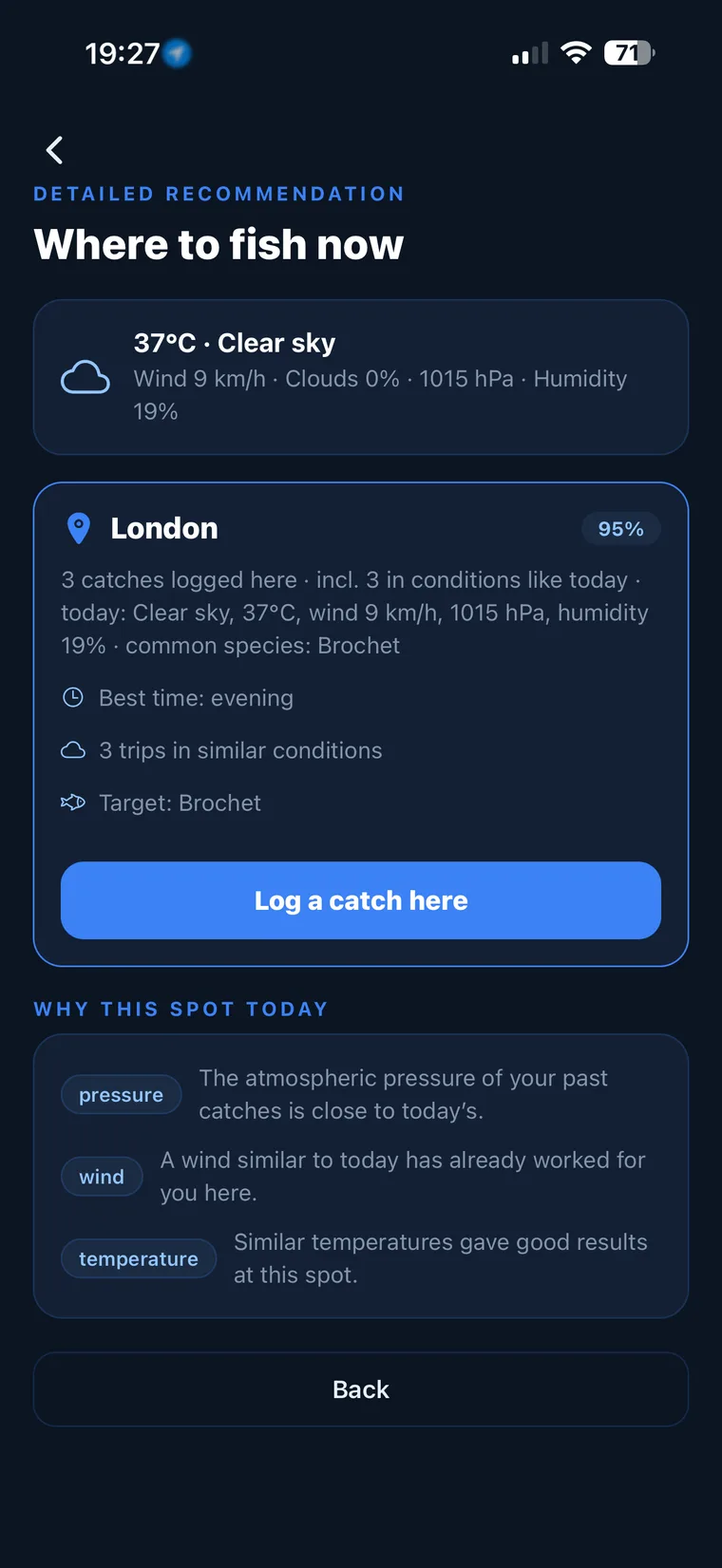
Not sure what to tie on?
Photograph your spot: CarnaFish reads the scene, cross-checks the conditions and gives you the zone, the lure and the retrieve. Free on iOS and Android.
Where it excels, where it fails
It excels on rocky plateaus and shallow ground worked by a bit of swell, on a rising tide, at dawn and dusk. It also excels when you do not know where the fish are: it is a calling lure, carrying far in both sound and casting range, and it will bring a bass up from two or three metres down.
It fails in two cases. On a glassy sea with wary fish, where its powerful spray becomes an alarm rather than a call — that is exactly the window for a wakebait, which is far more discreet. And when bass are feeding on tiny prey, sandeels or small shrimp: a 9 cm popper is then completely beside the point, and you have to drop in size or change lure family altogether.
World Pop or freshwater popper
Next to the Strike King KVD Splash, the difference is not the principle but the intended use. The KVD Splash is designed to zigzag forward between sprays and comb a bass bank; it is lighter, less strongly armed, and it will not hold up to saltwater casting distance or abrasion. The World Pop puts flight trajectory and chop resistance first, even if that makes it less subtle in the way it moves.
Next to the Rapala X-Rap Pop, the uses are close in freshwater, but the X-Rap Pop relies more on a contained spray and a rear feather that works during the pause. It is a finishing lure; the World Pop is a calling and distance lure. And if you find that your spray is scaring fish away instead of drawing them in on a flat sea at night, the answer is called the Daiwa Morethan Crosswake: same zone, same hour, opposite signal.
Our guide to lure fishing for sea bass covers which tide windows to favour from the shore. And if you are unsure between a popper and a sub-surface lure as you arrive on a plateau, CarnaFish analyses a photo of the spot and answers.
Key takeaways
- The internal weight transfer makes the lure fly straight: that is what gives useful casting distance in saltwater.
- A high, deep-toned spray, designed to stay readable in chop, not to be discreet.
- Three to five close-spaced pops at around two per second, then a pause of only one to two seconds.
- A missed boil is recovered by popping on for two more twitches, then stopping dead.
- Counterproductive on a glassy sea and on bass feeding on tiny prey.
FAQ
Why does a saltwater popper cast further than a freshwater one?
Thanks to the weight transfer system: a ball slides rearward on the cast, which stabilises the trajectory and stops the lure tumbling in flight. It returns forward on splashdown to restore the fishing attitude.
What rhythm should I use for sea bass?
Three to five sharp pops at around two per second, followed by a short pause of one to two seconds. Sea bass respond to speed and continuity, unlike bass in clear water, which often want long periods of stillness.
What should I do when a sea bass misses the lure?
Do not strike and do not stop. Keep popping for two or three more twitches at the same rhythm, then mark a clean two-second stop. A bass that has missed comes back in most cases, provided the prey appeared to keep fleeing.
Should I change the stock hooks?
In saltwater on big bass and in rocky ground, yes, for heavy trebles. Be careful though: they weigh down the front and change the flotation. Test the lure's behaviour a few metres out before fishing a whole session with them.
What leader should I use?
Fluorocarbon of 0.35 to 0.40 mm in saltwater, joined to braid of 0.15 to 0.20 mm. In freshwater for bass, 0.25 to 0.30 mm is enough and leaves the lure more freedom to work.
When is it better to leave the popper alone?
On a perfectly flat sea with wary fish, where the spray puts everything on alert, and when bass are feeding on very small prey. In the first case, a discreet sub-surface lure will be far more effective.
The full sea bass lure guideSeason-by-season strategy: which family of lure, when, and why.Go from theory to fish
CarnaFish reads your spot from a photo and gives you the game plan: zone, lure, retrieve. Free on iOS and Android.