Berkley Clickin' Frittside 5: the flat side that clicks in dirty water
One lure, endless conditions. CarnaFish reads your spot from a photo so you are not just guessing.
Thirty centimetres of visibility, a wind pushing silt against a bank, and fish that are there but cannot see a thing. That is the scenario where a standard crankbait becomes useless: too quiet to be found, too big for fish that have not seen forage all day. The Clickin' Frittside 5 was built for exactly that moment, by adding a sound signal to a shape David Fritts had already dialled in.
A flat side, and what that changes in the water
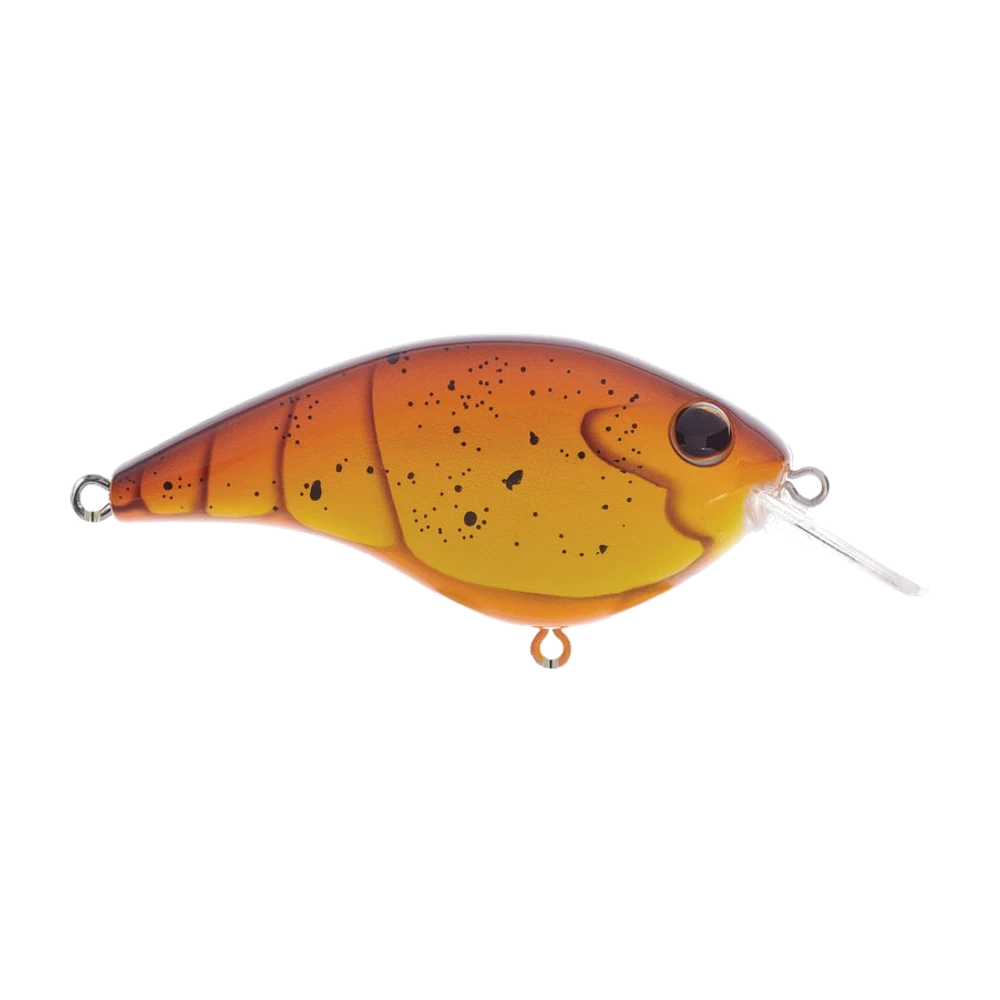
A flat-sided crankbait does not swim like a round-bodied one. Instead of a wide roll it produces a very tight, nervous oscillation with a side flash on every half turn of the body. That is the behaviour of old hand-carved balsa crankbaits, and Berkley owns it: the stated action is described as balsa-like, on a modern moulded body.
That swim has a specific advantage in cold water or on pressured fish: it does not make hydraulic noise, it does not shove volume, it vibrates. A bass that refuses a squarebill for being too loud will often take a flat side on the same pass. It is the same logic that keeps a Rapala Shad Rap relevant forty years on.
The real numbers, and why they matter
The maker gives three figures for the Frittside 5: 2-1/4 in long, 1/3 oz, and a depth of 2 to 5 ft. In metric that is 5.7 cm for about 9.5 g, running between 0.6 and 1.5 m.
Nine and a half grams on a 5.7 cm body is dense for a crankbait this size, and that density is what makes it castable despite the wind resistance of a flat body. On the other hand, do not count on depth: a metre and a half at most, and only with thin line and a long cast. This is a bank, flat and shallow-plateau bait, not a tool for digging a drop-off. A round-bodied diver remains the right answer there.
The compact profile is deliberate. The maker positions it for pressured fish and for periods when forage runs small — late winter, early spring, or any water where the year's fry dominates.
The ball, the FlashDisc, and what each one does
Two technologies coexist here, and they have nothing to do with each other.
Inside, a single ceramic ball rolls in a chamber and produces a sharp click. One ball, not a shot-filled rattle: the sound is punctual and high, not a continuous buzz. That is deliberate, and it is what keeps the bait usable in clear water, where a lipless full of beads would clear the area.
Underneath, the FlashDisc is a patented part that improves tracking, stability and accuracy. In plain terms: the bait does not blow out when you speed up. That is the historic weakness of flat sides, whose flat flanks lose grip as soon as you push the retrieve. Here you can crawl it or burn it without the body lying over.
A useful test after buying: cast five metres, retrieve while gradually speeding up, and watch it. If it tracks straight all the way to your top speed, it is tuned. If not, bend the nose eye very slightly away from the side it pulls to — a quarter of a millimetre is enough.
How to fish it
In dirty water the aim is not to cover ground fast but to pass close. The click carries a few metres, no more: the fish has to be in a fairly narrow cone to hear it and come looking. So multiply parallel passes along the bank rather than wide fan casts.
In cold water, slow down to the edge of where you can still feel the vibration in the rod, and make the bait contact bottom or a branch. The deflection, followed by half a second of float, triggers almost every flat-side bite you will get.
The classic mistake
Tying on heavy line. A 0.35 mm fluorocarbon costs you a good thirty centimetres of depth on a bait that only has a metre and a half to begin with, and it chokes the tight oscillation. Stay between 0.25 and 0.30 mm and accept losing a lure now and then: it is cheaper than a blank day.
The other mistake
Setting hard with the rod. The trebles on a small crankbait are fine wire and a bass tears them out easily if the blank is too stiff. Use a soft-actioned rod, set the drag light, and let the fish hook itself while you keep reeling.
Not sure what to tie on?
Photograph your spot: CarnaFish reads the scene, cross-checks the conditions and gives you the zone, the lure and the retrieve. Free on iOS and Android.
Colors by water
- Cold stained water: the orange craw in the photo, red-brown back and yellow belly. It is the late-winter pattern by definition, when crayfish are the only food available near bottom.
- Clear water: a silver shad with a green or blue back, letting the flash off the flat flank do the work instead of adding color.
- Genuinely dirty water: chartreuse with a black back. At thirty centimetres of visibility, fish read the contrast between two zones, not the shade.
Where it sits against other cranks
The Clickin' Frittside 5 is not a search bait. Over a big area to cover quickly, a Strike King KVD Squarebill moves more water and calls from further. In dirty water where you want a loud signal and a fast sink, a Rapala Clackin' Rap makes more noise. The Frittside fills the slot of the small bait that is discreet without being mute, for fish that have seen everything.
You still need to know whether today's bank fishes at one metre or three. That is exactly what CarnaFish gives you: one photo of the spot, and the AI returns a zone, a depth and a lure family consistent with the conditions. And to go deeper on picking a crankbait by species, our guide to perch fishing with lures lays out the sizes and speeds worth remembering.
Key takeaways
- 5.7 cm for about 9.5 g, running 0.6 to 1.5 m: a bank and shallow-flat bait, not a drop-off tool.
- A single ceramic ball gives a sharp, punctual click rather than a buzz, so it stays usable in clear water.
- The FlashDisc stops it blowing out at speed, the historic flaw of flat-sided crankbaits.
- Thin line and a soft set are the two conditions for getting the tight action and keeping the fish.
FAQ
How deep does the Clickin' Frittside 5 really run?
The maker states 2 to 5 ft, so 0.6 to 1.5 m. You will only reach the top of that range with a long cast and thin line; on heavy line, plan on a metre.
How does it differ from the original Frittside?
It keeps the profile and action of the Berkley Frittside and adds a ceramic ball that produces a click. That is the only claimed difference, and it really only pays in stained or dirty water.
Can it be burned?
Yes, and that is one of its selling points. The FlashDisc stabilises tracking and the bait does not lie over when you speed up, which is rare on a flat side. You can alternate slow and fast on the same pass.
Is it a good perch bait?
Yes. The 5.7 cm size and the tight vibration suit a school of perch pushing fry, especially along shallow banks. Just mind the fine wire trebles when you set.
What line should I use?
Fluorocarbon between 0.25 and 0.30 mm is the best compromise: thin enough to let the bait get down and vibrate, strong enough to pull a fish out of a cluttered bank. Past 0.35 mm the swim is noticeably choked.
Should I upgrade the factory trebles?
Not for quality reasons, the factory Fusion19 hooks are sound. Do check them after every session on hard bottom, though: on a bait that bumps structure, a folded point costs more fish than the wrong color ever will.
The full bass lure guideSeason-by-season strategy: which family of lure, when, and why.Go from theory to fish
CarnaFish reads your spot from a photo and gives you the game plan: zone, lure, retrieve. Free on iOS and Android.