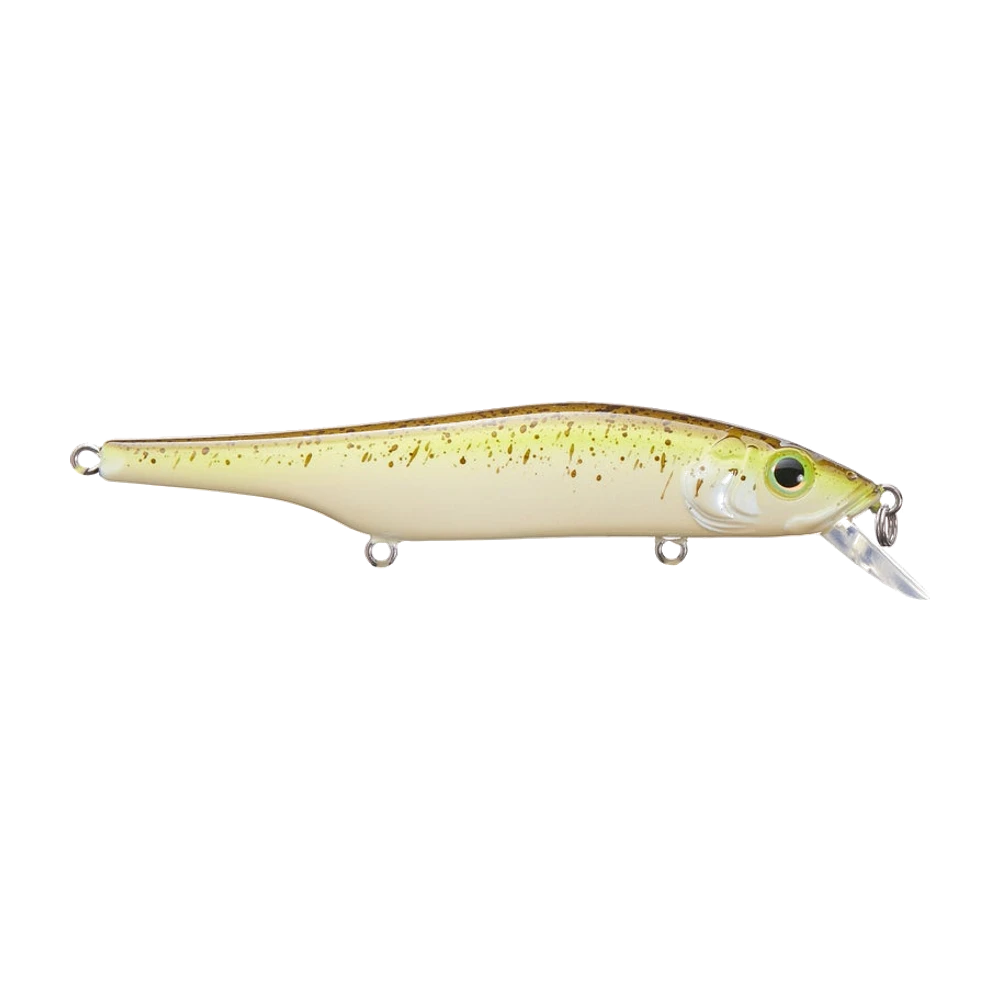
Bill Lewis Scope-Stik 100 SP: the jerkbait drawn for the sonar
One lure, endless conditions. CarnaFish reads your spot from a photo so you are not just guessing.
Ever since steerable live sonar found its way into tournament boats, part of lure design has been chasing a different goal. It's no longer only about the fish seeing the bait: it's about the angler seeing it on screen at twenty metres, so they can steer it to a fish they've already marked. The Scope-Stik is a jerkbait built around that constraint, and that's what explains its unusual profile.
Why a flat flank changes what you see on screen
A sonar beam returns more echo the wider and more perpendicular the surface it hits. A conventional round-bodied jerkbait offers a narrow reflecting surface and drops off the image fast. The Scope-Stik is built with pronounced flattened sides, a near-blade section, presenting a far bigger reflecting surface.
The bill reinforces the effect: it was shaped to impart a strong lateral displacement, a hard side-to-side dart. The result is that through much of the retrieve the bait is showing its flank to the beam rather than its nose. That design intent is something you'll find on almost no jerkbait built before 2020.
Let's be honest about it, though: if you're fishing from the bank without electronics, that feature does nothing for you directly. But the flat flank isn't only for the angler — it also throws more sideways light at the fish on every dart, and that's a genuine fishing argument independent of any screen.
The real numbers, and the small ambiguity in the name
For the SP6 version the manufacturer quotes a length of 3.8 in, around 9.7 cm, a weight of 3/8 oz, around 11 g, and a running range of 1.2-1.8 m (4-6 ft). The class is listed as Suspending: at rest the bait stays put, it neither rises nor sinks.
The trade name carries "100 mm", which would suggest 3.94 in. The 3.8 in in the official table works out closer to 9.7 cm. The gap is three millimetres and makes no difference on the water, but it's worth flagging rather than copying a round number. Think of it as a ten-centimetre jerkbait, which puts it right in the most versatile size band for bass, big perch and zander.
How to work it: the pause does all the work
The basic rhythm
Two or three sharp wrist twitches with the tip pointed down, then a pause. On the twitches the bait kicks out either side of the line's axis. On the pause it stops dead in the water column. That dead time is when the fish makes up its mind: it slides underneath, looks at the bait, and eats on the next twitch or during the pause itself.
Pause length is the only setting that genuinely matters. In water at 18 °C, a second is enough. At 8 °C you sometimes need to hold five to eight seconds doing absolutely nothing — far longer than it feels with a rod in your hand. Most anglers who catch nothing on a suspending jerkbait in cold water aren't fishing badly, they're just in a hurry.
Dialling in the depth
With a quoted range of 1.2-1.8 m, the Scope-Stik stays a mid-column bait. To hold the bottom of that range, cast long and keep the rod low on the first twitches. To stay high, raise the rod and shorten the twitches. Thick fluorocarbon lifts the bait slightly, thin line lets it run deeper: that's the simplest adjustment you have.
If you're fishing a suspending jerkbait in cold water and losing fish, look at your pause length before you look at your hooks. A fish that eats during an eight-second pause gets hooked properly; a fish that snaps at a hard twitch gets nipped on the lip. Lengthen the pause and the drop-offs often sort themselves out.
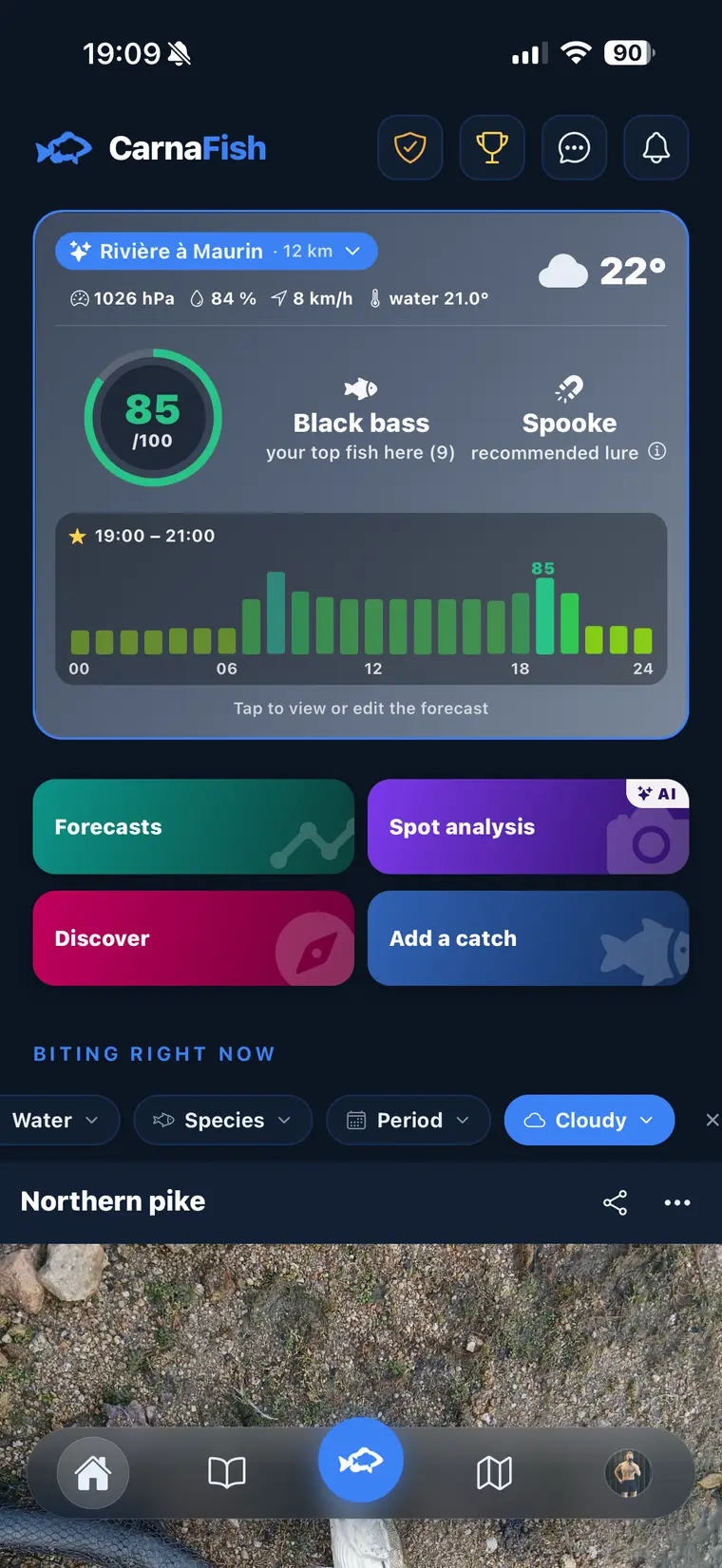
Not sure what to tie on?
Photograph your spot: CarnaFish reads the scene, cross-checks the conditions and gives you the zone, the lure and the retrieve. Free on iOS and Android.
The detail that counts: three trebles on quality rings
The Scope-Stik comes out of the box with three Mustad Triple Grip UltraPoint trebles anchored by quality split rings. On a bait this size, three trebles instead of two is not a trivial choice: it clearly lifts the hook-up rate on the soft sideways eats these baits draw, but it also makes life harder near vegetation and adds leverage during the fight.
There's also an internal weight transfer system that slides a ball to the tail on the cast to stabilise the bait in flight, then brings it back for the swim. That's what lets you cast a long, light bait a long way, especially into wind — and on a jerkbait, casting distance directly determines how many twitches you get per pass.
The classic mistake
Working a jerkbait with your arm rather than your wrist. A long arm sweep moves the bait a metre forward, which pulls it out of the strike zone and kills the dart. Useful twitches are short and sharp, wrist only, rod pointed down at forty-five degrees, moving the bait barely twenty to thirty centimetres.
Colors by water clarity
- Lightly stained water: Chartreuse Shad or cheek-accented finishes like the one in the photo, which keep a contrast point visible at a metre of visibility.
- Clear water over baitfish: Ghost Minnow or any translucent finish with a natural back, for wary fish in broad daylight.
- Low light, dawn or coloured water: Firetiger, more aggressive, giving a clear reference when fish are hunting on sound and silhouette.
A jerkbait is only worth the spot you run it through: a drop-off edge, a rocky point, a submerged treetop. That's exactly the job CarnaFish does, reading a photo of your water and handing you the zone and the depth that fit the conditions. To compare this model against more established suspenders, look at the Duo Realis Jerkbait 120SP and the Yo-Zuri 3DB Jerkbait, and for the wider picture our beginner's guide to lure fishing for zander covers the other families worth knowing.
The short version
- Flattened sides and a laterally driven bill: built to stay visible on live sonar as much as to flash the fish.
- Quoted specs: 3.8 in (around 9.7 cm), 3/8 oz (around 11 g), 1.2-1.8 m, Suspending class.
- Pause length is the decisive adjustment, from one second in warm water to eight seconds in cold.
- Three factory trebles: an excellent hook-up rate, but a bait to keep away from thick vegetation.
FAQ
Does the Scope-Stik float or sink?
Neither: the manufacturer lists it as Suspending, meaning it holds its place in the water column when you stop working it. That stillness is exactly what triggers sluggish fish in cold water.
Do I need forward-facing sonar to use this lure?
No. The flat flank was designed to return a better echo, but it also improves light reflection on every dart. Without electronics you lose the steering aid, not the swimming qualities.
What's the exact length of the Scope-Stik 100 SP6?
The trade name says 100 mm while the manufacturer's spec table quotes 3.8 in, around 9.7 cm. The gap is three millimetres with no effect on the water, but it explains the contradictory figures you'll see quoted around.
Is this jerkbait any good for zander?
Yes, the ten-centimetre size and the 1.2-1.8 m range line up well with the drop-off edges where zander hunt at dusk. Just remember to stretch the pauses considerably compared with bass fishing.
How long should the pause be?
One to two seconds in water above fifteen degrees, and up to five to eight seconds in cold water. It's the parameter that makes the biggest difference to bite count, well ahead of colour choice.
Why won't my jerkbait dart side to side?
Two causes cover the vast majority of cases: a knot cinched straight to the nose eye, which chokes the front of the bait, or twitches that are too long and driven from the arm. Switch to a quick snap and shorten the twitches to wrist only.
The full bass lure guideSeason-by-season strategy: which family of lure, when, and why.Go from theory to fish
CarnaFish reads your spot from a photo and gives you the game plan: zone, lure, retrieve. Free on iOS and Android.