Booyah Flash Point Jerkbait: the bladed jerkbait built for live sonar
One lure, endless conditions. CarnaFish reads your spot from a photo so you are not just guessing.
Since forward-facing sonar became affordable, a new problem has appeared: you can see the fish and you can see the bait, but a slim 10 cm jerkbait viewed at three-quarters gives a thin return, and you lose it the moment it drifts out of the cone. The Flash Point answers exactly that, with a metal blade mounted on the bait's back. The question is what that changes in the water, and what it changes for anyone fishing without a screen.
The numbers first
The maker publishes a clear spec line: 10.8 cm / 4.25 in, 14 g / 1/2 oz, running 1.2-1.8 m / 4-6 ft, suspending class. That's a standard jerkbait format, the same size bracket as a Strike King KVD Jerkbait 300 — neither a finesse model nor a big profile.
The suspending class is the key figure: at rest, the bait neither rises nor sinks. Booyah adds that it's weighted to sit at roughly 45 degrees during the pause, nose down. That isn't a detail: a jerkbait that suspends level shows its flank, a tilted one shows its back and a three-quarter profile. That attitude is precisely what lets the dorsal blade do its job.
What the blade actually does
Two functions, and it's worth separating them.
The first is technical and concerns imaging: the blade increases the bait's metal surface and makes it far easier to read on a forward-facing sonar screen. You track the bait, you watch a fish rise to it, you adjust the pause. That's the model's stated reason to exist.
The second is what the fish sees, and it's the more interesting one for everybody. A conventional jerkbait throws a lateral flash, the flank rolling over on each twitch. This one adds an upward flash, from the back. For a fish holding under the bait — the normal ambush position for a bass or a zander — that's a cue it almost never gets. You don't need a screen to benefit from it.
The blade also makes noise on a sharp twitch: a small metallic tick against the bait's back. In stained water that's a plus; in very clear water on pressured fish it sometimes turns a follower away. If you get three follows without a commit, go back to a plain jerkbait like the Duo Realis Jerkbait 120SP.
Casting far, and why it matters
The body carries mobile tungsten weights that slide to the tail during flight. The bait leaves like an arrow, tail first, instead of tumbling. On landing, the weights return to their swimming position.
That buys two things. First, raw distance, useful for covering a flat or reaching a bank from open water without approaching it. Second, wind: a light jerkbait thrown into a breeze becomes unmanageable fast, and weight transfer fixes most of that. The known downside of every transfer system applies here too — a very slow retrieve can leave the balls at the back, and the bait then swims slightly tail-down. One firm twitch resets everything.
The retrieve that goes with it
The basic sequence has three parts: two or three sharp downward twitches of the rod tip, half a turn of the handle between each to take up slack, then a pause. The whole game is in how long that pause lasts.
In water at 18-20 degrees, one or two seconds is enough. At 10 degrees, go to five, seven, sometimes ten seconds — it feels long, it feels wrong, and that's when the fish bite. A strike on a suspending jerkbait almost always comes during the stillness: you don't feel a knock, you feel odd resistance on the next twitch.
The classic mistake
Pulling too hard and too far. A 60 cm sweep sends the bait a long way sideways, moves it away from the fish and breaks the rhythm. A short, sharp 15 to 20 cm twitch pivots the bait on the spot and keeps the fish underneath it. With a bait whose whole point is to flash upward, keeping it in the zone beats covering ground.
Not sure what to tie on?
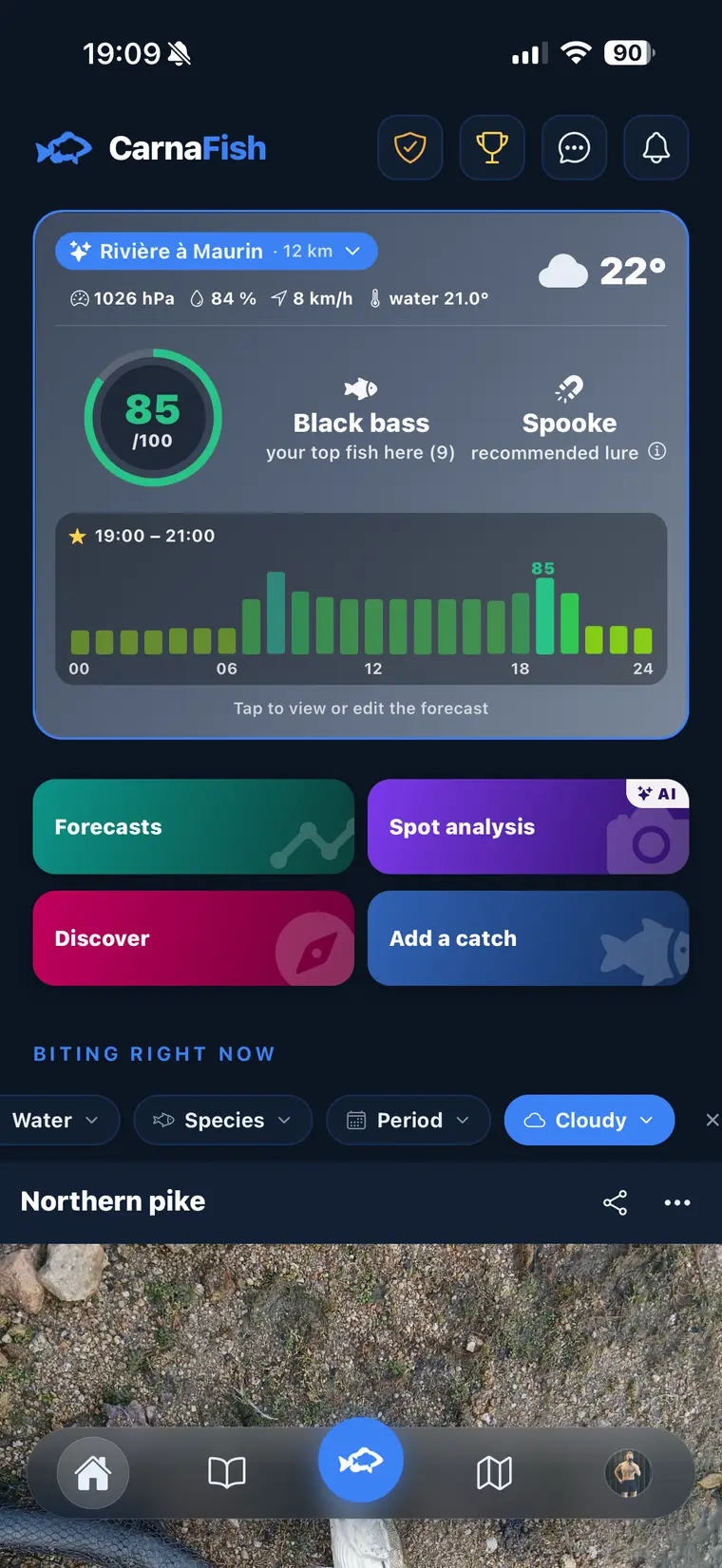
Photograph your spot: CarnaFish reads the scene, cross-checks the conditions and gives you the zone, the lure and the retrieve. Free on iOS and Android.
Three trebles, and a leader decision
The Flash Point comes armed with three Super Slide trebles from the factory. Three trebles on 10.8 cm is a lot of steel for a short body: the bait holds fish well, but the hooks tangling with each other is common on the cast and after every release. Get into the habit of checking their alignment before you cast again.
For line, 25-30/100 fluorocarbon. It sinks slightly, which helps the bait hold its depth through long pauses, and it stays discreet in clear water. A small snap beats a knot cinched on the ring: the lip needs freedom to kick the bait sideways.
If you're fishing water that holds pike, settle the wire leader question before the first cast rather than after losing the bait. With three trebles, a badly hooked pike has a good chance of cutting above the nose ring.
A point worth checking on the rules
This bait is sold around a forward-facing sonar argument. That technology isn't allowed everywhere: several federations, tournament circuits and private fisheries regulate or ban it in Europe. Check your water's rules before buying into the whole ecosystem. The lure itself fishes very well with no screen at all — that's the most honest way to approach it.
Colour by water
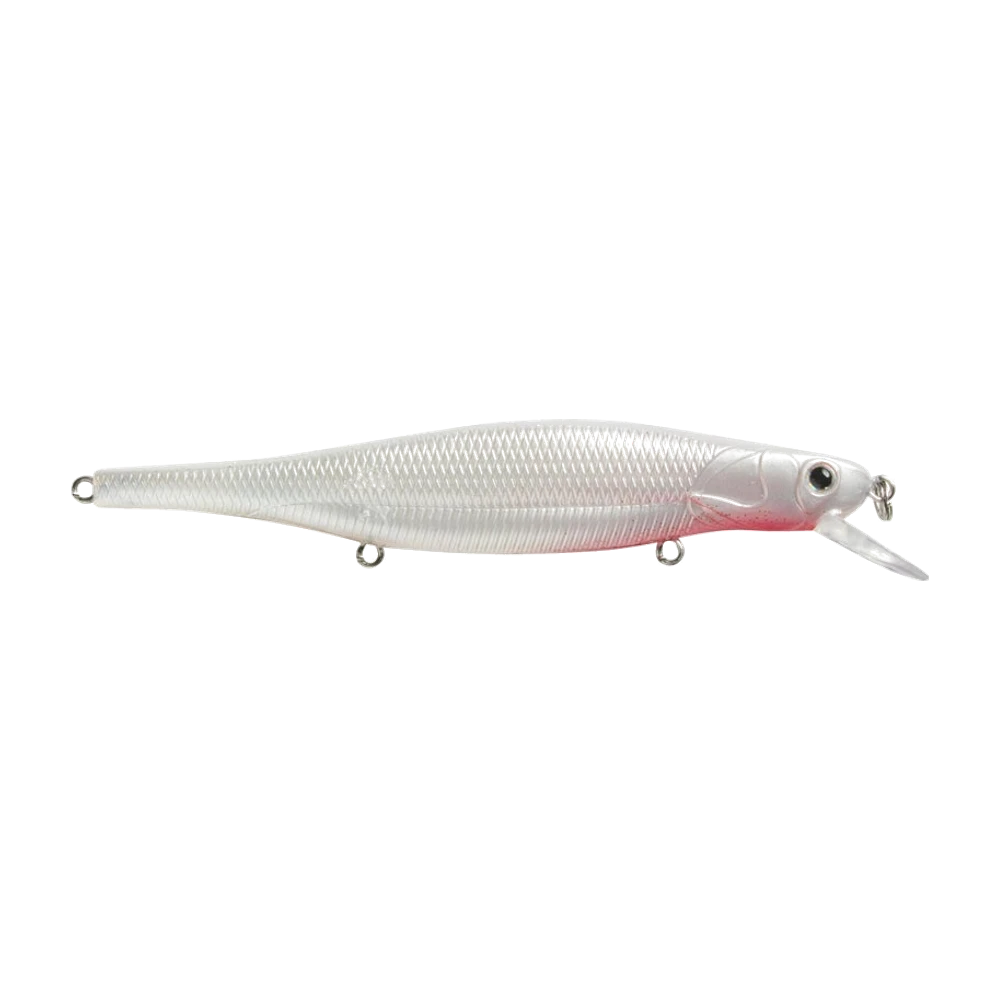
- Clear water: pearl white, the colour in the photo, with its red throat giving a fixation point at the moment of the strike.
- Stained water: a Chartreuse Shad, easier to read at distance when visibility drops under a metre.
- Bright light over light-coloured bottom: a dark back with a gold flank, keeping clean contrast when white washes out in the glare.
A jerkbait is only as good as your read on the layer the fish are holding in: with a 1.5 m running depth, the fish need to be between 1.5 and 4 m for it to work. That's exactly what CarnaFish helps estimate — a photo of the spot, and the app suggests the zone, the likely depth and a matching lure family. For the rest of the basics, our beginner's guide to bass fishing covers tackle and target spots. And to compare with another jerkbait built around live sonar, the Berkley Finisher 5 FFS Jerkbait page lays out a different answer to the same problem.
Key takeaways
- Factory specs: 10.8 cm / 4.25 in, 14 g / 1/2 oz, running 1.2-1.8 m / 4-6 ft, suspending at roughly 45 degrees.
- The dorsal blade adds an upward flash, useful to a fish sitting below it, screen or no screen.
- Mobile tungsten weights buy casting distance, especially into wind.
- The whole game is pause length, not twitch amplitude.
FAQ
How deep does the Flash Point run?
The maker states 1.2 to 1.8 m, the 4-6 ft range from its spec table. That's a running depth on the retrieve; during pauses the bait stays at whatever depth it reached, since it's a suspending model.
Do I need forward-facing sonar to use this bait?
No. The blade improves the sonar return, but above all it adds an upward-oriented flash that a fish holding beneath the bait reads perfectly. The Flash Point fishes normally with no electronics at all.
How long should the pause be?
One to two seconds in warm water, five to ten in cold water. The colder it gets, the longer the pause has to be: the great majority of bites come during the stillness.
Does the Flash Point suit zander?
Yes. The 10.8 cm size and the 1.2-1.8 m band match the shallow banks and breaks where zander hunt early and late in the day, and long pauses work in your favour on that species.
Why do my trebles keep tangling?
Three trebles on a 10.8 cm body leave little clearance. Check their alignment before every cast, and if it persists, dropping the tail treble one size reduces it sharply without costing fish.
What line should I use with this jerkbait?
25-30/100 fluorocarbon, which sinks just enough to hold depth through the pauses and stays discreet in clear water. Add a small snap rather than a knot cinched on the ring, so the lip can work.
The full bass lure guideSeason-by-season strategy: which family of lure, when, and why.Go from theory to fish
CarnaFish reads your spot from a photo and gives you the game plan: zone, lure, retrieve. Free on iOS and Android.