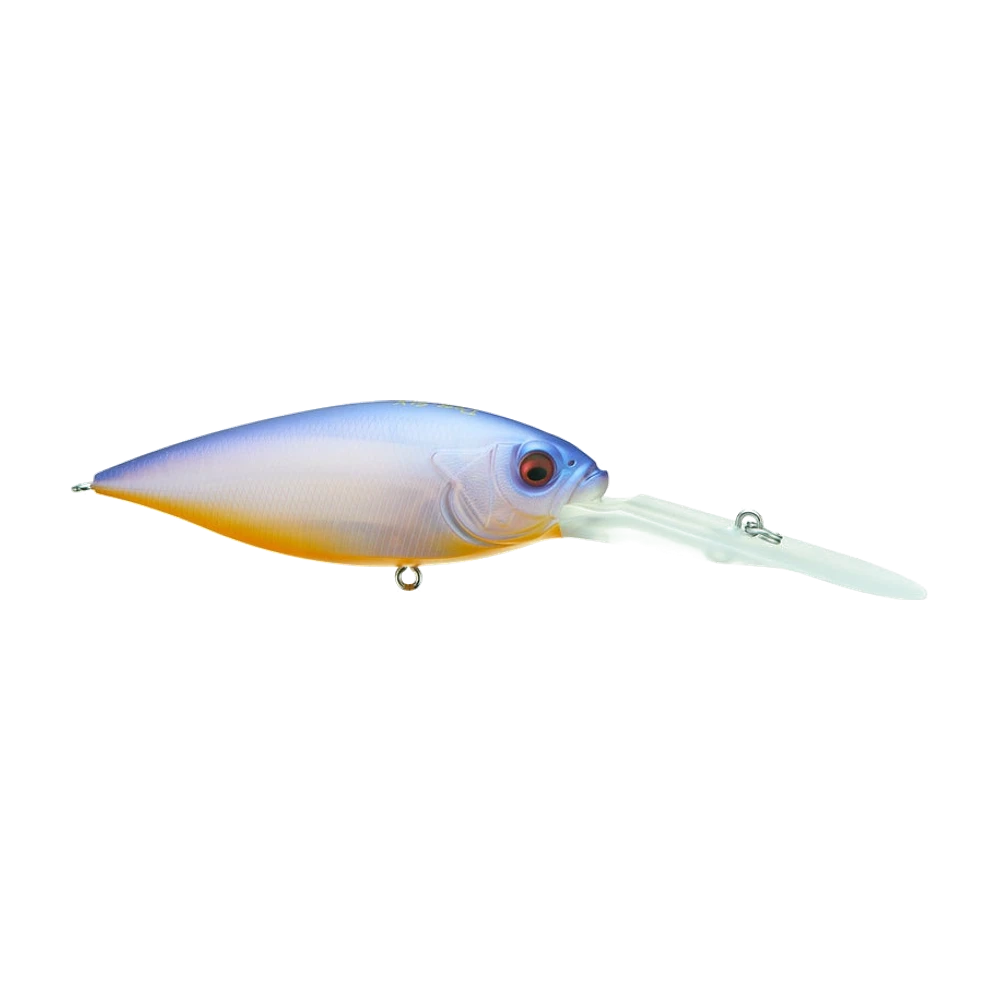
Megabass Deep-Six: the crankbait that reaches past the six-metre mark
The right lure in the wrong spot still catches nothing. CarnaFish spots the zone that works, from a single photo.
In midsummer, on a big lake, the better fish drop onto breaklines at seven or eight metres while most shop-bought crankbaits top out three metres above them. You can see them on the sonar, pinned to the bottom, and all you have left is a weighted Texas rig or a vertical presentation. The Megabass Deep-Six, designed by Yuki Ito, exists for exactly that situation: working a layer of water most crankbaits never reach.
Eight centimetres for more than six metres
The spec table Megabass publishes is short and unambiguous: 3.15 in, which is 8.0 cm, 7/8 oz, which is roughly 24.8 g, and a stated depth of 20 ft and beyond, a shade over 6.1 m. What matters is the relationship between those three numbers. Nearly 25 g on a body only 8 cm long is very heavy for the size: that density buys casting distance, and casting distance is precisely what buys depth on a diving crankbait.
The lip is described as exceptionally thin. That isn't cosmetic. A thin lip slices through current instead of fighting it, which lets the bait hold a steep dive angle without planing up or spinning out. A deep crank that fails is almost always a crank that loses its attitude halfway through the retrieve and climbs.
One honest caveat: Megabass publishes no buoyancy class for this model, unlike most of its other hard baits. So nothing here can state whether it officially floats or sinks. In practice, test the pause behaviour on your first cast, in sight, close to the bank. It takes thirty seconds and it governs the whole way you free the bait from an obstruction.
The moving balancer, three positions and three behaviours
The Deep-Six carries the in-house Megabass weight system, the Multi-Way Moving Balancer System (PAT.P). Most transfer-weight baits have two positions: rear on the cast, forward on the swim. This one has three, and that is what makes it unusual.
On the cast, the main weight slides rearward and the bait flies tail-first. An 8 cm body travelling in the right attitude is ten to fifteen metres of extra cast, and on a deep crankbait those metres convert straight into running depth, because the bait has more distance to descend before it arrives under the rod tip.
On the dive, the weight moves to the front of the body. The nose drops further, the dive angle steepens, and the bait hits target depth sooner — therefore earlier in the retrieve, therefore across a longer share of the cast.
Third phase, the interesting one. When the Deep-Six reaches maximum depth and touches bottom, a branch or a rock, or simply when you give it a sharp twitch, the main balancer is released and the weight slides: the action ramps up at the exact moment the bait has just hit something. And if it levels out at maximum depth without ever touching bottom, the weight is still released from the front and moves to a middle position: the swim then shifts from wobble, that wide flank oscillation, to roll, where the bait turns more on its axis and throws sideways flash.
What that changes in your retrieve
In practice the Deep-Six does not do the same thing at the start and the end of a cast, and that is fishable. Over the first half of the retrieve you are in the descent phase, the bait wobbling hard and tracking straight; over the second, either you are in bottom contact and every knock restarts the action, or you have levelled out in open water and the bait has switched to roll. Two different signals in a single cast is rare. To favour the contact phase, cast beyond your target and start reeling the moment it lands; to favour the roll, pick a stretch where the bottom sits deeper than the bait's running depth and let it level out.
Count your handle turns out loud between splashdown and first bottom contact. Once you know that number on your own spot, you know exactly when to slow down, when to recast and when the bait is still too high — far more reliable than any dive curve printed on the packaging.
Line and rod make half the depth
A deep crankbait does not dive on its own: it dives if you let it. Line diameter first — the thinner the line, the less lift the water exerts on it, and the deeper the bait goes. Dropping from a 0.35 mm fluorocarbon to a 0.25 mm can be worth half a metre to a metre of extra depth on the same bait. Thin braid with a two-metre fluorocarbon leader stays the best compromise between descent, discretion and abrasion resistance over rock.
Cast length next: maximum depth is only reached mid-cast, and a short cast is a bait that never had time to get down. Rod position last — rod low, tip in the water if needed, to remove any pointless angle between tip and bait. On 25 g, a slightly parabolic crankbait rod absorbs the surges better and stops you tearing a treble out mid-swim.
The classic mistake
Going up in line diameter "because 25 g pulls hard". That is the costliest error on this bait: heavy fluorocarbon cancels part of the work of a lip engineered to dive, and you end up with a crankbait rated past six metres that actually runs four and a half. Same goes for an oversized snap on the lip tie. Use the lightest model that holds your drag, and never tie tight straight onto the eye, it chokes the amplitude.
One last thing: check the trebles before taking on a fish that will fight from six metres down, and swap them at the first doubt — that is the manufacturer's own recommendation.
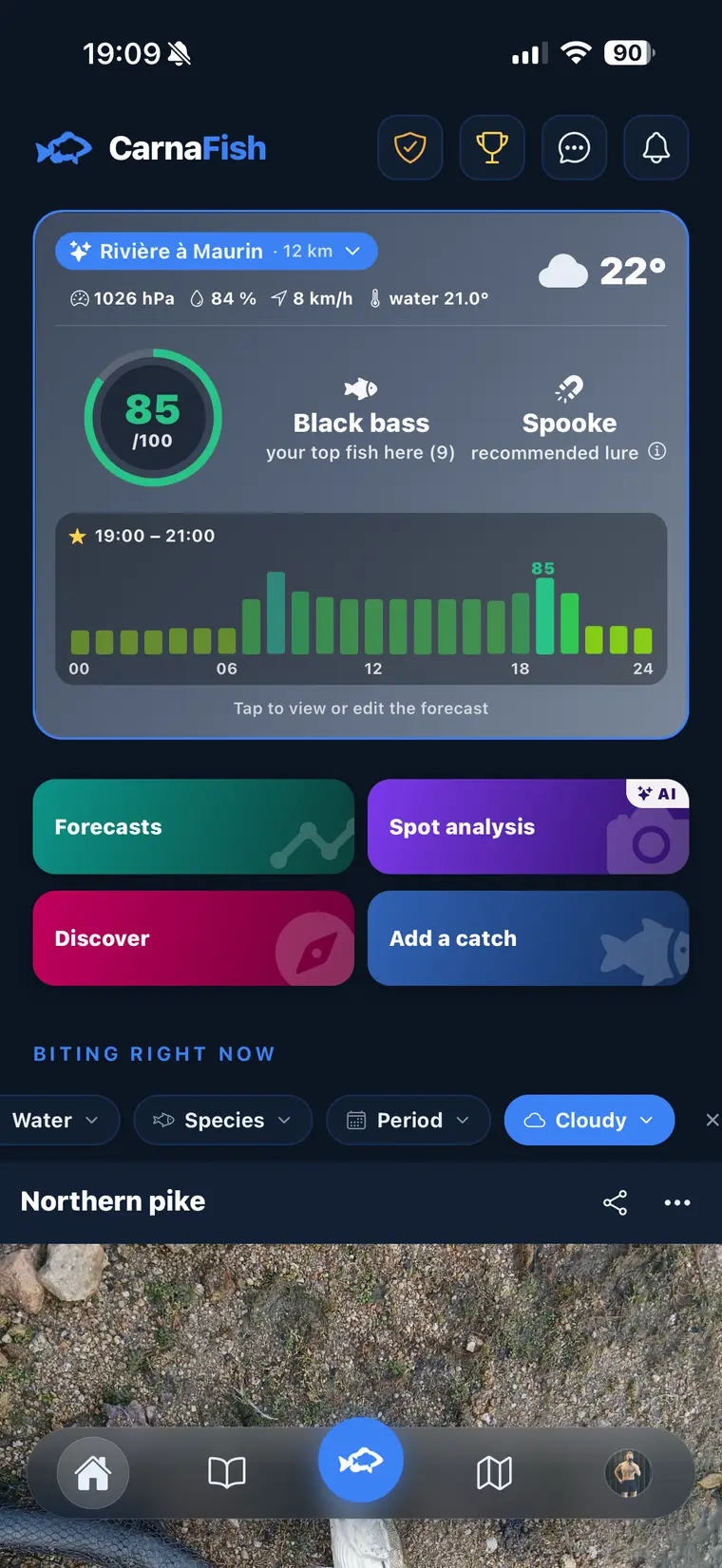
Not sure what to tie on?
Photograph your spot: CarnaFish reads the scene, cross-checks the conditions and gives you the zone, the lure and the retrieve. Free on iOS and Android.
Colour by water and depth
- Clear, deep water: pearl with an orange belly, like the one in the photo. At six metres red and orange have already dropped out of the visible spectrum, but the contrast between a darker belly and pearl flanks still reads perfectly to a fish looking upward.
- Stained water: firetiger or chartreuse. Green-yellow is the tone that travels best through loaded water, and this bait's running depth leaves little light to work with.
- Low light or very dark bottom: a black or midnight blue back, playing silhouette rather than colour.
A specialist tool, not a Swiss army knife
Let's be blunt: the Deep-Six is useless in two metres of water. Its lip forces it to nose down immediately and it will plough the bottom without ever swimming properly. For a bank, a weed edge or a two-metre breakline, a Megabass Griffon or a Strike King 5XD do a far better job. Its real competition is the Strike King 10XD, bigger and more brutal, or the Megabass Deep-X 300 from the same house but on a different depth band.
Knowing a bait reaches six metres is worthless if you don't know where the bottom sits at six metres. That's exactly what CarnaFish makes easier: a photo of the spot, and the app suggests the zone, the depth and the presentation type that match the day's conditions. For the rest of the box and the lure families that surround this kind of fishing, our beginner's guide to zander fishing with lures covers the basics.
Key takeaways
- 8.0 cm for roughly 24.8 g and a stated depth beyond 6.1 m: a compact but very dense format built around the long cast.
- The three-position balancer changes the action mid-retrieve, from wobble on the descent to roll once levelled out.
- Line diameter and cast length matter as much as the lip: heavy line means lost depth.
- Megabass publishes no buoyancy class for this model, and no technical source gives one: check it yourself on the first cast.
FAQ
Does the Deep-Six really run deeper than six metres?
That is what the Megabass spec table states, listing 20 ft and beyond. The figure assumes a long cast and thin line: with heavy fluorocarbon and short casts you will easily give up a metre to a metre and a half against the stated depth.
Does it float or sink on the pause?
The manufacturer's technical description carries no buoyancy class for this model, unlike most other Megabass hard baits. So it cannot be stated here. Test it in sight near the bank on your first cast, it takes thirty seconds.
What size of fish does this bait target?
An 8 cm body stays a medium format, but the depth it works at naturally filters for the most settled fish. On a big water, it is often the simplest way to reach fish that never come up into the top two metres.
Should the stock hooks be changed?
Megabass itself invites you to consider stepping up to heavier trebles. On a 25 g bait working at six metres, a treble that opens costs you the fish of the day, so checking them is the bare minimum before the first session.
Can it be fished for zander in Europe?
Yes, and it is one of its best uses outside bass. A crankbait that holds six metres and ticks the bottom through the back half of the cast fits zander sitting on a gravel pit or big lake breakline in late summer very well.
How does it differ from a Strike King 10XD?
The Strike King 10XD is distinctly bulkier and demands heavier tackle; the Deep-Six keeps a compact 8 cm profile with a more elaborate weight transfer. On a fish that has already seen big deep cranks go past, the smaller format sometimes makes the difference.
The full bass lure guideSeason-by-season strategy: which family of lure, when, and why.Go from theory to fish
CarnaFish reads your spot from a photo and gives you the game plan: zone, lure, retrieve. Free on iOS and Android.