Bomber Next Gen Fat Free Fingerling: the compact 8-10 ft crankbait
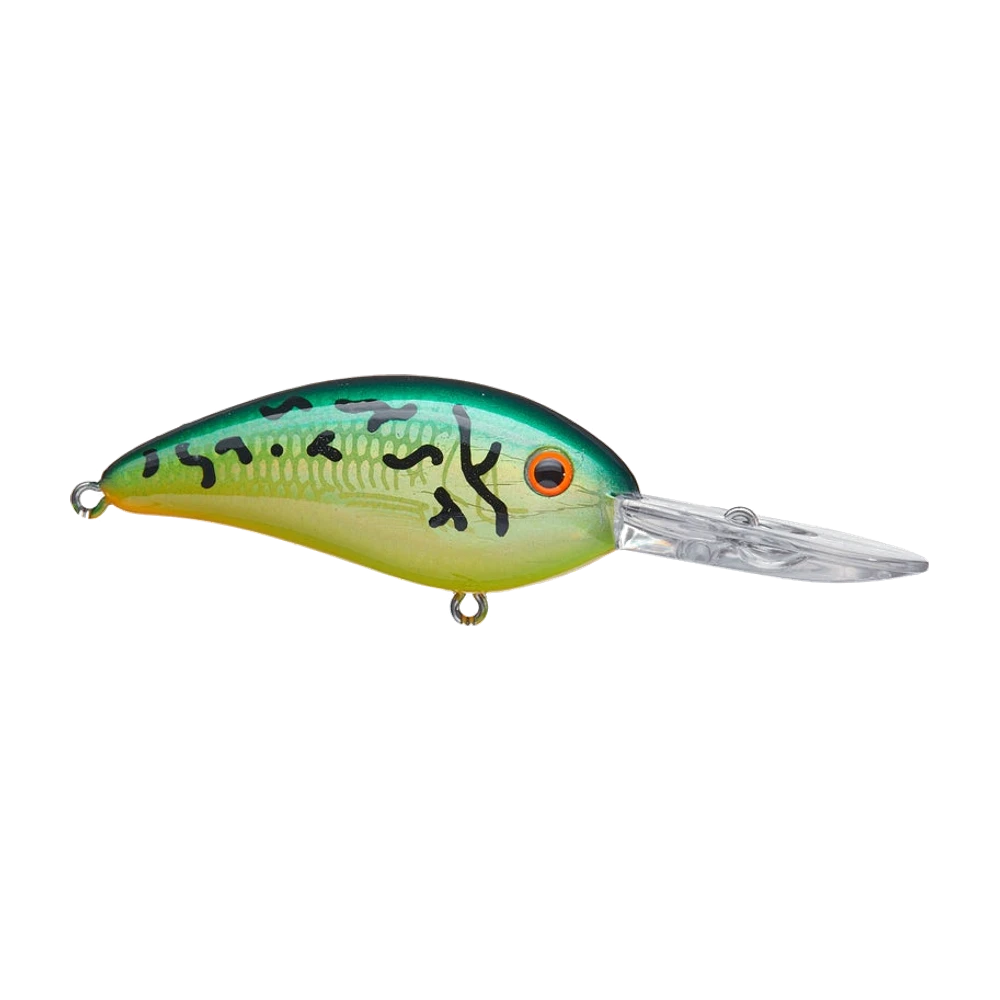
One lure, endless conditions. CarnaFish reads your spot from a photo so you are not just guessing.
There's one water layer most anglers cover badly: eight to ten feet. Too deep for a squarebill banging the bank, too shallow for a big deep diver that needs a twenty-metre cast before it ever reaches its ceiling. That gap is exactly what the Bomber Fat Free Fingerling targets, rated at 8-10 ft in a body only 6 cm long.
A small body, a rounded bill, a tight wiggle
The Fat Free Fingerling measures 2-3/8 in, about 6 cm, for 3/8 oz, about 10.6 g. That ratio is deliberately lopsided: this is a short, dense bait that casts well despite its size and gets down fast at the start of the retrieve.
Its bill is rounded, not square. A round or oval bill slices through water instead of pushing it, which produces a low-amplitude, high-frequency swim — the tight wiggle the Fat Free series is known for. A squarebill does the opposite, hunting wide and deflecting violently off the first thing it touches.
That difference isn't a matter of taste. A tight wiggle gets past pressured fish, or fish shut down by a front, far better. When a lake has seen three boats go through and the hard strikes dry up, a bait that vibrates fast and narrow looks more like ordinary prey than like an intruder throwing a fit. It's the same logic that makes you pick up a Rapala Shad Rap when the big cranks stop producing.
Actually reaching 8 to 10 ft
A manufacturer's stated depth is always a maximum, achieved under specific conditions: long cast, thin line, rod tip low. Fish this crankbait on 20 lb line, casting fifteen metres with the rod held high, and you'll never see ten feet.
Three levers close the gap. Line diameter first: dropping from 20 lb to 12 lb easily adds half a metre, because line drag in the water flattens the dive angle. Cast length second: a crankbait hits its ceiling around the middle third of the retrieve, so a short cast barely gives it time to get down. Rod position last: tip pointed at the water, or even twenty centimetres under the surface when you want the final few inches.
A benchmark worth keeping
Count the seconds between splashdown and the first contact with the bottom. If you touch after three or four seconds of reeling, you're over shallower ground than you thought. If you never touch, either the zone is too deep for this model or your line is too heavy. Either way, the information is worth more than the fish you didn't catch.
Contact with hard bottom
The Fat Free Fingerling is moulded in ABS, a rigid plastic that takes impacts without cracking. That's what allows the lure's real job: grinding it against rock, boulders, stumps and gravel breaks instead of swimming it through open water.
Every time the bill hits an obstacle the bait deflects, tips on its side for a fraction of a second, then rights itself. That stumble is the main trigger, far more than the retrieve itself. So fish it looking for contact: reel until you feel bottom in the rod, give half a second of slack, carry on. On rip-rap, that repeated sequence is worth ten casts in open water.
When you feel the bill wedge in a rock, don't pull. Give complete slack for a second: the lure's buoyancy floats it back up and it frees itself nine times out of ten. A hard pull only buries the trebles in the stone.
Hooks and rigging
The manufacturer ships this crankbait with two treble hooks. In the photo on this page the lure is shown bare, with no hooks fitted — don't be surprised to see only the hangers under the belly and at the tail. On arrival, check how sharp the factory trebles are; on a bait this size many anglers swap straight to a finer-wire model.
For the connection, a loop knot or a small snap lets the bill work freely. A knot cinched tight against the eye restricts the swim and cuts the amplitude, a flaw that shows up even more on a tight-wiggling bait with no margin to spare. Avoid an oversized snap swivel, though: its weight unbalances a 10 g body.
Fluorocarbon is the right pick here, both for discretion in clear water and because it sinks, which helps the bait hold its depth. Something in the 8 to 12 lb range covers most situations.
The classic mistake
Reeling fast in the belief that speed triggers bites. On this model, acceleration only lifts the bait up the water column: the vibration is already fully developed on a slow straight retrieve. The gain comes from bottom contact and pauses, not from pace. The other common mistake is picking this lure to fish fifteen feet down — the bill won't allow it, whatever you do with your line.
Not sure what to tie on?
Photograph your spot: CarnaFish reads the scene, cross-checks the conditions and gives you the zone, the lure and the retrieve. Free on iOS and Android.
Colour by water
- Lightly stained water: the barred green and chartreuse shown in the photo, which stays readable without going full fluorescent.
- Clear water: a natural silver or brown back, closer to a real baitfish, essential once visibility passes a metre and a half.
- Coloured water: firetiger, the classic that stays detectable when light no longer gets far down.
What it completes in the box
The Fat Free Fingerling only makes sense alongside other depths. For the three to six foot band, the Bomber Next Gen Flat A from the same catalogue is the logical companion, with an even tighter flat-sided swim. To get past ten feet, a Bandit 300 Series takes over with a far longer bill. And when you need to bang cover in under five feet, a squarebill like the Bill Lewis ATV 1.5 remains the better tool.
Choosing the right depth before you cast saves an hour spent searching the wrong layer. That's exactly what CarnaFish makes easier: a photo of the spot, and the app suggests the zone, the depth and the lure type suited to the day. To dig into reading breaklines and hard bottom, our beginner's guide to zander fishing with lures details the spots worth working first.
Key takeaways
- 6 cm for 10.6 g, rated 8-10 ft: a compact format for a layer that often goes uncovered.
- Rounded bill and tight wiggle: the right call on pressured fish or in cold water, where a squarebill does too much.
- Thin line and long casts are what separate the stated depth from the real one.
- The ABS body is built to hit rock: look for contact, then pause.
FAQ
How deep does this crankbait really run?
The manufacturer states 8 to 10 ft, or 2.4 to 3 m. That figure assumes a long cast and thin line; on 20 lb line with short casts, expect closer to six feet.
Does this lure work for zander?
Yes, across Europe it's a sensible size over gravel breaks and flats around ten feet. The tight wiggle and slow retrieve suit a zander that refuses anything too frantic.
Why a rounded bill rather than a square one?
A round bill slices the water and produces a low-amplitude, high-frequency swim. A square bill instead hunts wide, useful in shallow cover but less effective on wary fish.
Should I replace the factory hooks?
Check their points on arrival. On a compact bait this size many anglers fit finer-wire trebles for better penetration, keeping the same size so the balance isn't disturbed.
How do I free the lure when it snags?
Give complete slack for a second. The body's buoyancy floats it up and clears the bill in most cases. Pulling sharply only drives the trebles further into the obstruction.
Should I fish it fast or slow?
Slow and steady, hunting for bottom contact. The vibration is already complete at low speed, and speeding up just lifts the bait out of the layer you're targeting.
The full bass lure guideSeason-by-season strategy: which family of lure, when, and why.Go from theory to fish
CarnaFish reads your spot from a photo and gives you the game plan: zone, lure, retrieve. Free on iOS and Android.