Z-Man Graph Shadz: the pre-rigged shad built for live sonar
One lure, endless conditions. CarnaFish reads your spot from a photo so you are not just guessing.
Forward-facing sonar created a problem nobody had before: the lure now has to be visible on screen, not just to the fish. A conventional soft plastic on a jighead returns a weak echo that often drowns in the background noise, and you end up spending half the session hunting for your own bait instead of watching the fish. The Graph Shadz is Z-Man's answer to that specific constraint, and it is more technical than it looks.
What is built for the screen, and what is built for the fish
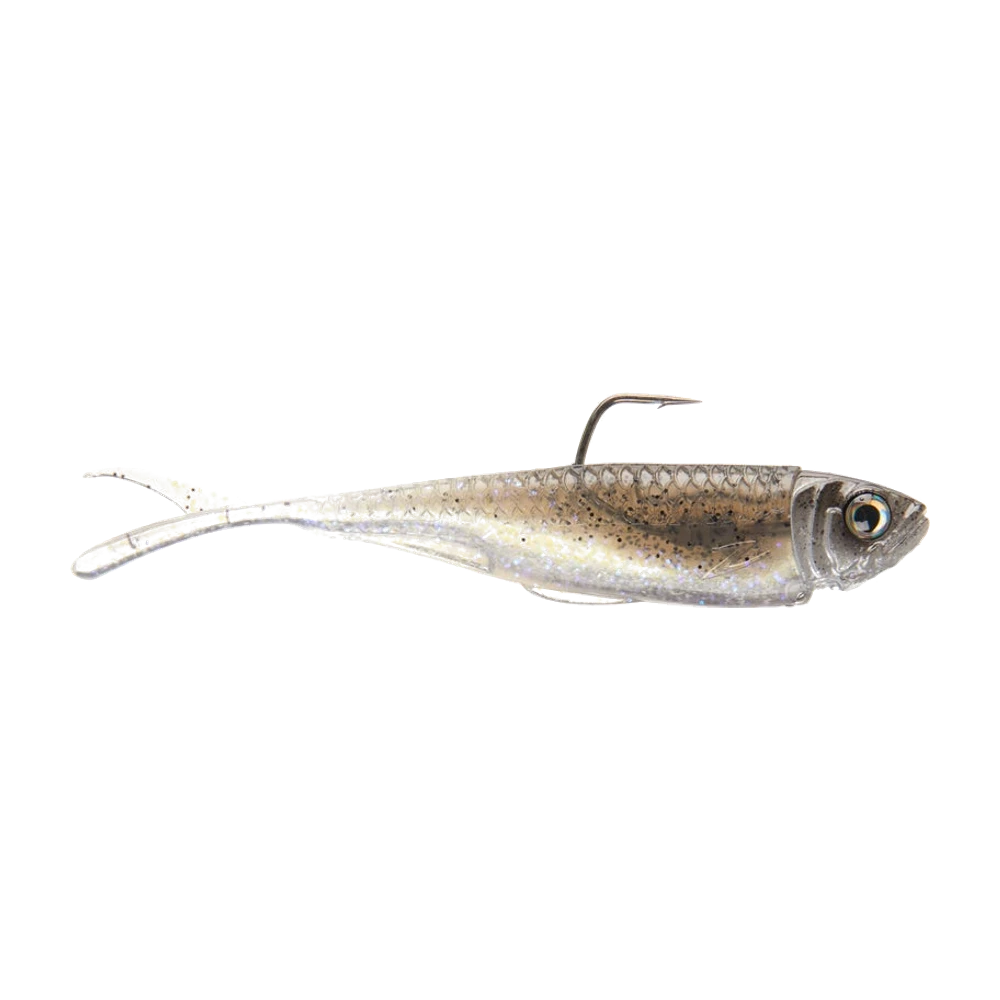
Three design choices explicitly target screen readability. First, an alloy head rather than plain lead: a harder, denser metal sends back a crisper acoustic signature. Second, an air cavity moulded into the body: air is the best acoustic reflector available inside a soft bait, which is exactly why a live fish's swim bladder is what your sonar actually sees. Third, a moulded scale pattern that Z-Man says traps and releases small air bubbles.
That last point deserves a step back. A bubble held in a surface texture disappears within seconds once the bait is under water, and a lure does not recharge itself with air halfway down. The effect probably exists right at the start of the fall, just after the bait enters the water, but do not expect it to last a full descent to ten metres. The internal air cavity, on the other hand, is permanent: that is what does the real work.
For the fish, the silhouette stays that of a classic shad: a tapered body, a detailed head, and a forked tail that does not thump like a paddle but flares and quivers at every change of direction. That is deliberate. In sonar fishing you are not after a bait that vibrates constantly, you are after one that reacts instantly to what you ask of it.
The two numbers that are missing
Z-Man publishes neither the body length nor the head weight for this item. That is a genuine gap, and it needs saying plainly: on a bait meant for screen-guided vertical fishing, head weight is the figure that sets the fall rate, and therefore your ability to put the lure at the right depth at the right moment. Without it, you cannot anticipate a drop time or compare two items.
So make a habit of it on the first trip: time the fall over a known depth with the Graph Shadz you actually hold. Three seconds for three metres, ten seconds for ten metres — once that ratio is written down, you can pilot the lure blind when the screen gets busy.
Put the lure on a small kitchen scale before it ever touches water and write the figure on the box in marker. It takes thirty seconds and it replaces a spec the manufacturer does not supply. It is also the only way to know whether two colors you buy sit on the same head.
Line-through rigging, and why it changes the retrieve
The Graph Shadz uses a line-through rigging system with the tie point recessed under the head rather than sitting on top of it like a conventional jighead. That low, set-back position changes the pulling angle: the bait holds horizontal instead of nosing down, and it describes a wide pendulum arc when you lift the rod and release.
The pendulum swing
This is the retrieve that exploits the rigging best. A short, controlled lift, then follow the descent on a semi-tight line: the bait travels forward, slows, and glides back under the vertical while staying flat. On a fish you are tracking on screen, that lateral path gives the bait time to enter its field of view, which a lure dropping straight down never does.
The dead stop
The second useful move: drop the bait just above the fish you have marked, then do absolutely nothing. Naturally buoyant Elaztech holds it flat instead of letting it tip nose-down. An undecided fish often rises to that perfect stillness, not to an extra bit of action.
The classic mistake
Working the bait constantly because you can see the fish. The moment the dot on screen closes in, the instinct is to add more. It is almost always counterproductive: slow down, stop, let the bait finish its arc. A fish rising on screen has already decided to look; it needs a reason to bite, not more commotion.
The hook and what it implies
The hook is a 3/0 medium wire sickle in black nickel, rigged point-up and exiting the back. The point is exposed, so this is not a weedless bait. Over rip-rap, deadfall or weed you will snag. That is the price of an instant hookset, which is exactly what screen-guided vertical fishing needs, where the bite is seen before it is felt.
Medium wire is a good compromise: fine enough to penetrate on a short, low-amplitude set, thick enough not to open on a good fish. Check the point after every fish all the same — a dulled sickle loses its advantage much faster than a standard round-bend hook.
The package contains one pre-rigged head and one spare body. That is a budget point worth knowing: once both bodies are finished, the head goes with them unless you can find bare replacement bodies.
Not sure what to tie on?
Photograph your spot: CarnaFish reads the scene, cross-checks the conditions and gives you the zone, the lure and the retrieve. Free on iOS and Android.
Colors by water clarity
Z-Man publishes no color names for this item, only the fact that body, head and eyes are color-matched. So reason in families of shades.
- Clear water, deep fishing: the translucent silver finishes, like the one in the photo — pearl-flaked body, speckled olive-brown back, moulded scales and a blue and gold 3D eye. It is a generic baitfish imitation that never looks wrong.
- Lightly stained water: a hard pearl white, easier to read at distance when light no longer reaches far down.
- Low light or deep water: a solid dark back, which gives a clean backlit silhouette once color is no longer perceived.
Next to hand-rigged soft plastics
If you already fish vertically, you get much of this behaviour from a Z-Man Finesse ShadZ or a Z-Man Slim SwimZ on a well-chosen plain jighead, for far less money. What the Graph Shadz adds is the echo on screen and the horizontal posture with no tuning. If you do not fish live sonar, most of its value disappears and a standard soft plastic will do the job.
Knowing where to look for the fish still matters more than what is tied on the end, and that is what CarnaFish offers: a photo of the spot, and the AI suggests the zone, the depth and the lure family that fit the conditions. To build the logic of vertical fishing and lure fishing for zander, our beginner guide to zander fishing sets the framework.
What to remember
- The internal air cavity and the alloy head serve sonar visibility; bubbles trapped in the scale texture only last the beginning of the fall.
- Neither length nor weight is published: weigh and time your own lure on the first trip.
- Line-through rigging with a recessed tie gives the horizontal posture and the pendulum swing, which are the heart of the product.
- Exposed point: instant hooksets, but no passage through wood or weed.
FAQ
What size is the Graph Shadz?
Z-Man does not state it in the technical description for this item, and the head weight is missing too. Measure and weigh the one you buy and write down the result: that is the only reliable figure you will have.
Do I need live sonar to use it?
No, but much of what justifies its price disappears without a screen. The air cavity and the alloy head serve acoustic visibility; if you are not watching a live image, a standard shad on a jighead does the same job for less.
Do the advertised air bubbles really work?
The effect is plausible right after the bait enters the water, while the scale texture still holds surface air. It cannot last a full deep descent, because the lure does not recharge with air under water. The internal cavity, however, is permanent and is the real contribution.
Does the Graph Shadz come through cover?
No. The 3/0 sickle is rigged point-up and exposed on the back. It is built to hook a fish you can see on screen instantly, not to cross deadfall or vegetation.
How many bodies come in the pack?
One body already rigged on its head, plus one spare. Beyond that you have to buy the whole assembly again, which changes how you cost a session compared with a bare soft plastic on a jighead.
Is it suited to zander in Europe?
On paper, yes: the baitfish silhouette, the horizontal posture and the short swings match exactly what vertical zander fishing asks for. With no published weight, just check that the head you buy lets you hold bottom at the depths of your stretch.
The full bass lure guideSeason-by-season strategy: which family of lure, when, and why.Go from theory to fish
CarnaFish reads your spot from a photo and gives you the game plan: zone, lure, retrieve. Free on iOS and Android.