Creme Coachwhip Worm: the 40 cm ribbon-tail worm for big bass
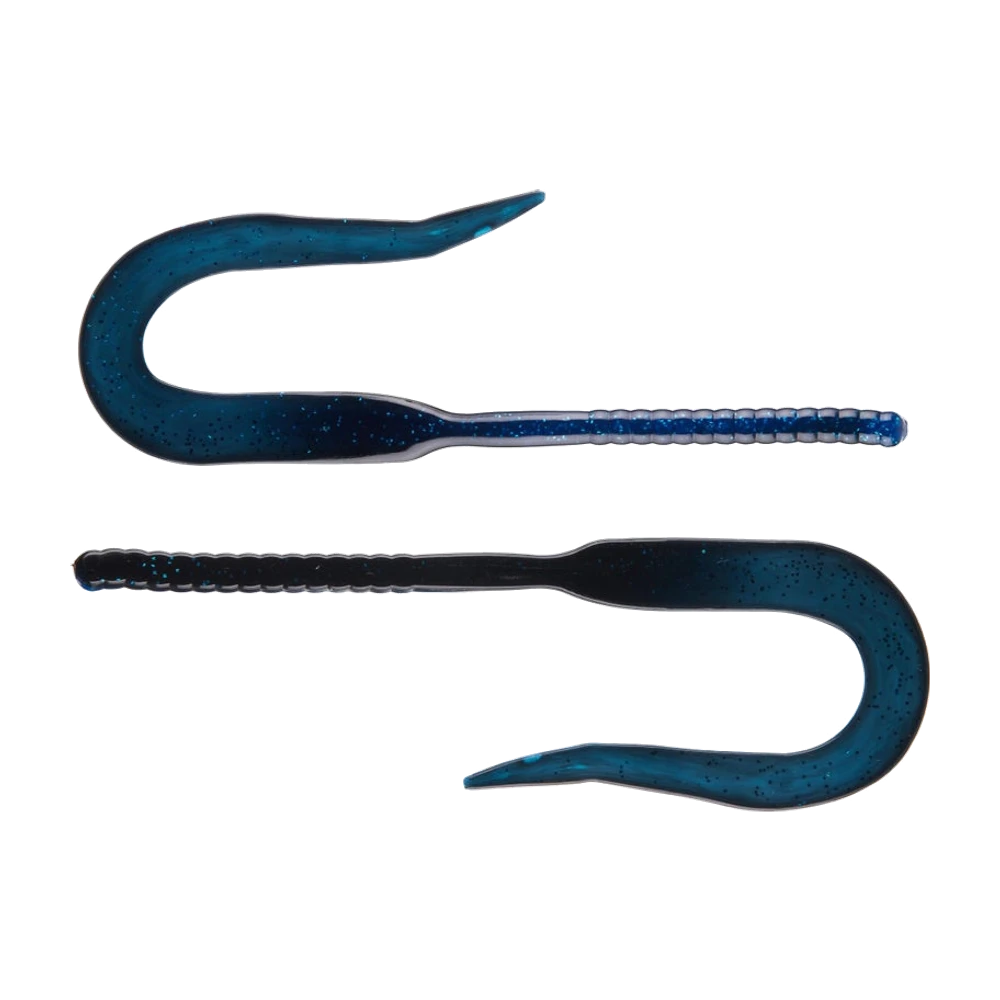
This lure shines under specific conditions. CarnaFish tells you in 10 seconds if today is one of them.
Forty centimetres of soft plastic raises a smile the first time you open the bag. Then you put it in the water, drag it slowly over a metre, and the long flat tail starts waving continuously behind a ribbed body that shoves water along its whole length. The Creme Lures Coachwhip Worm, designed by Kenneth Hicks, a bayou bass specialist, is not a novelty: it is a filter, built to let only the big fish come.
One size, and it is enormous
The maker lists a single spec: 16 in, or 40.6 cm, sold four to a pack. That is everything the data sheet publishes — no weight is given, which is normal for an unweighted soft plastic whose mass varies with the density of the plastic. So do not trust any figure you find elsewhere: it is the rig that determines the total weight of your setup.
The body splits into two clear halves, visible in the photo. The front half is fully ribbed, with even grooves that create turbulence and catch light. The rear half flattens into a wide ribbon tail, thin and supple, that works continuously the moment the bait moves. That split is the heart of the lure: the front supplies bulk and vibration, the back supplies movement.
Why a size like this changes the fishing
A 40 cm worm is not fished like a 15 cm one. Three concrete differences.
First, the number of bites drops, and that is deliberate. A small bass will not take on prey this size; the ones that do have a mouth capable of swallowing it. If you are after action, this is the wrong lure. If you are after one specific fish you have located on a spot, it is a very good one.
Second, the signature in the water is huge. On stained water where a subtle bait goes unnoticed, the displacement of a ribbed body this long registers on the lateral line from a long way off. That is why the black-with-blue-flake of the photo remains the historic colour for this kind of worm.
Third, managing the hookset becomes the real subject. With that much plastic behind the hook, a fish can hold thirty centimetres of tail in its mouth with the point nowhere near it.
When you feel the bite, drop the rod and count to three before setting. On this worm that is the advice that changes everything: half the missed fish come from setting on the tail, not from an undecided fish.
Rigs that work
Weighted Texas rig
The reference rig. A 6/0 to 8/0 wide-gap hook, driven into the ribbed section about ten centimetres back from the nose, point tucked into the body. A 1/4 to 1/2 oz bullet weight ahead of it, pegged or free depending on whether you want contact or want the worm to glide. This is the rig that goes through flooded timber and weed and lets you fish the cluttered spots where big fish hold.
Carolina rig
Over hard, open bottom, the Carolina moves the weight a metre away and lets the ribbon tail work up in the water while the sinker scrapes bottom. It is slower, more of a search rig, and lethal along a long drop-off.
The classic mistake
Setting the hook too close to the nose. On a worm this long, placing the hook two centimetres from the head leaves thirty-eight centimetres of free plastic behind the point, and the miss rate goes through the roof. Move the hook point back towards the middle of the ribbed section: you lose a little in swimming profile and gain a great deal in hook-ups.
Where this lure belongs
The maker aims it at bass, in fresh and salt water alike, and presents it as the product of bayou field trials: warm water, dense vegetation, cluttered bottom. That is indeed its ground: ponds and reservoirs in summer, weed edges, flooded timber, snaggy flats.
In Europe, a soft plastic of this length naturally finds its way into a pike or catfish angler's box, and some anglers use it that way. It has to be said plainly: that is a use by extension, not a stated purpose from the maker, and the rig then needs a bite-resistant leader.
Not sure what to tie on?
Photograph your spot: CarnaFish reads the scene, cross-checks the conditions and gives you the zone, the lure and the retrieve. Free on iOS and Android.
The tackle it needs behind it
A 7/0 hook buried in forty centimetres of plastic does not get set with a medium rod. You need a heavy to extra-heavy casting rod, 7' to 7'6", able to drive the point through all that bulk and then pull a fish out of flooded timber before it gets back in. A 40-50 lb braid completes the setup: the stretch in monofilament would absorb a good share of the hookset energy, exactly where you have no margin.
The reel matters less than its gear ratio. A fast ratio, around 7:1, lets you pick up slack instantly after the three-second pause mentioned above — and that is precisely the moment a slow ratio loses you the fish. Keep the drag fairly tight, though: on this rig, the fight is won in the first two seconds or not at all.
Colour by water
- Stained water, silty bottom or night fishing: black with blue flake, the colour pictured. The most readable silhouette for a fish hunting on the lateral line and against the light.
- Clear water: green pumpkin, which blends into vegetation and reassures a wary fish.
- Dark bottom, lightly coloured water: a dark red tone, which keeps a discreet contrast without flashing.
A big worm does not make up for a bad spot: you need to know where the fish is before casting forty centimetres of plastic. That is exactly what CarnaFish makes easier: a photo of the spot, and the app suggests the zone and the presentation suited to the conditions. To build up spot and tackle fundamentals, our beginner's guide to bass fishing is a good starting point.
Key takeaways
- One size: 40.6 cm / 16 in, sold in packs of four, with no weight published by the maker.
- Ribbed body up front for bulk and vibration, ribbon tail at the back for continuous movement.
- Fewer bites but bigger fish: this is a filtering lure, not a searching one.
- Wait three seconds before setting, and move the hook point towards the middle of the body.
FAQ
How much does the Coachwhip Worm weigh?
The maker publishes no weight, only the 16 in (40.6 cm) length and a four-per-pack count. That is normal for a bare soft plastic: the working weight depends entirely on the sinker and hook you rig ahead of it.
What hook size does it need?
A 6/0 to 8/0 wide-gap Texas hook depending on how soft the plastic is and the size of fish you are after. Below 6/0 the gap will not clear enough point through a body this thick.
Why am I missing so many bites?
Two causes, often combined: setting too fast, and a hook placed too close to the nose. Give the fish three seconds to take the worm properly, and move the hook point towards the middle of the ribbed section.
Does it catch small fish?
Rarely, and that is the point. A 40 cm worm naturally selects mouths big enough to swallow it. If you want numbers, a standard size like the Zoom Trick Worm or the Culprit Original Worm remains far more effective.
How does it differ from a standard ribbon-tail worm?
A 6th Sense Boosa 9.6 Ribbon Tail Worm uses the same tail principle in a 24 cm format, far more versatile. The Coachwhip pushes the logic to the limit and changes category: it does not replace a standard worm, it completes the box for one specific situation.
Can it be fished weightless?
Yes, weightless over shallow flats in warm water. The fall is very slow and the tail works through the whole descent, but casting distance suffers and wind management gets awkward with that much air resistance.
The full bass lure guideSeason-by-season strategy: which family of lure, when, and why.Go from theory to fish
CarnaFish reads your spot from a photo and gives you the game plan: zone, lure, retrieve. Free on iOS and Android.