Decoy Texas rig hooks: the hook that stops your lure sliding back
Rather not fish it blind? Photograph your spot — CarnaFish cross-checks the conditions and points you the right way.
Three casts. That is often all it takes for a soft plastic on a Texas rig to slide back down the shank, crumple, and start spinning like a propeller. You do not notice straight away, because nothing changes through the rod. You notice at the end of the retrieve, when the lure comes back sideways — or worse, you never notice and you fish an hour with a dead rig.
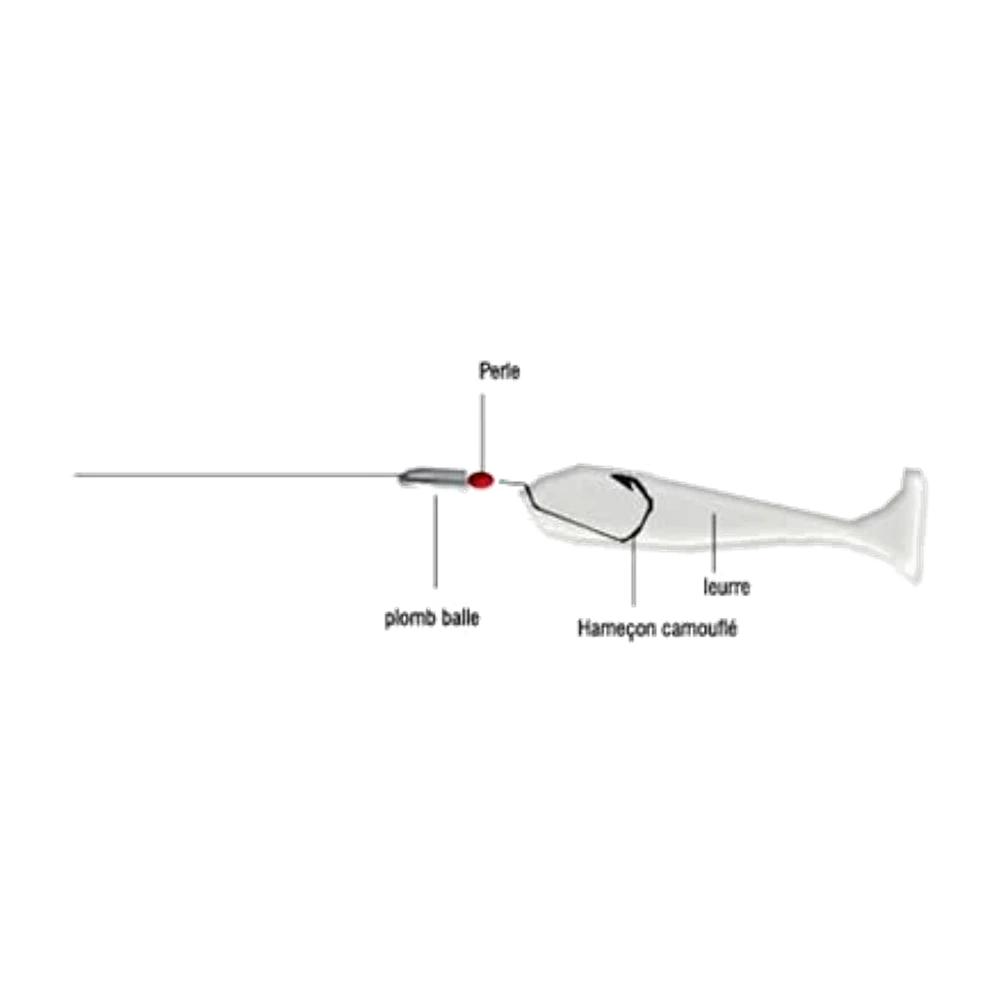
The Texas rig is still the only way to fish the heart of the cover, and the technique is covered in our page on the Texas rig. But its reliability depends almost entirely on one thing people rarely look at: the quality of the hook, and above all its keeper system.
That is exactly where Decoy's Texas hooks stand out. Not through a marketing gimmick, but through three manufacturing details you can measure in fish landed by the end of the day.
The keeper, the detail that decides everything
On a Texas hook, the lure is held at the front by a retaining system just behind the eye. There are three schools.
- The simple Z-bend: two right angles in the shank. It holds a dense plastic reasonably well, a soft plastic badly, and it tears the nose of the lure after a few fish.
- The barb on the shank: better, but it works the plastic in one direction only and eventually digs a tunnel the lure slides freely along.
- The spring (screw) keeper: a small metal coil you screw the head of the lure onto. It is the solution that lasts longest, because the load is spread over several turns instead of a single point.
Decoy works the last two families with particular care over the depth of the bends and the pitch of the spring. In practice, a 12 cm shad that lasted four or five casts on a budget hook will last twenty to thirty.
The gain is not just financial. A lure held properly always presents the same profile: it does not spin, it does not crumple, and your line does not twist.
Point and gap geometry
The second thing a hook is judged on is its ability to go through plastic before it goes through a jaw.
Three parameters matter:
The gap. On a Texas rig, the body of the lure occupies the space between the point and the shank. If the gap is too tight, the point has no free travel and the hookset turns into a slide. So-called wide gap models solve that, and they are essential as soon as the lure has any bulk.
The point angle. A point turned slightly inwards penetrates with less force than a straight one. That is decisive when you set at thirty metres, through braid that stretches and a thick lure.
The wire diameter. Thin wire pricks with nothing. Heavy wire will not open up on a pike or a big bass hauled out of a brush pile. Choose on species and rod power, not on price.
On the water: before you change lures after three refusals, run a fingernail over your hook point. If it bites the nail, it is good. If it slides, it is dead — and no colour change will fix that. Over rocky bottom, a point dulls in half an hour of fishing.
Which size to fit
Size is chosen on the bulk and thickness of the lure, not on its length alone. A slim 15 cm worm calls for a smaller hook than a stocky 10 cm creature bait.
| Lure | Hook size |
|---|---|
| Slim finesse worm, 8 to 12 cm | 1/0 to 2/0 |
| Shad or stick bait, 10 to 13 cm | 3/0 to 4/0 |
| Creature bait or thick craw | 4/0 |
| 15 to 18 cm shad for pike | 5/0 to 6/0, heavy wire |
The test that never lies: once rigged, there must be at least half a centimetre between the back of the lure and the point. If the point is grazing the plastic, go up a size.
Rigging and working it
- Screw or push the head of the lure onto the keeper, straight along the axis. A lure engaged crooked will spin, whatever hook you use.
- Pierce the nose, bring the point out after five to seven millimetres, then rotate the hook and bury the point back into the back of the lure, just under the skin.
- Check it is straight by holding the rig horizontally: the lure must be perfectly straight, with no bump or bend.
- Cast and let it drop on a controlled slack line, following the line with your eyes.
- Two short twenty-centimetre pulls, then a three to five second pause on the bottom.
- Set the hook by tightening first, reeling, then lifting the rod firmly. Do not go with one big snap: the point has to get through the plastic before the jaw.
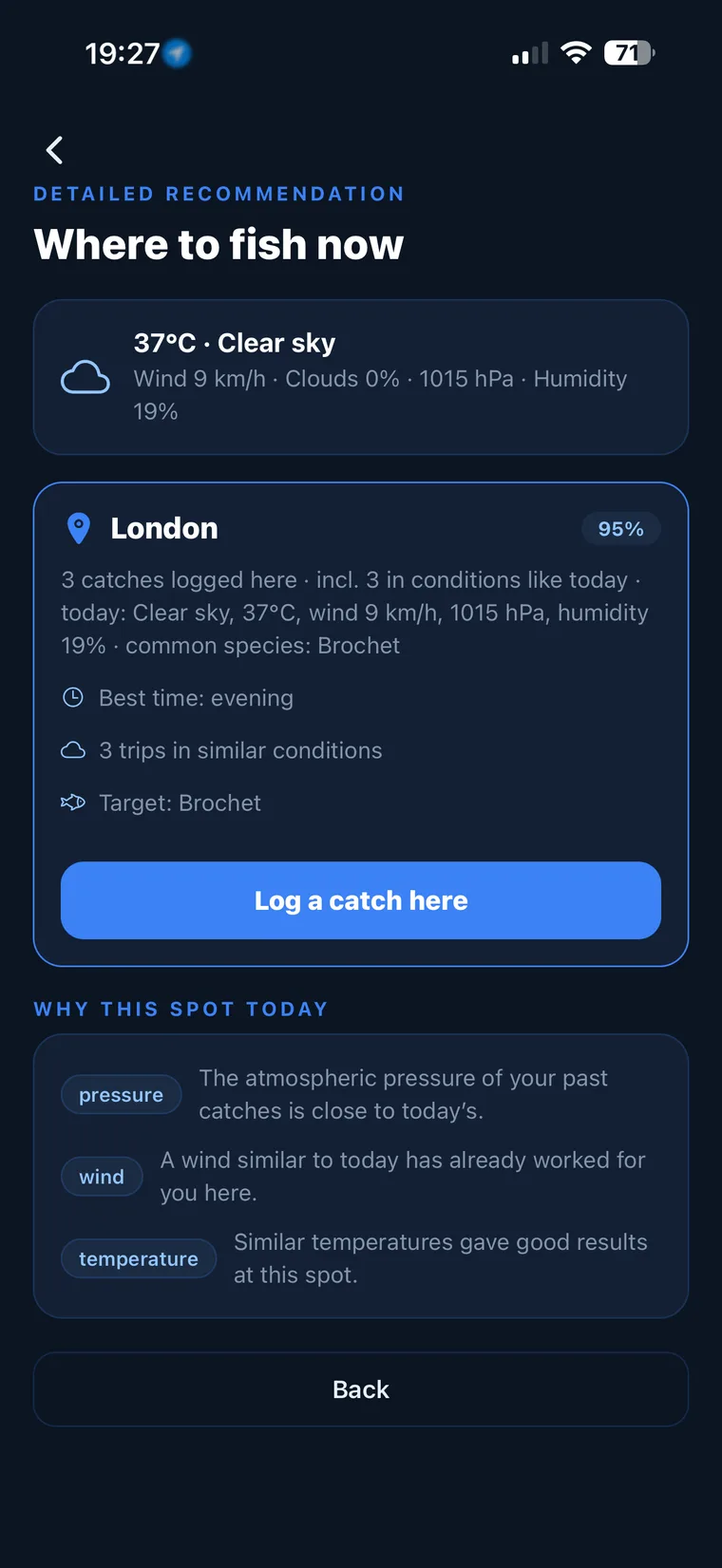
Not sure what to tie on?
Photograph your spot: CarnaFish reads the scene, cross-checks the conditions and gives you the zone, the lure and the retrieve. Free on iOS and Android.
Where the hook makes the difference, and where it makes none
A well-made hook fully earns its place as soon as you fish far, deep, or in cover — in other words every time the hookset needs force and the point has to travel through a lot of material. It also earns its place on pike, where wire that is too thin opens cleanly on an 80 cm fish.
It changes very little, on the other hand, in very finesse work at short range with a small soft plastic in clear water: at five metres, on an average fish, almost any decent hook does the job.
Decoy or a budget Texas hook
The difference is not in the concept — an offset is an offset — but in how long it lasts. Over a full day, the gap shows up in three columns: the number of lures consumed, the number of lures that come back twisted, and the number of missed hooksets at long range.
If you fish occasionally, close in, for average bass, the gap will stay theoretical. If you fish laydowns, big shads for pike, or long distances on a reservoir, it becomes very concrete from the first session.
For a different angle on cluttered spots, look at the VMC Tokyo Rig, which lifts the lure off the bottom instead of dragging it along it. And if you are after pike with big soft plastics, our guide to choosing a pike lure sets out the sizes to favour.
If you are torn between a buried Texas rig and a more exposed hook in front of a spot, CarnaFish analyses a photo of the spot and answers.
Key takeaways
- The keeper decides how long the lure lasts and how consistent its profile stays, far more than the brand of plastic.
- A wide gap is essential as soon as the lure has bulk: with no free travel, the point slides.
- Size on the thickness of the lure, with at least half a centimetre of clearance.
- Check the point with a fingernail every half hour over rocky bottom.
- The gap against a cheap hook opens up mainly at long range, in deep water and on big fish.
FAQ
Why does my Texas-rigged lure slide backwards?
Because the keeper system no longer holds, or because it has dug a tunnel in the plastic. A spring keeper spreads the load over several turns and fixes that; failing that, a drop of soft-plastic glue extends the hold.
What Texas hook size for a 12 cm shad?
A 3/0 or a 4/0 depending on how thick the body is. The reliable benchmark is clearance: you need at least half a centimetre between the back of the lure and the point once the rig is finished.
Thin wire or heavy wire?
Thin wire for finesse work on bass or perch, where the hookset is short and the fish moderate. Heavy wire as soon as you fish for pike, big soft plastics or dense cover, otherwise the hook opens.
How do I know if my hook is still sharp?
Draw the point across a fingernail without pressing. If it bites and grabs, it is good. If it slides, replace it: over rocky bottom a point can dull in thirty minutes.
Can these hooks be fished weightless?
Yes, weightless Texas style for floating or dense lures in shallow water. It is an excellent presentation for a slow fall along the margins, provided the lure is heavy enough to cast properly.
Is the Texas rig suitable for pike?
Yes, with a 5/0 to 6/0 heavy-wire hook and a leader that handles the teeth. It is the reference rig for walking a big shad through branches without losing it on the first cast.
The full bass lure guideSeason-by-season strategy: which family of lure, when, and why.Go from theory to fish
CarnaFish reads your spot from a photo and gives you the game plan: zone, lure, retrieve. Free on iOS and Android.